Get Full Government Meeting Transcripts, Videos, & Alerts Forever!
Get email alerts on the Historic Preservation topic
No spam. Unsubscribe anytime.
Committee advances conservation-district bill with state tax-credit provision
Summary
Baltimore City Council’s Housing & Economic Development Committee moved Council Bill 250003, creating a conservation-district process and adding language to make qualifying districts eligible for the state historic tax credit. The committee passed two administration-sponsored amendments and approved the bill to advance to the full Council.
The Housing & Economic Development Committee of the Baltimore City Council voted to move Council Bill 250003, a measure to establish a process for designating conservation districts and to enable properties in such districts to access state historic tax credits, after adopting two favorable amendments.
The bill, introduced January 13, 2025, was the first item heard. Sponsor Councilman John Bullock said the proposal would allow council members to introduce legislation creating conservation districts to protect neighborhood character in parts of West and Southwest Baltimore that are not covered by existing CHAP (Commission for Historical and Architectural Preservation) designations. "This is a fruitful way to preserve the history and the legacy of our communities," Bullock said during sponsor remarks.
The committee received favorable reports from multiple agencies and advisory bodies. Desiree Lucky of the city solicitor's office delivered a legal review supporting the bill. The Mayor’s Department of Housing and Community Development (DHCD), CHAP and the Planning Commission submitted favorable reports; the Department of Finance submitted a report opposing the original local-tax-credit language. Committee members and administration representatives explained that two amendments—one from the mayor’s office of government relations and a chair’s amendment—were placed on the desk before the hearing to resolve Finance’s concerns by removing a local tax-cap proposal and instead making conservation districts eligible for the state historic rehabilitation tax credit via COMAR-aligned language.
Committee members voted first to adopt the administration’s amendment and then the chair’s amendment. The committee then voted to move the bill favorably, with a roll-call recorded during the meeting. Councilman James Torrance, chair, and Councilwoman Odette Ramos voted aye; Councilman Zach Blanchard also voted aye and asked to explain his vote to note concern about the distribution of tax credits; Councilman Jermaine Jones voted yes. The committee recorded one absence. The chair said the bill will proceed to the full Council for a second reader on March 24.
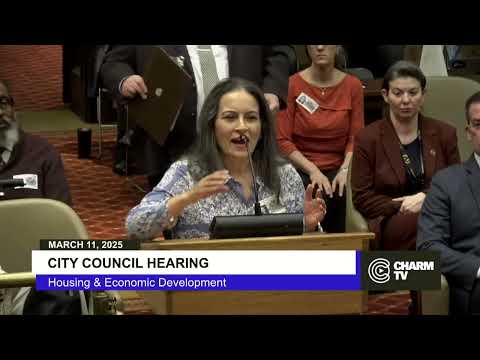
Public comment during the item included a resident, Sujata Massey, who said her Windrush neighborhood had discussed CHAP status nearly 20 years earlier but declined because of concerns about cost and regulatory burden; she said a conservation-district option that paired a lighter regulatory framework with the state tax credit would be welcome and urged a yes vote.
What’s next: the bill passed the committee with the agreed amendments and will be scheduled for the full Council’s next consideration per the committee notice.
Ending: The committee produced a record of the amendments and the roll-call; implementation details—such as criteria for district petitions and the precise COMAR citations referenced in the amendment—were discussed but the transcript records the COMAR citation as “referenced” rather than spelled out in full.