Get Full Government Meeting Transcripts, Videos, & Alerts Forever!
Get email alerts on the Opioid Settlement topic
No spam. Unsubscribe anytime.
Las Cruces and Dona Ana County advisory group recommends evidence-based opioid programs, offers trust options
Summary
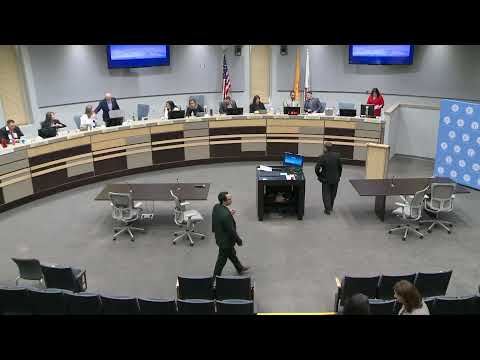
Las Cruces and Dona Ana County officials on Monday presented advisory council recommendations for investing approximately $24 million in opioid settlement funds and asked elected leaders for guidance to move to program design and procurement.
Las Cruces and Dona Ana County officials on Monday presented advisory council recommendations for investing approximately $24 million in opioid settlement funds and asked elected leaders for guidance to move to program design and procurement.
The advisory council recommended four initial strategies — expand medication-assisted treatment and transitions of care, broaden recovery support services and harm-reduction linkages, invest in universal prevention and anti-stigma work, and fund standardized data collection and evaluation — and asked staff to return with scopes of work, outcome measures and procurement options.
The recommendations follow an advisory process that used a needs assessment from New Mexico State University and technical assistance from Vital Strategies. Jamie Michael, director of Dona Ana County Health and Human Services, told the joint meeting the council prioritized interventions that are evidence-based and designed to “save lives.” Barbara Bencomo, the city’s chief administrative officer, said the city and county will continue coordinating next steps and that both governments must approve any allocations.
Advisory recommendations and why they matter
The council framed its work around Exhibit E of the settlement agreements, which lists nine allowable strategy areas for settlement spending; members narrowed that list to four priorities for initial investment. Jamie Michael said the group was guided by Johns Hopkins best-practice principles and equity considerations and wanted projects that produce measurable outcomes.
Athena Huckaby, who identified herself as working for a medication-assisted treatment (MAT) provider, described gaps the council wants to fill: transitions from emergency departments to MAT ("only 1 of our emergency departments currently provides that type of service"), expanded primary-care linkages, 24/7 telehealth access, specialized care for pregnant and postpartum people, and mobile MAT units for rural areas such as Chaparral. Ray Stewart, recovery director at Amador Health Center, emphasized that recovery support services should be low-barrier and person-centered and that harm-reduction sites can be key access points.
Dr. Ned Rubin, a retired addiction and health psychologist, urged universal screening across health-care settings and anti-stigma campaigns to increase both community and provider willingness to engage people in treatment.
Trust options and fund timing
Officials reviewed trust-structure options for preserving a portion of the settlement proceeds for long-term spending. According to the presentation, the state will receive about 45% of New Mexico’s total settlements and local governments split the remainder; local estimates shown to the council were roughly $14 million to the county (about $5.4 million received to date) and just under $10 million to the city (about $3.7 million received to date).
Barbara Bencomo laid out two illustrative trust scenarios the advisory group considered: one in which 100% of distributed funds are placed into a trust and investment income (or a 5% annual draw) is used for spending, producing roughly $500,000 per year for near-term expenditures and a corpus that could grow to about $24 million by the end of distributions; a second scenario would split distributions 50/50 between immediate expenditures and the trust, yielding more front-loaded dollars (examples shown: about $3.7 million available initially) while still leaving an invested corpus (projected to grow to about $21 million). Bencomo said there is no legal expiration date for the funds but any expenditures must meet the settlement’s allowable categories (Exhibit E).
Next steps and governance
Councilors and commissioners pressed for clarity on implementation. Questions included whether funds would be distributed by RFPs, how the advisory council would avoid conflicts if members’ organizations applied for grants, and how to ensure programs are sustained after one-time investments. Jamie Michael and staff said they expect to design scopes of work and outcome measures, then work with procurement and finance to create a funding process that could include RFPs; they proposed keeping the advisory council engaged for monitoring and evaluation but noted conflict-of-interest procedures would need development for procurement phases.
Public comment and local officials’ views
Public commenter Tim Jenkins urged that trust structures include mechanisms to release funds for urgent purchases (for example, a mobile unit) when demonstrable needs arise. Some elected members said they favored creating a trust to preserve funding long-term; others — including Councilor Korn — stressed front-loading life-saving interventions now and asked staff to present costed program options to inform trust-vs.-spend decisions.
What was not decided
No formal allocation or budget ordinance was approved at the meeting. Officials asked staff to use the council’s guidance to draft specific program scopes, funding amounts, procurement mechanisms and evaluation metrics, then return with those recommendations and any required resolutions or budget adjustments to the city council and county commission for formal approval.
Ending
Council and commission members generally signaled support for the four recommended strategies and for staff to move to the next administrative steps; officials said they would return with costed program designs and recommended procurement approaches for formal action.