Get Full Government Meeting Transcripts, Videos, & Alerts Forever!
Get email alerts on the Program Integrity Prac topic
No spam. Unsubscribe anytime.
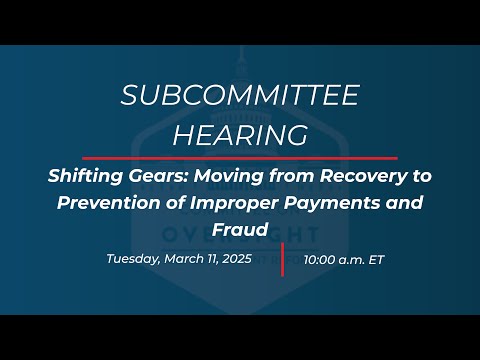
House subcommittee presses for prevention-first approach, urges extending PRAC and do-not-pay access
Summary
At a House Oversight and Reform subcommittee hearing, GAO and pandemic oversight officials urged Congress to prioritize prevention of improper payments, keep Treasury's Do Not Pay effective, and extend the Pandemic Response Accountability Committee's analytic work beyond its scheduled September 2025 sunset.
The House Oversight and Reform Subcommittee on Government Operations heard bipartisan testimony that Congress should shift from a "pay and chase" model to a prevention-first approach to reduce improper federal payments and fraud.
Ken Diefenbach, executive director of the Pandemic Response Accountability Committee (PRAC), told members that "Pay and chase is not the solution. Prevention is." He urged Congress to preserve PRAC's analytic capacity, warning that its scheduled September 2025 sunset would force deletion of curated data and the loss of staff expertise built since 2020.
The hearing featured testimony from Kristin Coakley, managing director for Financial Management and Assurance at the U.S. Government Accountability Office (GAO), who told the panel, "The best way to reduce improper or fraudulent payments is to not make them." Coakley recommended strengthening preventive controls, broadening the data available to Treasury's Do Not Pay system, and making some pilot data-sharing arrangements permanent.
Why it matters: Witnesses and members said the financial stakes are large. GAO figures cited at the hearing show an estimated $2.8 trillion in improper payments since 2003 and $162 billion reported for fiscal 2024; GAO's fraud estimates range widely depending on program scope and crisis-period spending. Committee members and witnesses agreed that preventing improper payments up front is more cost-effective than post-payment recovery.
Key evidence and proposals
- Data and tools: Coakley urged Congress to make permanent a temporary Social Security Administration (SSA) data-sharing arrangement so Treasury's Do Not Pay can use SSA's full death data to flag likely improper payments. GAO and Treasury said the pilot prevented and recovered millions within months and projected much larger net benefits for a multi-year period.
- Centralized analytics: Diefenbach described PRAC as a central analytic hub that assembled more than 60 major data sources and roughly 1.7 billion data points during the pandemic response. He warned that terminating PRAC would remove cross-program trend analysis and pre-award vetting capacity that can detect schemes that exploit multiple programs.
- Accountability and reporting: GAO recommended assigning senior accountable officials in agencies to lead fraud-prevention efforts and returning reporting on anti-fraud controls to annual financial reports. Coakley recommended agencies report not only on improper payments discovered but also on instances where Do Not Pay flags were present yet payments proceeded.
Committee response and next steps
Members of both parties pressed witnesses on practical reforms. Several members said they plan to move legislation to preserve or replicate PRAC's capabilities and to require stronger preventative controls and reporting from agencies. Chairman Sessions and Ranking Member Mfume said they expect bipartisan work on legislation; the chairman said a draft would be put forward for consideration in the coming weeks.
Ending note: Witnesses framed the issue as technical and data-driven rather than purely partisan, urging Congress to authorize sustained data access, invest in prevention-oriented systems, and ensure analytic capacity survives between emergencies to reduce future improper payments and fraud.