Get Full Government Meeting Transcripts, Videos, & Alerts Forever!
Get email alerts on the School Aid And Education topic
No spam. Unsubscribe anytime.
Charter and cyber school leaders tell House subcommittee governor—s budget shortchanges cyber students
Summary
Leaders from the Michigan Association of Public School Academies and several cyber charter operators told a House Appropriations subcommittee that the governor—s proposed school-aid budget reduces funding for cyber charter students and leaves charters without the same local facility funding available to traditional districts.
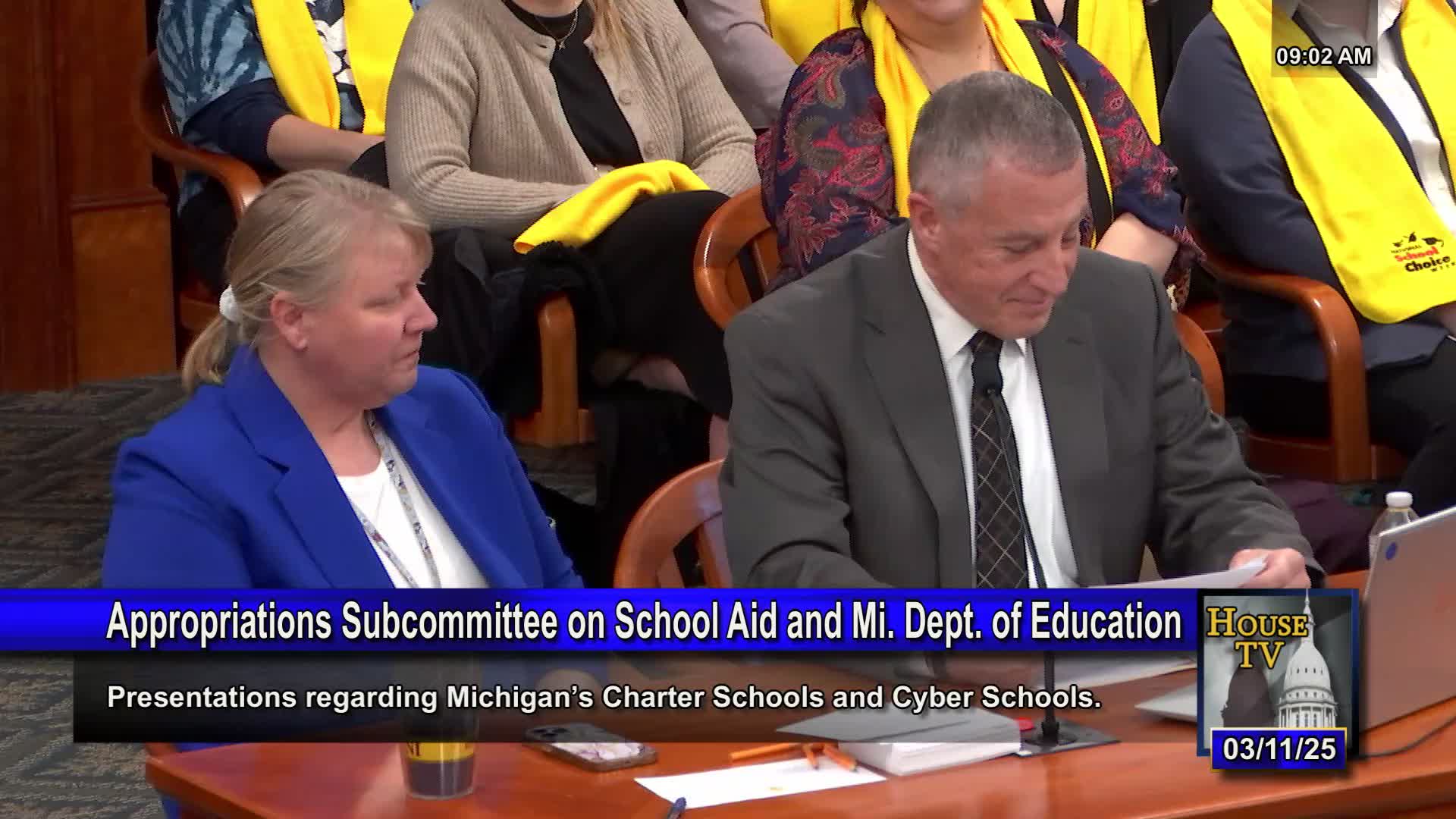
Lansing — Leaders of Michigan charter and cyber charter schools told the House Appropriations Committee's Subcommittee on School Aid and the Department of Education on March 4 that the governor—s proposed K-12 budget treats cyber charter students and many charter operators unequally and would reduce funding for some students.
Dan Quisenberry, president of the Michigan Association of Public School Academies, told the panel that charter public schools serve about 150,000 students at roughly 286 schools statewide and that many charter students are low-income or from minority communities. "Seventy-five percent of the students that attend a charter school are below the poverty line," Quisenberry said, adding that 67% of charter students are minority and that charter schools do not receive local millage or property-tax revenue for facilities.
Quisenberry said the governor—s budget language proposing a $10,000 investment "for every child in every school" does not apply equally. "If you—re attending a cyber charter school, you—re only getting $8,000," he said. He and other presenters noted the governor—s proposal zeroed out a prior offset under section 22e that had partially equalized funding in the last budget cycle.
Nut graf: Presenters argued the funding gap matters because charter and cyber charter operators serve a disproportionate share of students with high needs and no access to local facility revenue, yet they face lower per-pupil allocations under the current proposal. Committee members pressed presenters on staffing, special-education costs and how charters use flexible schedules and wraparound services for at-risk students.
In testimony and questioning, cyber and alternative operators described student populations and services that would be affected if per-pupil funding declines. Tanya Lowery, superintendent of Uplift Michigan Online School, said her cyber charter serves many students with significant needs and lists several costly related services: "If you're not familiar with special education costs, I'd like you to spend some time becoming familiar because they're astronomical," Lowery said. She told the committee her school provides speech and language supports, occupational therapy, behavioral therapy and other related services to students with individualized education programs.
Uplift officials said roughly 90% of their students qualify for at-risk (31a) funding and that 31'32% of their population is in special education; Tim Wood, Uplift's managing partner, said the school's special-education share is "two and a half times" the state average. Uplift reported current enrollment around 650'700 students, five to six social workers, and three counselors for the model they operate.
Miranda Coburn, executive director of Success Virtual Learning Centers, described Success's blended virtual-and-in-person centers and the social supports the operator provides, including center-level social workers, extended evening hours and weekend teacher availability. "A combination of academic support, emotional guidance, extended hours, transportation, and access to meals make Success a model that truly works for many at-risk students," Coburn said. Success said it operates 11 centers, updates technology every three years and refreshes facilities every five years.
Speakers urged the subcommittee to restore or equalize components of school-aid funding so that charter and cyber students receive funding tied to student need rather than the operator type. Quisenberry recommended restoring an $800-per-student gap and reinstating the previous section 22e offset that helped equalize retirement and categorical adjustments for some charters.
Committee members questioned presenters on root causes and on measurable outcomes. Representative Glanville and others asked about student-teacher ratios, counseling supports and the programs schools use to re-engage students. Uplift described an advisory model in which staff are assigned about 14 students and make near-daily contact to maintain engagement; Uplift also reported home visits and intervention teams for disengaged students.
No formal action was taken at the hearing. The subcommittee will incorporate testimony and materials into its budget recommendations to the full Appropriations Committee.
Ending: Presenters left written reports and budget memos with the subcommittee; the chair closed the session after noting statewide per-pupil spending figures included in the packet and adjourned the meeting.