Get Full Government Meeting Transcripts, Videos, & Alerts Forever!
Get email alerts on the School Aid Budget topic
No spam. Unsubscribe anytime.
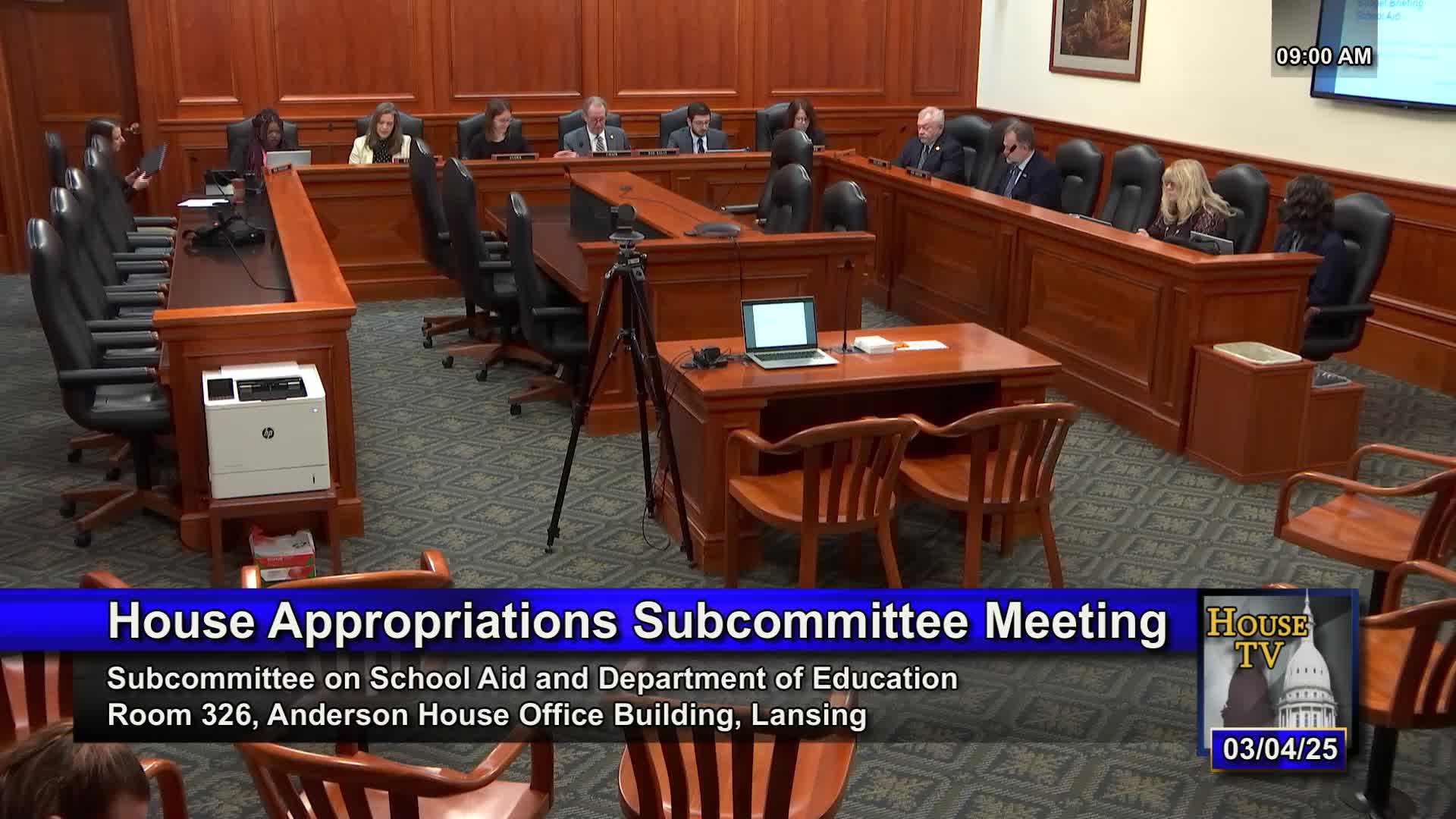
House appropriations subcommittee reviews $20.8 billion School Aid Fund; members press for on-time passage
Summary
The House Appropriations Subcommittee on School Aid and Department of Education heard a briefing on the School Aid Fund budget at a committee meeting where analysts described a roughly $20.8 billion statewide school-aid appropriation, declining pupil membership, and a mix of ongoing and one-time funding that committee members said they will evaluate as they prepare the FY 2026 budget.
The House Appropriations Subcommittee on School Aid and Department of Education heard a briefing on the School Aid Fund budget at a committee meeting where analysts described a roughly $20.8 billion statewide school-aid appropriation, declining pupil membership, and a mix of ongoing and one-time funding that committee members said they will evaluate as they prepare the FY 2026 budget.
The analysts said the school-aid budget pays for K–12 operations and categorical programs and provides funds to the Michigan Department of Education, the Center for Educational Performance and Information and other third parties. "School aid is about 26% at $20,800,000,000," said Jacqueline Mullins, senior fiscal analyst, House Fiscal. Mullins and Noel Benson, fiscal analyst, presented high-level figures and answered committee questions.
Why it matters: the School Aid Fund is the state's main K–12 funding vehicle. The briefing showed a mix of steady or rising appropriations for retirement and categorical programs alongside a projected decline in total students, which shapes policy debates about foundation allowances, per-pupil equity and whether the budget will be delivered on time to districts.
Analysts' overview and key figures
Jacqueline Mullins and Noel Benson outlined the fund's scope and major line items. The presenters said Michigan allocates money to 537 traditional local school districts, 286 public school academies (charters) and 56 intermediate districts; traditional districts represent roughly 89% of statewide pupil membership, while charters represent about 11%. Presenters said there are 16 cyber schools with about 21,872 enrolled and a statutory cap of 30,870 under 2012 public act provisions cited by the analysts.
Mullins said state-restricted sources make up about 89% of school-aid revenue, federal funding about 11%, and a smaller general-fund component that covers items not eligible for school-aid fund spending. She summarized major appropriations: foundation allowances account for about 49% of appropriations (roughly $10.2 billion), the Public School Employees Retirement System (MPSERS) about 13%, special education about 13% ($2.6 billion total in the current fiscal year: $2.1 billion state and $533 million federal), at-risk programming about 5%, and early-childhood (largely the Great Start Readiness Program) about 3%.
On balances and trends, the presenters said the fund shows roughly $21.5 billion in available resources this fiscal year and that a beginning balance of about $1 billion keeps the overall ending balance positive despite a structural gap on a baseline. They noted total pupil membership was projected at about 1,380,000 for FY25, declining slightly in subsequent years.
Foundation allowance, charters and cyber schools
Mullins explained Michigan's single target foundation allowance is $9,608 per pupil for most districts; cyber schools receive a lower cyber rate cited at $9,150. She described local millage interactions: districts are expected to levy about 18 mills on non-homestead property and the state backfills remaining amounts up to the foundation allowance. Mullins noted exceptions: some "out of formula" districts (for example, Big Bay and Baldwin as discussed in the briefing) have higher per-pupil funding and may retain amounts above the target foundation allowance.
On charter funding, Mullins said most charter schools now receive the same $9,608 target as traditional districts except cyber charters, and the committee heard that charters do not receive local property-tax offsets because they do not levy millages.
Special education and MPSERS
Presenters said special education reimbursement totals about $2.6 billion and that local districts still incur uncompensated special-education costs; Mullins cited an FY23 figure of about $601.5 million in uncompensated costs statewide. She noted the reimbursement framework traces to a 1997 court case (identified in the briefing as the Durant case) and that districts must cover costs not paid by federal, state or local special-education revenues.
Mullins described MPSERS appropriations of about $2.8 billion in the current year, including recent one-time payments to reduce unfunded liabilities and a statutory district contribution cap that has been reduced from 20.96% of payroll to 15.21% beginning in the next fiscal year per the briefing. The presenters showed projections that the state’s unfunded liabilities would be paid off by 2038 under current assumptions.
Categoricals, GSRP and one-time funding
The analysts described growth in categorical spending (program-specific appropriations) from 15 years ago to today and listed several notable one-time items in FY25. Benson summarized the Great Start Readiness Program (GSRP), the state's four-year-old preschool program, noting eligibility expansions and corresponding increases in appropriation and children served.
Mullins and Benson listed FY25 one-time categoricals totaling about $1.2 billion, including amounts cited in the briefing such as $181.5 million for MPSERS employee health-care reimbursement, $126.5 million for per-pupil mental health and school safety (including $25 million ongoing), $125 million for transportation costs, $87 million for literacy supports, $71 million for enrollment stabilization, $57 million for charter school per-pupil payments, and $25 million for out-of-school-time programs (with $50 million ongoing in another line). The presenters offered to provide the committee the full line-by-line list.
Questions, requests and next steps
Committee members pressed analysts for additional detail. Representative Danville asked for an inflation-adjusted history of the foundation allowance; Mullins said, "We can absolutely run those numbers for you and send them to you after committee in the next couple days." Representatives also asked for special-education head-count figures rather than FTEs; Mullins said staff could provide head-count data on request.
Representative Kelly, the committee chair, commented on the broad theme of "more money, fewer students" and expressed concern about student achievement relative to rising spending. Representative Glanville and others emphasized the importance of passing a school-aid budget on time so districts can finalize staffing and programming before each school fiscal year begins.
No formal motions or votes were recorded during this briefing. Staff committed to distributing requested follow-up data to subcommittee members.
The subcommittee indicated it will use the analysts' materials as it develops FY26 recommendations and to inform potential policy reviews, including questions raised about hold-harmless districts, Title I distribution, and the foundation allowance differential for cyber and charter schools.