Get Full Government Meeting Transcripts, Videos, & Alerts Forever!
Get email alerts on the Math Adoption topic
No spam. Unsubscribe anytime.
District staff say Amplify Desmos led pilot for grades 5–8 math; formal adoption to return in April
Summary
Waunakee Community School District curriculum staff reported that teachers piloting two programs ranked Amplify Desmos highest on weighted criteria. No formal board adoption occurred; staff plan a one‑year blended subscription trial and will return to the committee with pricing and a proposed motion in April.
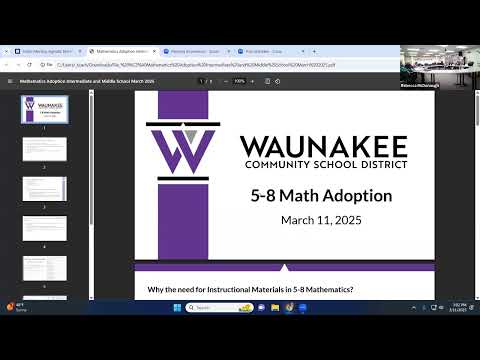
Waunakee Community School District curriculum staff reported March 11 that teachers piloting two middle‑school mathematics programs rated Amplify Desmos (published by Amplify in partnership with Desmos) as the top option and that staff intend to bring a purchasing recommendation back to the committee in April.
The recommendation follows a pilot that ran from October through February in grades 5–8. Nineteen classroom and support teachers completed a survey that asked them to allocate 100 points across 10 selection criteria; staff said Amplify led on nine of the 10 criteria and had the highest total weighted score. The three highest‑weighted criteria were: materials that support all students in learning, materials that provide opportunities for students to share thinking and promote discourse, and student engagement.
District staff described the process as modeled on the elementary adoption they completed previously and said the pilot included classroom visits between teachers so each pilot site could see the alternate program in practice. The other finalist was Imagine Learning built on Illustrative Mathematics; staff said Imagine Learning and Amplify both draw from Illustrative Mathematics but that Amplify adds digital and Desmos‑embedded tools on top of the core curriculum.
Staff said their likely implementation plan, if the board approves the adoption, would be a seven‑year adoption with a one‑year blended subscription (digital access plus printed consumable workbooks) in year one. Pricing was not finalized at the March meeting; staff said they will include cost options in the April packet and that the committee will vote on a motion at a subsequent meeting.
Committee members asked practical questions about scope and continuity: staff said Amplify’s program currently extends through Algebra I, so most eighth graders would use the Algebra I materials. High school Algebra I teachers are independently evaluating the package and may decide later whether to adopt for high school use.
Committee members also raised questions about how the district will measure impact. Staff said they expect the new materials, schedule changes (a six‑period day at the middle school), and professional development to work together to improve outcomes but acknowledged it will be difficult to apportion how much growth is attributable to any single change. Staff said the district will monitor local assessment data and intervention placement (tier 2/3) trends and will report back as part of future assessment updates.
Other items in the curriculum packet discussed at the March 11 meeting included AP Psychology textbook purchases and intermediate‑school ELA resources; staff said the packet will be updated next month to include the finalized math pricing and to reduce some curriculum project requests to meet budget constraints.
Next steps: staff will provide pricing options and a refined curriculum request list at the committee’s April meeting, at which point the committee is expected to consider a motion on textbook/curriculum purchases. May will include a broader instructional technology update and a deeper look at local assessment trends, staff said.