Get Full Government Meeting Transcripts, Videos, & Alerts Forever!
Get email alerts on the Appropriations Labor And Economic Opportunity topic
No spam. Unsubscribe anytime.
House Appropriations subcommittee reviews FY25 Labor and Economic Opportunity budget; SOAR funding set to lapse unless reauthorized
Summary
House Appropriations Subcommittee on Labor and Economic Opportunity received an overview of the department’s FY25 budget, including a $2.4 billion gross appropriation, large one-time grant buckets, FTE changes, and a $456.4 million remaining balance in the SOAR fund that will lapse at the end of FY25 unless reauthorized.
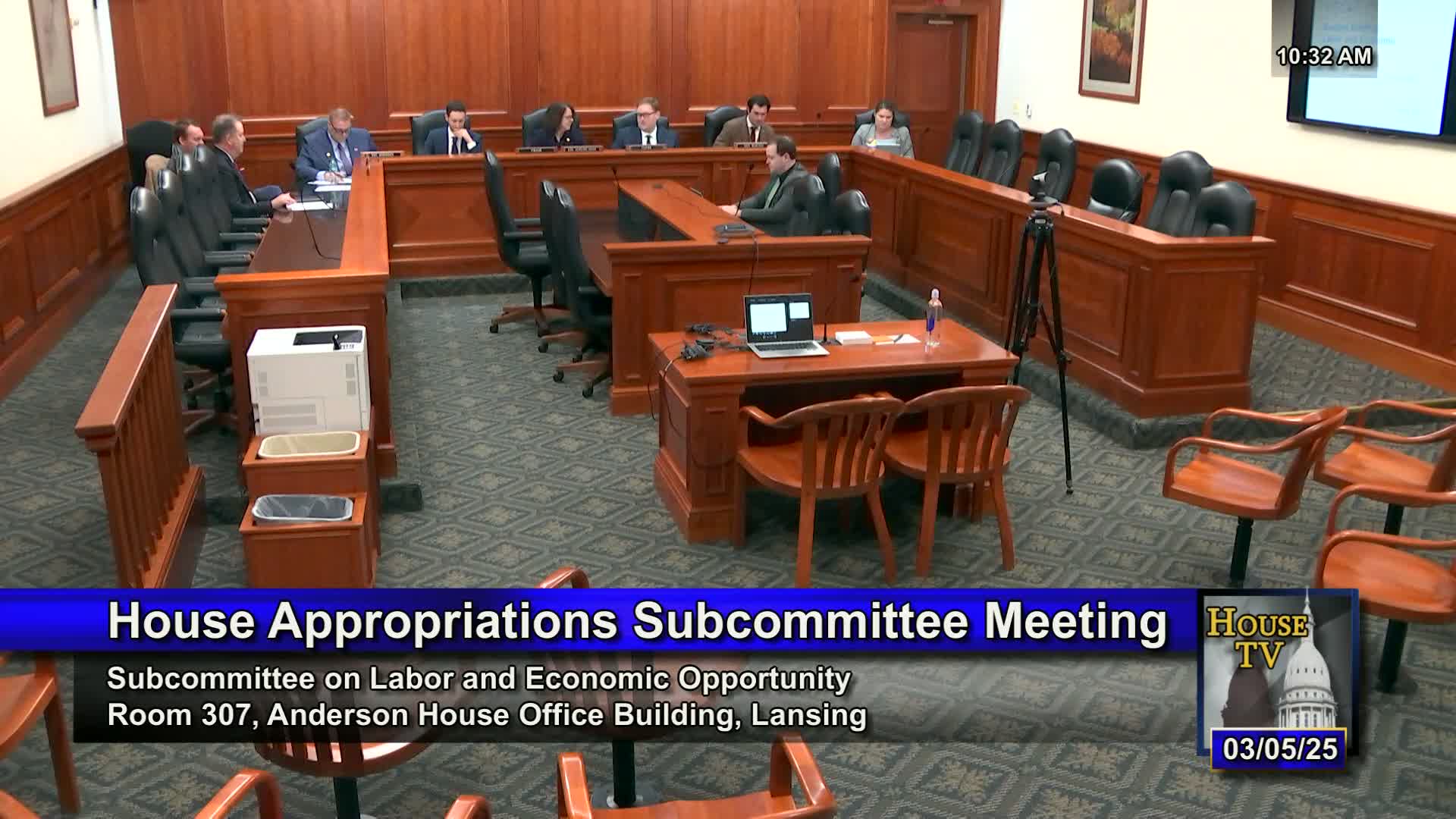
The House Appropriations Subcommittee on Labor and Economic Opportunity heard a high-level presentation on the department’s fiscal year 2025 budget on the committee’s meeting. Marcus Coffin of the House Fiscal Agency presented the overview and answered members’ questions.
LEO’s FY25 budget totals roughly $2.4 billion in gross appropriations, of which about $1.2 billion is federal revenue and roughly $793.6 million is general fund, Coffin told the subcommittee. He said approximately a quarter of the department’s FY25 spending is one-time funding that supports 60 distinct grants and programs.
Coffin said the department’s ongoing budget is relatively stable while the year-to-year variation is driven by one-time allocations such as federal COVID funding, deposits to the Strategic Outreach and Attraction Reserve (SOAR) fund, and targeted grant programs. He described LEO as “the state’s primary economic development, workforce development and affordable housing department,” and summarized major appropriation units that include workforce development, rehabilitation services, employment services, the Unemployment Insurance Agency, MEDC/MSF programs, MSHDA, and the State Land Bank Authority.
The presentation included the budget’s major line-item figures: workforce development about $510.3 million gross; rehabilitation services about $195.7 million; employment services about $107.8 million; Unemployment Insurance Agency about $303.1 million; MEDC/MSF-related programs about $252.8 million; MSHDA about $322.6 million; and the one-time appropriations unit about $638.8 million. Coffin also identified specific one-time grant buckets: $137.2 million for community enhancement grants (103 recipients), $43 million for health care grants (14 recipients), $3.9 million for housing grants (5 recipients), $102.5 million for infrastructure grants (51 recipients), and $45.8 million for public safety grants (23 recipients).
Committee members pressed for more detail about staffing and accountability. Representative Robinson asked whether recently added full-time-equated positions had all been filled; Coffin said staffing levels are “in flux” and deferred to department officials for vacancy specifics. On reporting and oversight, Coffin said SOAR projects and MEDC/MSF approvals include documentation and board-level prospectuses, but that many of the large one-time enhancement grant buckets do not carry legislative reporting requirements beyond routine auditing and financial oversight. He said, “for the most part, especially those larger enhancement grant buckets … I don't believe that there's reporting required for the majority of those items.”
Coffin reported a remaining SOAR balance of $456.4 million available for allocation and said a scheduled $500 million deposit from corporate income tax revenue was reflected for FY25. He told the committee that the current earmarks that support certain programs, including revitalization and placemaking, are funded from corporate income tax revenue and that “at the conclusion of fiscal year 25, those earmarks will cease.” He added that unless funding receives work-project status or is otherwise reauthorized, the amounts would lapse.
On Going Pro, Coffin said the budget includes gross appropriations of about $4,054,800,000 with roughly $45.2 million coming from the general fund; he described Going Pro as a competitive, performance‑reimbursed employer training program that pays awards after completion of training or employee retention milestones. Coffin also noted program shifts in FY25, including transfers out of LEO for the Reconnect and Tri-Share childcare programs to My LEAP and the transfer of the Office of Rural Prosperity into LEO.
During the discussion Representative Van Workum asked for specifics on the infrastructure grants and whether the allocations were full project funding or supplemental; Coffin said the grants went to 51 projects “throughout the state” and that he could provide a list of specific allocations but did not have project-level detail during the presentation. No formal committee action or votes were taken during the meeting.
The subcommittee adjourned after the presentation and questions; Coffin said he would provide additional details to members who requested them.