Get Full Government Meeting Transcripts, Videos, & Alerts Forever!
Get email alerts on the Higher Education topic
No spam. Unsubscribe anytime.
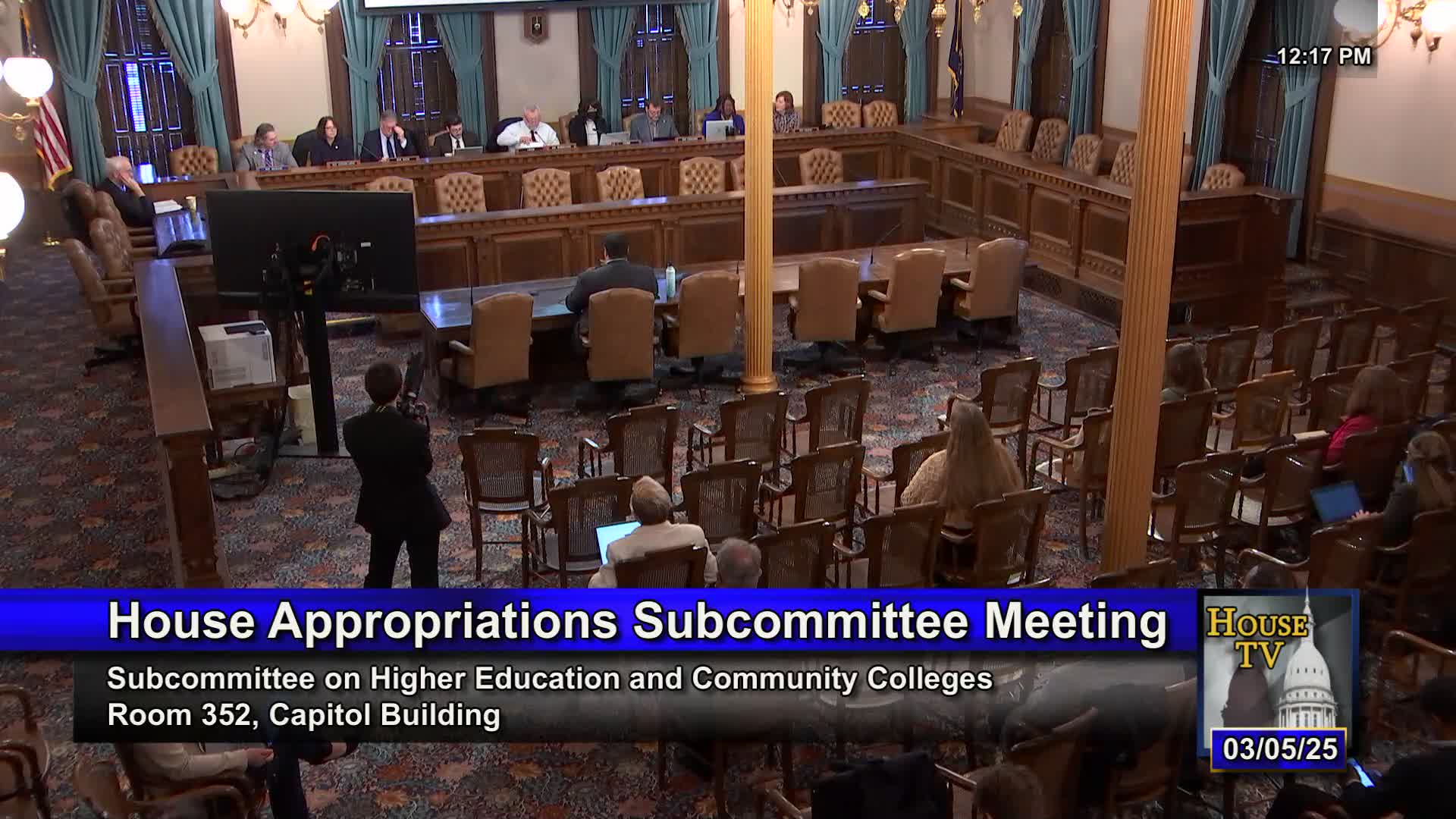
Subcommittee hears $2.324 billion higher education budget and community college formula details
Summary
House fiscal agency staff briefed the subcommittee on the FY24–25 higher education and community college budgets, including the $2.324 billion higher education gross appropriation, the $330 million Michigan Achievement Scholarship, MPSERS funding moves and tuition‑restraint conditions tied to operations increases.
Perry Zylak, senior fiscal analyst, House Fiscal Agency, told the House Appropriations Subcommittee on Higher Education and Community Colleges that the fiscal year 2024–25 higher education gross appropriation is about $2.324 billion and that higher education funding is concentrated in operations grants to the state’s 15 public universities.
Zylak said roughly $1.859 billion of the higher education budget comes from the state’s general fund/general purpose (about 80 percent of the higher education budget), with the remainder largely from state restricted revenues such as the School Aid Fund and a small federal funding component. He said higher education represents roughly 3 percent of the state’s $81.4 billion budget and about 13 percent of the state general fund.
The fiscal analyst outlined several major issues: the Michigan Achievement Scholarship (appropriated at $330 million for FY25), institutions’ operational grants (about $1.7 billion), tuition restraint conditions attached to new operations funding and ongoing state support for MPSERS retirement costs. “All of that being said,” Zylak said in his presentation, “I am happy to answer any questions that you may have,” after walking members through allocations and program details.
Zylak described the Achievement Scholarship as the largest single financial aid appropriation in the budget (about 61 percent of state financial aid dollars), with different tracks for community college, tribal students, four‑year public and private institutions and a small private training component. The committee was told the scholarship includes a community college guarantee (last‑dollar tuition and fee coverage in district) and up to $5,500 for students attending four‑year public or private institutions under the program’s current design.
On institutional funding, Zylak walked members through the operations funding model used for public universities—baseline funding plus any new operations increase and tuition‑waiver reimbursements (North American Indian tuition waivers). He noted the legislature has attached conditions to increased operations funding in recent years, including caps on resident undergraduate tuition and fee increases (generally no more than 4.5 percent or a specified dollar amount year to year), participation in reverse transfer and transfer‑transparency requirements and certification of institutional best practices on transfer.
Community college funding was presented as a related but distinct budget. Community colleges’ FY25 gross appropriation is about $642.2 million, almost entirely financed by the School Aid Fund, with a $500,000 general fund supplement. Zylak explained the community college performance funding formula (30 percent across‑the‑board adjustments; 30 percent contact hours/equated students with weights for health and technical fields; 10 percent completion improvement; 10 percent completion number; 10 percent completion rate; 5 percent administrative costs; 5 percent local strategic value) and that community colleges received a 2.5 percent gross increase for FY25 (1.5 percent ongoing, 1.0 percent one‑time).
Zylak also reviewed MPSERS funding history, noting recent large one‑time state payments that reduced the unfunded actuarial accrued liability (UAAL) and that the state continues to provide both UAAL support and normal cost offsets for certain institutions. He flagged the recurring tension between legislative direction and constitutional autonomy for public universities, noting many budget provisions sit in a gray area where courts ultimately decide whether the legislature’s directives violate autonomy.
Members asked a range of questions, including comparisons to other states, FAFSA completion and Michigan Reconnect eligibility; Zylak offered to supply additional comparative and programmatic data to members and noted MyLEAP (the department previously briefed) maintains program dashboards for scholarship participation.
No formal committee motions or votes occurred during the presentations.