Get Full Government Meeting Transcripts, Videos, & Alerts Forever!
Get email alerts on the Budget Boilerplate topic
No spam. Unsubscribe anytime.
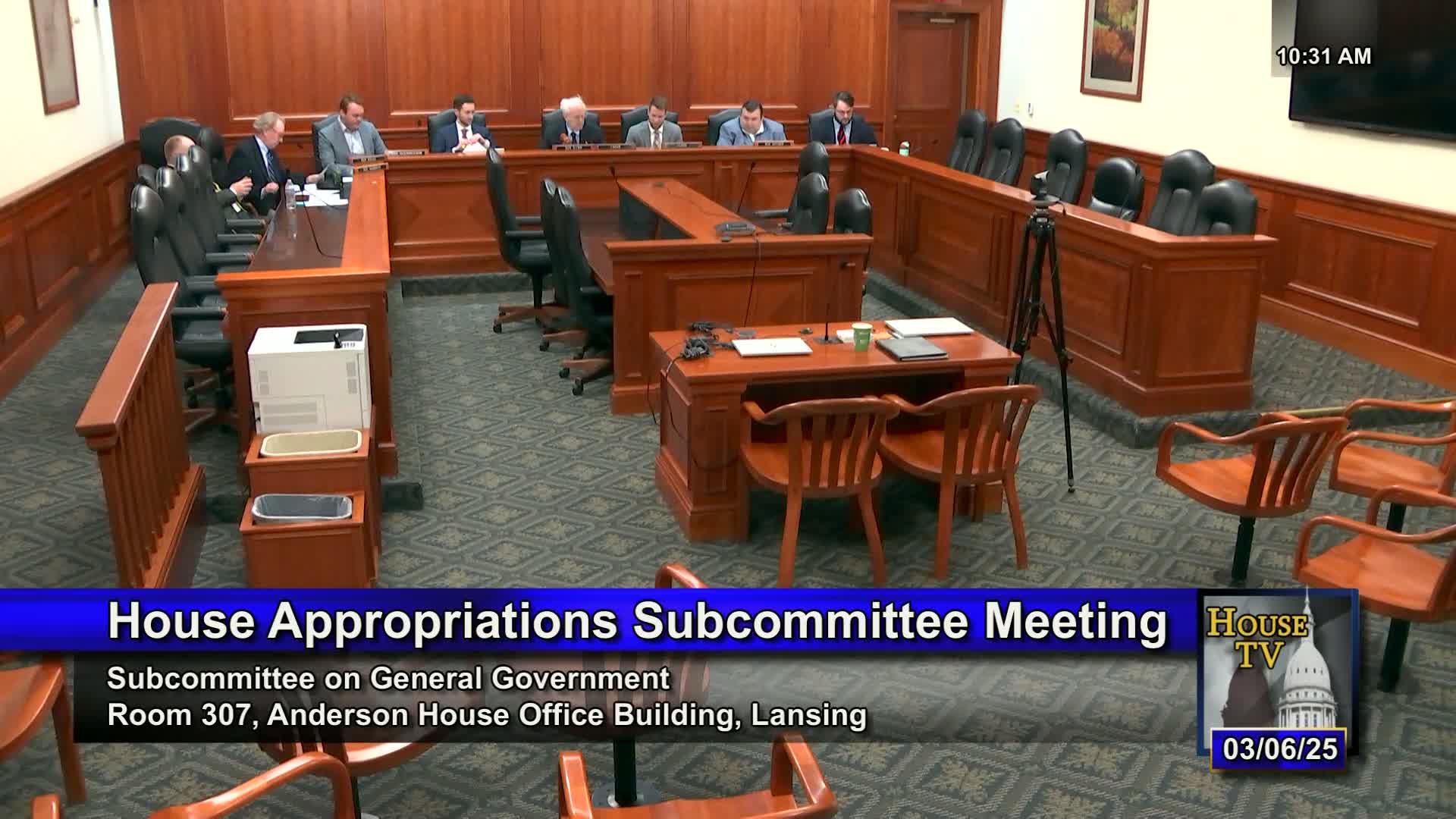
House Appropriations subcommittee reviews proposed cuts and changes to ‘General Government’ budget boilerplate
Summary
The House Appropriations Subcommittee on General Government reviewed a House Fiscal Agency comparison of budget boilerplate across fiscal years 2023, 2025 and the governor’s fiscal 2026 recommendation, focusing on deleted reporting requirements, receipt authority changes and targeted appropriations.
Lansing — The House Appropriations Subcommittee on General Government reviewed a House Fiscal Agency comparison of budget “boilerplate” language across fiscal year 2023, the current enacted year and the governor’s fiscal 2026 executive recommendation during its February 2025 meeting. The session included a line-by-line overview of sections affecting the Attorney General, Department of State, Department of Technology, Management and Budget (DTMB), Department of Civil Rights and legislative operations.
The comparison shows the executive proposal removes many reporting requirements and some receipt-and-spend authorizations while adding or retaining targeted appropriations and contingency authorizations in a few areas. Committee members and the presenter discussed impacts on transparency, local reimbursements and program administration.
Michael Knasson of the House Fiscal Agency told the panel the document compares three sets of boilerplate and “shows where boilerplate has been, where it is now and where the governor would like to see it go,” and described the packet as “80 pages of boilerplate.” The analysis focused on sections that changed; blank entries in the comparison indicate no change rather than deletion.
Examples discussed include multiple Attorney General sections: Section 305 (reimbursement for Third Circuit Court costs tied to SNAP fraud diversion) was removed because the court-ordered diversion program ended; language on tobacco litigation proceeds was moved and expanded in later sections to also cover opioid litigation proceeds; and an authorization for litigation-expense reimbursements rose from $500,000 in fiscal 2023 to $1,000,000 in the current year. A new Section 311 was noted in the current-year text to earmark $500,000 for the Center for Civil Justice to provide legal assistance to low-income populations; the presenter said Part 1 includes a corresponding $500,000 increase.
Committee members pressed for detail where the executive budget deletes reporting requirements. For the Department of Civil Rights, the private-revenue authorization for employer training and publications increased from $85,000 in fiscal 2023 to $600,000 in the current-year text; Rep. Kelly asked why the jump was so large, and Knasson said the department had previously requested up to $1 million in fiscal 2024 as part of a strategic effort to grow private sponsorship, although actual revenue collected historically has been far lower.
The Department of State review highlighted that several receipt-and-spend authorizations or related reports were removed in the executive recommendation. The presentation noted the lookup-fee authority (raising a fee from $11 to $15) has since been codified in statute and that the Department’s branch-office notification requirement and an “adequate in-person services” boilerplate were removed after the governor deemed them unenforceable; members asked whether those deletions would reduce protections for in-person services, and committee members were told the governor’s unenforceability finding typically reflects separation-of-powers concerns about directing executive day-to-day operations.
DTMB drew sustained discussion. The packet shows large changes to contingency authorization levels tied to the Make It in Michigan competitiveness fund and other transfer authorities: federal and restricted receipt authorizations were increased in the House-passed/current-year language and then reduced in the executive recommendation to reflect evolving fund balances. Several DTMB reporting requirements tied to IT projects and contracting were removed in the executive text, including some IT project-reporting thresholds (raising the reporting threshold from $250,000 to $500,000 in the current-year column and removing that requirement in the executive recommendation) and multiple ITIF (IT investment fund) reporting items. The packet also lists one-time appropriations, including a $10 million request related to state property insurance, and a continued boilerplate energy-efficiency revolving fund (two $5 million deposits were discussed by members as one-time appropriations).
Throughout the presentation, members asked for additional detail and were invited to provide notes they would like considered when drafting future boilerplate. Rep. Dan Morica and Rep. Van Werkom (members on the committee) and others asked clarifying questions about the provenance and utility of specific reporting items — for example, a detailed retirement-systems report that was costly for departments to produce and therefore removed from the executive recommendation.
There were no formal votes on policy changes during the meeting. The committee did approve the minutes of the February 2025 meeting on a motion by Rep. Maddock; there were no objections and the minutes were approved.
The meeting adjourned after the presentation and questions.