Get Full Government Meeting Transcripts, Videos, & Alerts Forever!
Get email alerts on the Transportation Budget topic
No spam. Unsubscribe anytime.
House subcommittee hears $6.8 billion snapshot of Michigan transportation budget; members press on revenue, debt and pavement shortfalls
Summary
Bill Hamilton of the House Fiscal Agency presented a roughly $6.8 billion snapshot of Michigan’s current-year transportation budget to the House Appropriations Subcommittee on State and Local Transportation and described the funding mix and program areas supported by the Michigan Transportation Fund and federal aid.
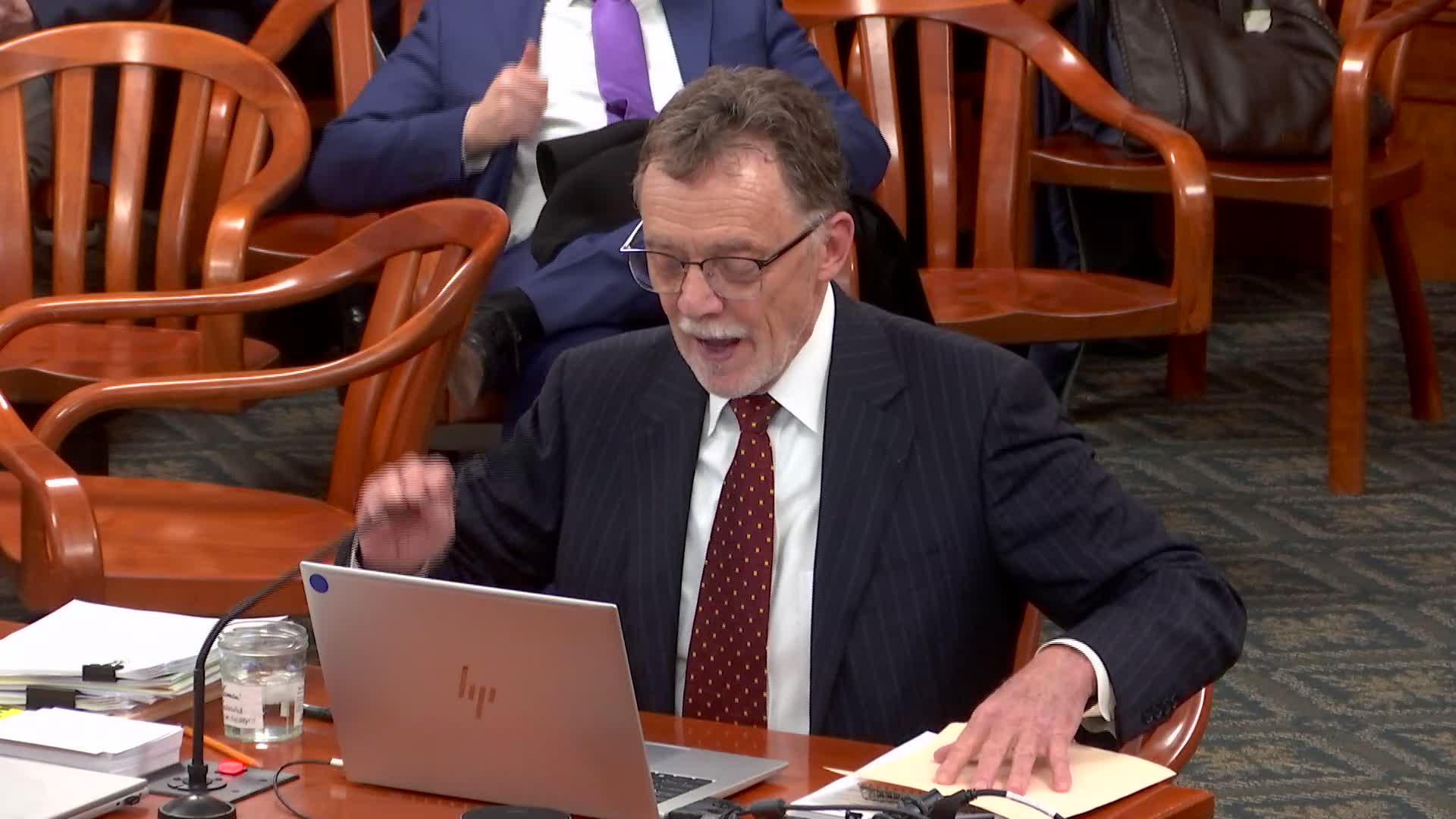
LANSING — Bill Hamilton of the House Fiscal Agency presented an overview of Michigan’s current-year state transportation budget to the House Appropriations Subcommittee on State and Local Transportation and told members the budget totals roughly $6.8 billion, with most funding coming from state-restricted revenue and federal aid.
Hamilton said the gross appropriations in the current-year budget total $6,807,900,300 (rounded in discussion to about $6.8 billion). He described state-restricted revenue as the single largest funding source at about $4.2 billion, federal revenue of roughly $2.3 billion and a variable State General Fund/General Purpose appropriation of about $193 million.
Hamilton summarized the major program areas supported by that funding: road and bridge programs at about $5.7 billion (approximately 83% of the budget), public transportation programs at about $805.6 million (roughly 12%), and aeronautics programs at about $330.3 million (about 5%). He said roughly $2.6 billion is distributed to local road agencies (county road commissions and cities and villages) and about $1.6 billion is directed to the State Trunk Line Capital Construction program.
Why it matters: Hamilton highlighted long-term maintenance and performance concerns. Using pavement-condition measures supplied by the Michigan Department of Transportation (MDOT), he said MDOT projects it would need an additional $2.5 billion for the State Trunk Line system to attain and sustain a 90% “good” pavement condition. He cautioned the pavement metric is one of several performance measures and does not capture safety, mobility or environmental factors.
Hamilton walked members through the Michigan Transportation Fund (MTF), the statutory distribution model created by Public Act 51 of 1951. He said five primary MTF revenue sources credited and distributed under Act 51 are vehicle registration taxes, motor fuel taxes on gasoline, motor fuel taxes on diesel, a statutory income-tax earmark created in the November 2015 road funding package (about $600 million), and the marijuana excise tax. He noted vehicle registration revenue has become the largest single state-restricted contributor, at about $1.6 billion, while gasoline motor fuel tax receipts were described around $1.3 billion and combined motor fuel taxes (gasoline and diesel) are roughly $1.6 billion.
On federal aid, Hamilton noted the current federal program authorizing surface-transportation formula and competitive programs is the Infrastructure Investment and Jobs Act (IJA). He said IJA funds are “made available” to states and that the current authorization extends through Sept. 30, 2026.
Members asked detailed questions. Representative Edwards asked whether fewer young adults obtaining driver’s licenses — and thus fewer registrations — will cut registration revenue. Hamilton said registration revenue does not track solely with the number of registrations because most light-vehicle registration fees are tied to the vehicle’s value. “Even in years when the number of registrations declines, actual registration revenue tends to increase,” Hamilton said.
Representative Morgan asked whether budget figures are tracked on an inflation-adjusted basis. Hamilton said the state budget office includes economic increases for wages and other costs in each budget, and MDOT tracks construction bid costs; he recommended asking MDOT for a direct comparison of funding versus inflation and asset deterioration.
Members also raised debt and bonding. Hamilton pointed to a House Fiscal Agency publication showing roughly $3.3 billion of outstanding State Trunk Line Fund debt as of Sept. 30, 2023, and annual debt-service figures in the low hundreds of millions (he cited about $226 million for 2023 and noted an estimate of about $257.6 million for a subsequent year). He said MDOT has been authorized to sell up to about $3.5 billion in a recent bond program, has sold roughly $2.8 billion so far, and may have about $700 million of authority remaining under that authorization; whether additional bonds are issued depends on cash-flow needs and bond-market conditions.
Hamilton reiterated that state-restricted MTF dollars are distributed monthly and that the MTF typically has no year-end fund balance because the statute directs distribution. He emphasized that many line items are ongoing baseline programs and that the largest year-to-year budget variability comes from one-time appropriations decided by appropriators.
The committee packet included a more detailed line-item summary, the MTF publication, and other House Fiscal Agency analyses Hamilton said he updates annually. He encouraged members to use the House Fiscal Agency website for publications and multiyear comparisons.
No substantive bill votes were recorded in the transcript. At the start of the meeting the clerk recorded four of seven members present and the committee established a quorum. Toward the end, a member moved to excuse absent members; another member supported the motion, but the transcript does not record a formal vote or final outcome for that motion.
The subcommittee chair said the group will return for follow-up meetings to examine bonding, bridge needs, local road conditions and the detailed line items that feed long-term performance projections.