Get Full Government Meeting Transcripts, Videos, & Alerts Forever!
Get email alerts on the General Government Budget topic
No spam. Unsubscribe anytime.
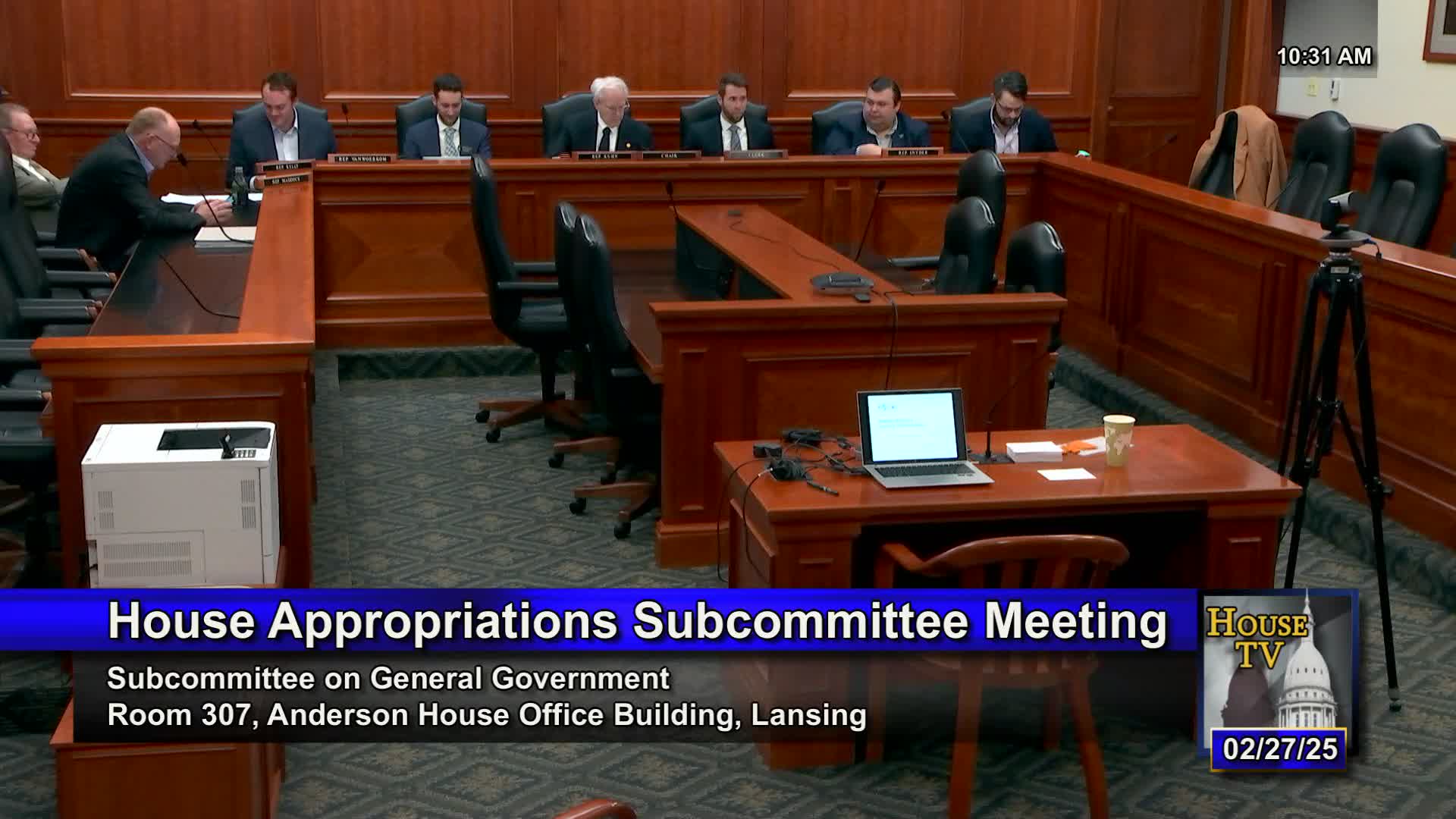
House Appropriations Subcommittee hears overview of General Government FY26 budget; major IT and revenue-sharing items highlighted
Summary
House fiscal staff told the House Appropriations Subcommittee on General Government that the governor's fiscal 2026 recommendation would leave the general government budget largely steady while advancing major IT modernization projects, continuing revenue-sharing passthroughs and proposing additional deposits to the budget stabilization fund.
The House Appropriations Subcommittee on General Government heard a department-by-department preview of the governor’s fiscal 2026 budget recommendation on general government, with the House Fiscal Agency’s senior fiscal analyst Michael Knausson presenting key totals, program changes and funding questions.
Knausson said the general government budget totals about $5.2 billion gross, with roughly $1.8 billion of restricted funds designated for revenue sharing and about $1.6 billion for Department of Technology, Management and Budget (DTMB) operations. He said roughly a quarter of the budget is funded by interdepartmental grants (IDGs) and that, excluding IDGs, the general government share approximates $4.0 billion. "The general government budget is many budgets," Knausson said, adding that much of the general fund share pays State Building Authority (SBA) rent and debt service.
Why it matters: the general government package covers multiple executive departments and several constitutionally established agencies whose budgets affect local revenue-sharing dollars, statewide IT systems and debt obligations. The subcommittee’s review will guide line-item scrutiny and any boilerplate language the House chooses to attach during the budget process.
Knausson summarized the governor’s notable recommendations and history:
- Budget stabilization fund: the governor proposes a $50 million deposit that, with current balances and expected receipts, would bring the fund to about $2.5 billion. Knausson said the balance stood at roughly $2.3 billion as of January.
- Attorney General: the department’s budget is presented as just under $130 million, about 44% general fund. Knausson said approximately 92% of the attorney general’s budget is in the operations line item, which funds bureaus and most staff costs. The governor’s recommendation contains modest ongoing increases and removes some one-time appropriations included in the current year.
- Civil Rights: the Department of Civil Rights remains primarily general fund (about 90%). Knausson told the subcommittee the department expanded complaint-investigation FTEs in recent years to address a backlog; the complaint-investigation and enforcement line is about $19.4 million.
- Department of State: motor-vehicle services are funded mainly by restricted fees (the TAC fund). Knausson flagged earlier fee increases that helped stabilize a multi-year shortfall and noted recommended restricted spending increases for IT support and election administration.
- DTMB and IT modernization: DTMB’s budget is roughly $1.8 billion, about 63% IDG revenue; about $1 billion of IDGs funds IT work. The governor’s recommended Information Technology Investment Fund (ITIF) package includes both ongoing and one-time funding. Knausson said ITIF ongoing funding typically centers near $35 million, but the FY26 recommendation includes one of the larger single-year ITIF proposals, including $20 million for replanning the unemployment insurance system (Midas) and about $23.5 million to replace the human resources system (HERMAN/Human Resource Management Network). He said DTMB manages more than 260 active IT projects as of February.
- Make It in Michigan Competitiveness Fund: Knausson said the state has deposited roughly $337 million into the fund (a $50 million initial amount plus a larger later deposit). He said about $128 million remained available as of January and that federal pauses on some grant programs could affect whether federal partner funds are drawndown for certain projects.
- Treasury and revenue sharing: Knausson said Treasury’s budget is largely state restricted and that roughly $1.8 billion in the department delineates statutory and constitutional revenue-sharing passthroughs to local units. The governor’s recommendation uses statutory formulas and includes a technical increase tied to sales-tax-based distributions.
Subcommittee members asked for additional detail and follow-up documents. Representative Kelly asked about a program in the attorney general’s budget described in the materials as pursuing oil-and-gas-related matters; Knausson pointed to a line labeled "utility rate increases" in the AG’s table and said the current-year table shows about $2.2 million in such activity, $1.9 million of it restricted. Representative Kelly: "I don't see where their program to go after oil and gas." Knausson replied that it may be recorded under that label.
Members also pressed for statutory references and reports. The chair and members asked staff to locate (1) the statutory reference for the typical four-year work-project authorization; (2) the AG’s outside-counsel reporting required in boilerplate, noting the committee’s online repository lists reports through 2023 but not later years; and (3) itemized lists for one-time facility maintenance projects the governor proposes to fund through DTMB.
Vice Chair Bender asked about the composition of debt service in the SBA rent line; Knausson identified three general obligation bond programs that the SBA rents help pay: the Quality of Life Bond, the Clean Michigan Initiative/Environmental Protection Bond, and the Great Lakes Water Quality Bond.
Other department-level details noted by Knausson: the Office of the Governor remains mostly general fund with modest economic adjustments; the Auditor General conducts about 60 reports a year and is funded partly by IDGs; the state lottery and gaming control functions remain financed from restricted revenues; and Treasury’s supplemental requests include one-time items such as $25 million to remove hazardous wiring in Detroit and administrative funding for a proposed nicotine/tobacco tax (Knausson cited $2.5 million and 17 FTEs to implement that proposed tax).
The presentation closed with staff offering to provide supplemental materials: a line-item breakout for AG operations and initiatives, a list of ITIF projects recommended for FY26, the list of work projects and their statutory duration, and updated civil-rights complaint counts and disposition information. The subcommittee scheduled a deeper review next week focused on boilerplate language used to require reports and build oversight provisions.
Ending: No formal votes or motions were taken during the session; the meeting proceeded as an informational budget briefing with follow-up requests for documentation and statutory citations.