Get Full Government Meeting Transcripts, Videos, & Alerts Forever!
Get email alerts on the Egle Budget topic
No spam. Unsubscribe anytime.
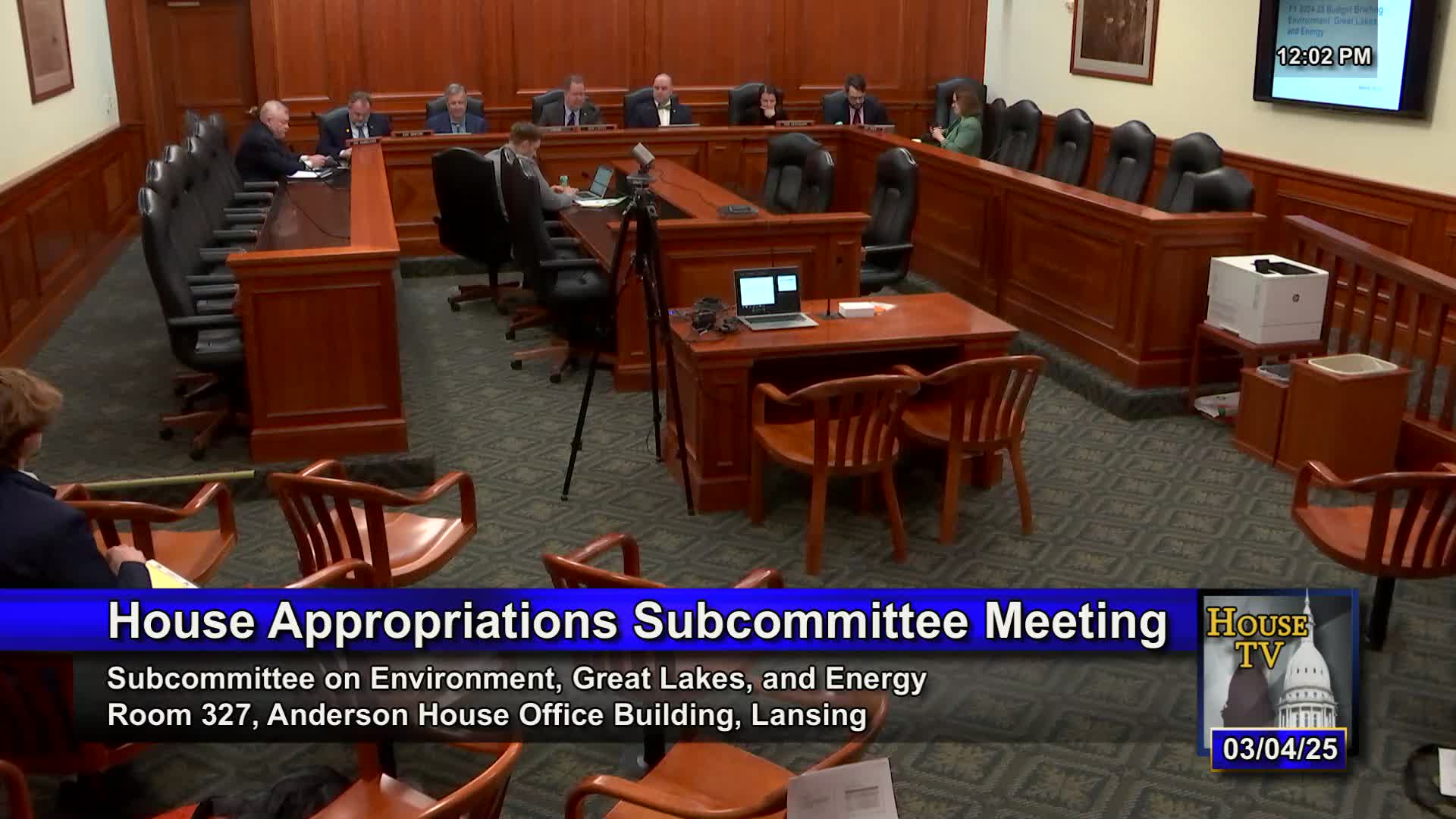
House subcommittee reviews Environment, Great Lakes and Energy budget, spotlights water infrastructure funding
Summary
At a meeting of the House Appropriations Subcommittee on Environment, Great Lakes and Energy, Austin Scott, fiscal analyst with the House Fiscal Agency, presented an overview of EGLE's current‑year budget and funding sources, emphasizing federal grants and restricted funds that support water infrastructure and cleanup work.
At a meeting of the House Appropriations Subcommittee on Environment, Great Lakes and Energy, Austin Scott, fiscal analyst with the House Fiscal Agency, presented an overview of EGLE's current-year budget and funding sources, emphasizing federal grants and restricted funds that support water infrastructure and cleanup work.
The presentation matters because EGLE's budget—just over $1 billion and roughly 1% of the state's total budget—relies heavily on federal dollars and more than 50 restricted funds to finance drinking-water projects, remediation of contaminated sites and other environmental programs. Scott told the committee that federal funding and restricted revenues together make up roughly three‑quarters of the department's current funding.
Scott said most federal funding in EGLE's budget comes from the U.S. Environmental Protection Agency and that a significant portion of recent federal dollars arrived through the Infrastructure Investment and Jobs Act (IIJA). Much of the IIJA money is routed to the state's water state revolving funds (SRFs), which provide loans—and in some cases principal forgiveness—to local governments or water suppliers for large water projects such as treatment facilities, pipe replacement and sewer work.
Restricted funds also play a major role in EGLE's work. Scott highlighted four large restricted funds used primarily by the department's Remediation and Redevelopment Division: the Renewing Michigan's Environment income‑tax earmark (Renew Michigan), the Cleanup and Redevelopment Fund, the Refined Petroleum Fund and the Underground Storage Tank Cleanup Fund. He said Renew Michigan, created after the Clean Michigan bond authority was exhausted, dedicates roughly two‑thirds of its revenue to cleanup of non‑petroleum sites and also supports recycling and solid‑waste programs.
Scott described the Refined Petroleum Fund and the Underground Storage Tank Cleanup Fund as the principal sources for petroleum site remediation. He said the Refined Petroleum Fund has been used to address “orphan” leaking underground storage tank sites—locations where a responsible owner or operator cannot be found—while the Underground Storage Tank Cleanup Fund reimburses owners and operators that meet program requirements.
Committee members asked about the Strategic Water Quality Initiatives Fund (SQUIF), a bond program passed by voters in 2002. Representative Price asked how much need remained after SQUIF authority was largely expended and how communities were responding to grant opportunities. A staff member identified by members as Hugh replied that the 2002 Great Lakes Water Quality Bond was a $1,000,000,000 voter‑approved bond and said the state managed that authority through the Department of Treasury while EGLE provided appropriation authority to award assistance. “That billion dollars...was approved by voters in November of that year,” Hugh said, and he told members that the bond authority has largely been exhausted while federal funding available since 2022 has filled some—but not all—of the ongoing need for water projects.
Scott told the subcommittee that EGLE shows roughly $109,000,000 in one‑time general‑fund appropriations in the current year, most targeted to water infrastructure projects though the one‑time funding also included items such as a solar energy project, microplastics research and wetlands mapping. He noted that one‑time general‑fund allocations vary year to year and are not a recurring source of ongoing program support.
Scott also reviewed historical changes in EGLE funding: the department was reorganized and renamed over the last decade (DEQ to EGLE in 2019), and federal funding rose substantially beginning in fiscal 2022, changing the department's revenue mix. He said the drinking-water and remediation divisions account for a large share of the department's spending because they oversee major infrastructure and cleanup programs.
No formal motions or votes were taken during this presentation. The subcommittee adjourned after questions. Scott closed by offering House Fiscal Agency support to members who seek additional detail on EGLE or the Department of Natural Resources budgets.
Contacts and follow‑up: Scott provided his House Fiscal Agency contact information during the meeting for members seeking deeper line‑item or program detail.