Get Full Government Meeting Transcripts, Videos, & Alerts Forever!
Get email alerts on the Judiciary Budget topic
No spam. Unsubscribe anytime.
Judiciary budget overview: $373.4 million total; judges' compensation and problem-solving courts highlighted
Summary
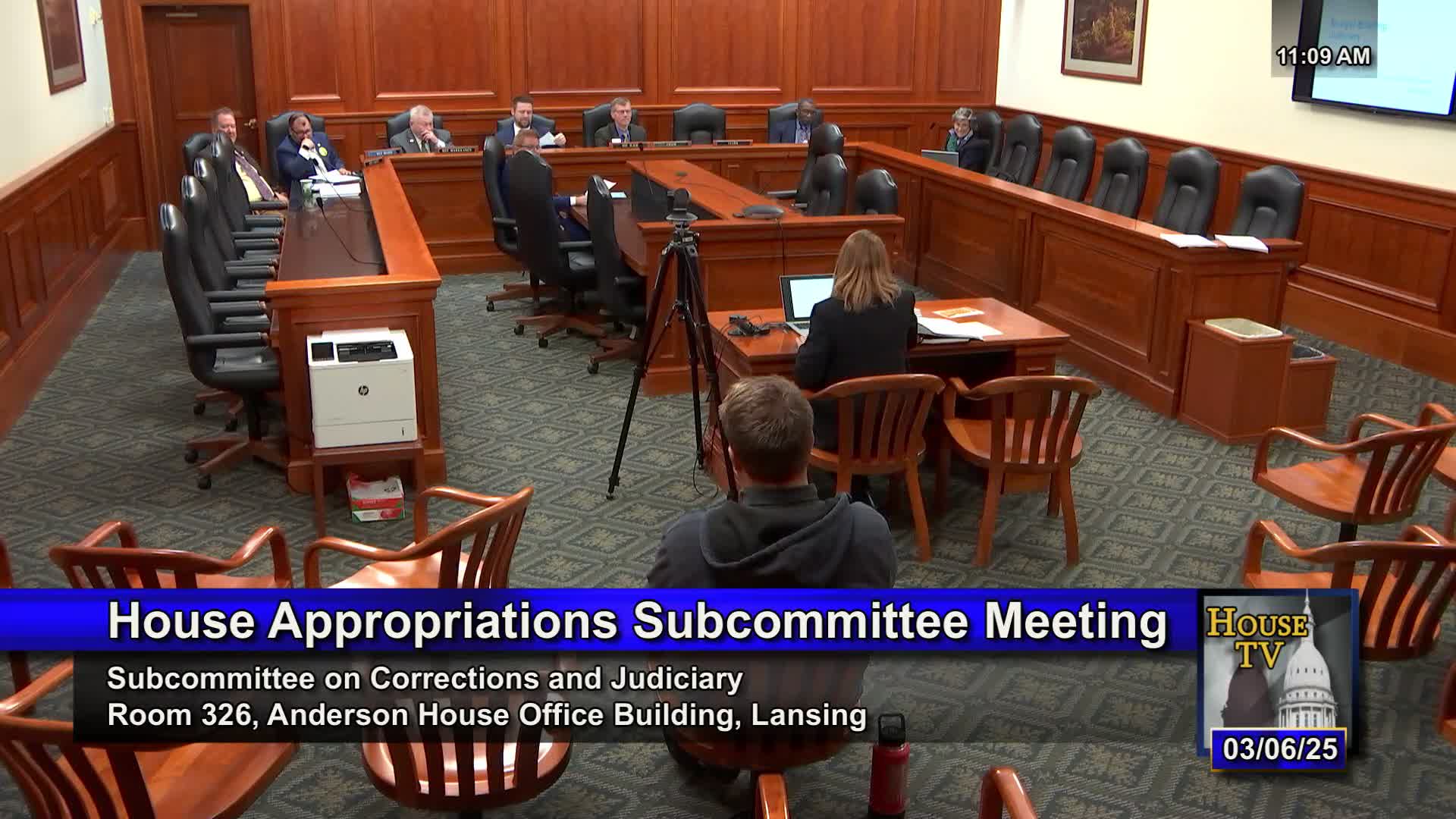
The House Appropriations Subcommittee on Corrections and Judiciary received a fiscal 2025 overview from House Fiscal Agency analyst Robin Risco showing a $373.4 million judiciary appropriation, with the largest share devoted to judicial salaries and grants for problem-solving courts.
Robin Risco, fiscal analyst with the House Fiscal Agency, presented the judiciary budget to the House Appropriations Subcommittee on Corrections and Judiciary, describing how the $373.4 million appropriation is distributed and why it differs from executive-branch budgets.
"The judiciary budget is a bit different from all other state departments' budgets," Risco said, noting the constitutional separation of powers and that the legislature appropriates funds but cannot direct judicial decisions.
Why it matters: The judiciary’s operating budget supports the Supreme Court, Court of Appeals, trial courts, judicial salaries and grant programs for local courts. Several grant programs fund problem-solving courts that provide community alternatives to incarceration.
Key items Risco presented include:
- Fiscal 2025 totals: $373,400,000 gross appropriations and $266,100,000 in general fund support. About 81% of the budget (roughly $302.2 million) supports justices and judges compensation, the Supreme Court and trial court operations.
- Fund sources: The budget is funded primarily with state general fund and state restricted funding. Notable restricted sources include the Court Equity Fund ($50.4 million), the Judicial Electronic Filing Fund ($12 million), the State Court Fund ($8.4 million) and the Juror Compensation Fund ($6.6 million). Federal grant funding totals about $7.1 million from multiple sources, the largest of which Risco said was Department of Health and Human Services grants.
- One-time and recent changes: Risco said fiscal 2023 included a one-time appropriation of $150 million to support a statewide judicial case management system; removing that one-time funding largely accounts for budget differences across years.
- Problem-solving courts and grants: The presentation listed appropriations for drug treatment courts (about $13 million), mental health courts (about $5.7 million) and veterans treatment courts (about $1.1 million), and noted that participation in grant programs is discretionary for local judges. Risco said there are about 134 drug treatment courts, 39 mental health courts and 27 veterans courts operating in the state.
Risco also reviewed statutory authorities governing judicial salaries, noting the State Officers' Compensation Commission sets Supreme Court justice pay and that the Revised Judicature Act of 1961 and later amendments determine salaries for other judges. Committee members asked clarifying questions about the federal highway-safety grant the analyst referenced; Risco said funds from the National Highway Traffic Safety Administration are targeted to drug treatment courts and impaired-driving programs.
No committee votes or formal actions on judiciary funding were taken during the meeting; Risco concluded the presentation and invited questions.