Get Full Government Meeting Transcripts, Videos, & Alerts Forever!
Get email alerts on the Budget topic
No spam. Unsubscribe anytime.
Chappaqua board reviews $144.4 million budget proposal that stays inside tax cap
Summary
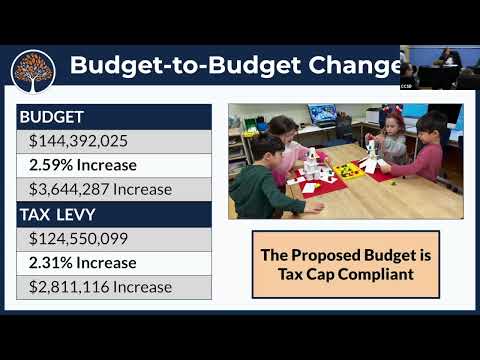
Board members reviewed a $144,392,025 proposed 2025-26 budget that the district says is tax-cap compliant, preserves class sizes K–6, adds several student supports and shifts more purchasing to BOCES while noting some state and federal funding uncertainties.
The Chappaqua Central School District Board of Education on March 5 reviewed a proposed $144,392,025 budget for the 2025–26 school year that district staff said keeps the levy within the state tax cap and preserves current class-size goals.
The proposal would increase the budget by 2.59 percent over this year and reflects a 2.31 percent tax-levy increase, district finance staff said. The district described the levy increase as within the legal tax-cap calculation and said other revenue sources — including projected increases in state aid and expense-based aid tied to BOCES purchases — are offsetting some costs.
Why it matters: The presentation lays out how the district plans to keep core programming stable while adding targeted services and capital priorities without exceeding the state property-tax cap. The budget vote is scheduled for May 20; board members and administration said detailed budget components will be presented at weekly March meetings leading up to adoption deadlines.
District staff framed the budget around three strategic questions: maintain instructional excellence while being fiscally responsible; ensure learning spaces support deep, collaborative work; and develop students’ ethical and social skills. Key features presented include funding for safety and communication upgrades, expanded elementary world-language offerings and new supports for student emotional health.
District highlights and assumptions - Total proposed budget: $144,392,025 (2.59% increase). District presenters described this as a tax-cap–compliant budget. The presentation identified an approximate $3.6 million increase over the prior year in headline figures shown to the board. - Tax levy increase: 2.31% (presenters said this is aligned with the tax-cap calculation used by the district). The district described the levy as being supported in part by increased state and expense-based aid. - Enrollment: projected net increase of about 9 students districtwide; minor shifts between specific schools (a small decline at Bell School and a slight increase at "Southern Bridges," per the presentation). - Debt service: projected to increase ~18.28% because of principal and interest from the 2023 bond; the district said it plans to offset part of that by reducing the transfer-to-capital line for one-year projects. - Salaries and benefits: described as the largest budget component (roughly 71.26% of expenditures) and rising slightly (salaries/benefits increase cited at roughly 2.87%). Health-insurance premiums were said to be rising about 3.9%. - BOCES: the district plans to purchase more services through BOCES (including technology services and wide-area-network/internet services) and expects to receive expense-based aid back in later school years; presenters cited a projected increase in BOCES aid (staff cited a figure of roughly 27% and estimated an expense-based aid line at about $1.866 million, but said exact numbers will be finalized as state and aid data arrive).
New or expanded programs noted in the presentation - Safety and security: upgrades to two-way radio (walkie-talkie) systems, phone systems, and a future security recommendation for the Education Center/Greeley main entrance (including paving and a guard-house project described as part of a capital schedule). - Instructional additions: additional elementary world-language staffing and support for the district’s International Baccalaureate (IB) conversations at the high school level. - Emotional/behavioral supports: a proposed Transitional Support Program (TSP) for the middle school (modeled on an existing high-school program) and additional AIS math supports for middle-school students. The TSP would include a social worker, a teaching assistant and rotating special-education teacher support and would be tied to the district’s multi-tiered system of supports. District presenters said Dialectical Behavior Therapy (DBT)-informed staff training is being expanded to support these students. - Partnerships: the budget includes continuing the district’s contract arrangement that provides an on-site confidential substance-support counselor at Horace Greeley High School; administration said the contract is renewed annually and is contingent on budget approval.
Revenue assumptions and uncertainties District presenters listed several items still subject to change: - State aid: the governor’s budget proposal included a sizable increase to foundation aid (the presentation cited a governor-proposed 8.66% increase), but presenters warned legislative changes could alter the final figure. They characterized the district’s current state-aid outlook as favorable for next year but said uncertainty remains beyond the coming year. - Federal funding: the district reported approximately $933,000 in federal grant funding (title and special-education grants); staff said those grants are currently allocated for next year but noted federal funding priorities are subject to change. - Transportation, special-education placements, assessed valuation and unallocated insurance costs remain uncertain and may affect final numbers. - The district said it expects to appropriate less fund balance than in the prior year and that restricted reserves have been rebuilt toward pre‑COVID levels, giving the district contingency capacity.
Board questions and public comment Board members asked for clarifications on the tax-base growth factor (presenters said recent residential construction in the district accounts for most of a 0.53% growth factor), BOCES purchasing strategy and plans for regional shared services. Presenters said some technology contracts have been transitioned to BOCES to realize future expense-based aid and that the district is exploring additional cooperative purchasing and shared services with neighboring districts.
Tim McNamara, a parent and resident, urged the board to ensure that adding new programs does not reduce instructional resources or increase class sizes in practice. "If our budget is lower compared to last year, how are we adding these new programs? Where are we finding the savings?" McNamara said, and asked the board to provide more granular class-size and median-based reports rather than averages.
What happens next District staff said they will present budget components in detail at weekly March meetings; a proposed budget for adoption is planned later in March and the public budget vote is scheduled for May 20. Administration encouraged residents with questions to contact district business staff and said summary and federal-funding details will be posted on the district website.
Ending: The board moved on to committee reports and a consent agenda after the budget presentation; no formal budget adoption vote occurred on March 5.