Get Full Government Meeting Transcripts, Videos, & Alerts Forever!
Get email alerts on the Corrections Budget topic
No spam. Unsubscribe anytime.
Corrections budget totals $2.1 billion; staffing and health care cited as main drivers
Summary
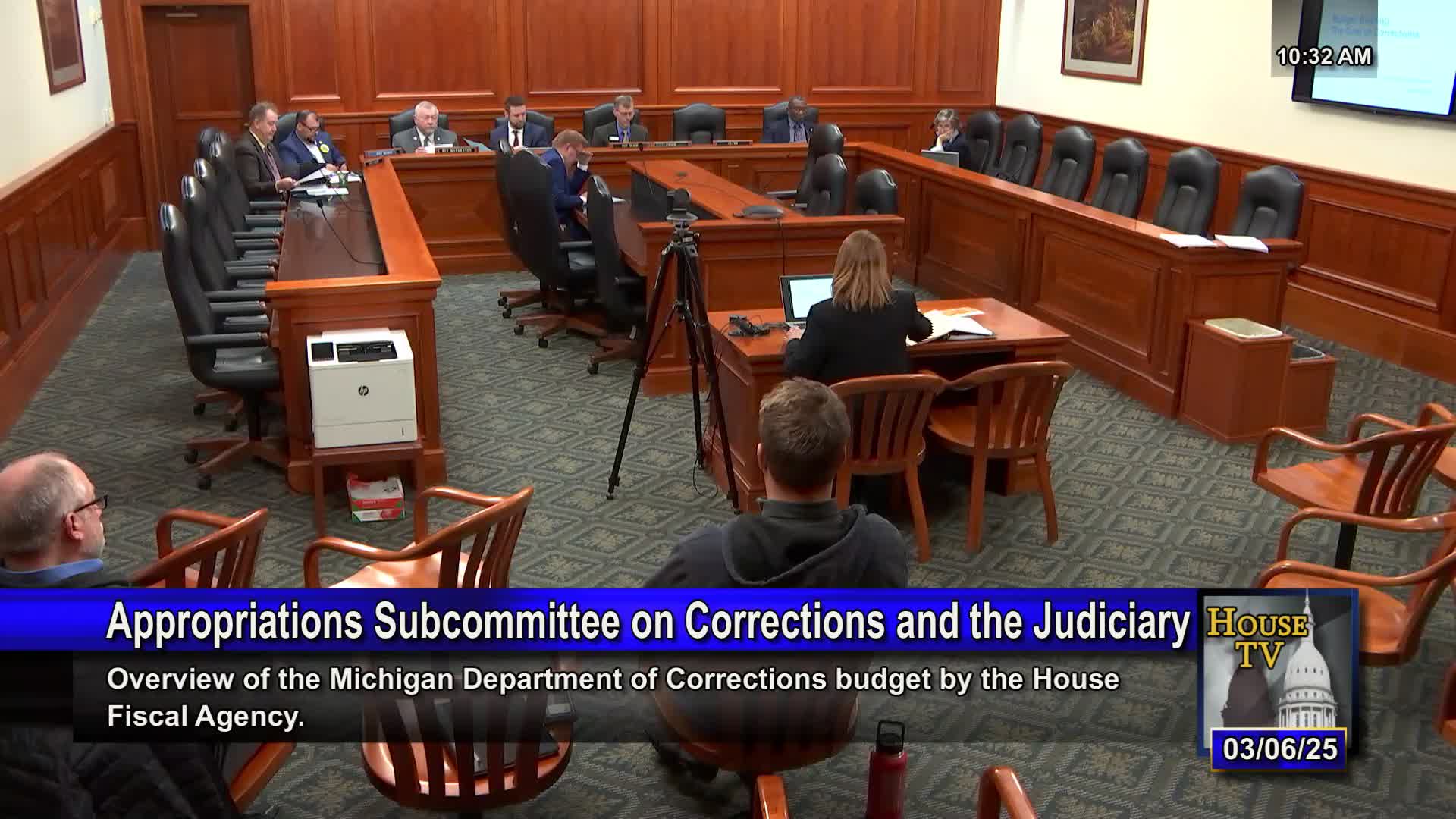
House Appropriations Subcommittee on Corrections and Judiciary received an overview from Robin Risco of the House Fiscal Agency showing a $2.1 billion corrections budget dominated by prison operations, heavy use of general fund dollars, large staffing vacancies and rising per-prisoner health costs.
Robin Risco, fiscal analyst with the House Fiscal Agency, told the House Appropriations Subcommittee on Corrections and Judiciary that the Department of Corrections’ fiscal 2025 budget totals roughly $2.1 billion and is financed predominantly by state general fund dollars.
The overview, presented at the committee meeting, said $1.7 billion — about 77% of the corrections appropriation — is devoted to prison operations, and that roughly 98% of the department’s budget comes from state general purpose revenue. "The budget is one of the bigger budgets," Risco said, adding that health care and employee costs are the largest components of budget growth.
Why it matters: Corrections consumes a substantial share of the state general fund and competes with other priorities such as higher education and social services. The department’s aging prisoner population and persistent staffing shortages place upward pressure on health-care and overtime costs.
Risco walked the committee through trends and figures in the department’s budget. Key points she reported include:
- Fiscal 2025 appropriations for corrections: about $2,100,000,000 gross with roughly $2,097,000,000 in general fund support; state restricted funds total about $33,500,000; federal grants about $5,200,000; local revenues about $11,700,000 (about $11.4 million from the city of Detroit for the Detroit Detention Center).
- Federal COVID relief: the department received approximately $1.8 billion in federal COVID-related funds across multiple years, which Risco said was used in part to offset general fund payroll costs.
- Staffing and vacancies: as of February 25, the department had roughly 2,239 total vacancies across classifications, including about 967.4 corrections officer vacancies and about 183.5 registered nurse vacancies. Risco said custody staff account for 93–100% of overtime hours; MDOC employees worked about 2,572,496 overtime hours in fiscal 2024, which the presentation estimated cost about $118,200,000 that year.
- Offender population and costs: as of Feb. 1, 2025, the department supervised about 73,397 people (32,574 of whom were incarcerated). Risco presented a fiscal 2024 estimated annual total cost per prisoner of roughly $46,000 when operational and health-care costs are combined; the daily operational per diem alone in fiscal 2024 was reported at $137.44.
- Population and health profile: Risco said about 52.1% of prisoners were over age 40 and 28.2% over 50 in 2024, contributing to higher health care spending. She reported about 201 active oncology patients, 86 prisoners in hospice care, 59 prisoners receiving dialysis, and roughly 100,000 prescriptions filled per month for about 21,000 prisoners.
Risco noted that changes in appropriations since fiscal 2021 included restorations of general fund dollars previously replaced by federal COVID relief, closure-related savings from shuttered facilities (for example, savings tied to closure of the Michigan Reformatory and parts of Gus Harrison Correctional Facility) and staffing-related adjustments.
Committee members asked follow-up questions about reimbursement to local ambulance providers for runs into facilities, the geographic definitions of expanded reentry "Prosperity Regions," and how the department fills clinical staffing gaps. Kyle (Department of Corrections staff) told the committee that Region 1 consists of the Upper Peninsula and that Region 4 is West Michigan anchored by Kent County; Regions 2, 7 and 8 run west to east across the state and include the southwest and capital regions. On contracted clinical staffing, Risco said the department does contract for nursing staff when civil-service positions are vacant and that contracted RNs/LPNs can cost roughly 17–19% more than comparable civil-service employees, with contract funding drawn from existing line-item dollars freed by vacancies.
No formal committee action or votes were recorded on corrections items during the meeting; Risco concluded her presentation and invited questions.