Get Full Government Meeting Transcripts, Videos, & Alerts Forever!
Get email alerts on the Poultry Ordinance topic
No spam. Unsubscribe anytime.
Commissioners adopt new poultry rule including 200-foot setback after contentious public comment
Summary
The Whitfield County Board of Commissioners approved new language to regulate large poultry operations, including a 200-foot setback and other standards. Supporters said the rules provide needed oversight; opponents said the standards could effectively ban large-scale chicken houses and harm farmers and neighbors.
The Whitfield County Board of Commissioners voted to adopt new regulations for poultry operations on March 10, approving Planning Commission language that includes a 200-foot setback from property lines and other development standards.
The ordinance language was presented by county staff and the Planning Commission as a starting regulatory framework for industrial-scale poultry operations. After debate, the board voted to accept the recommendation without imposing a moratorium on new permits.
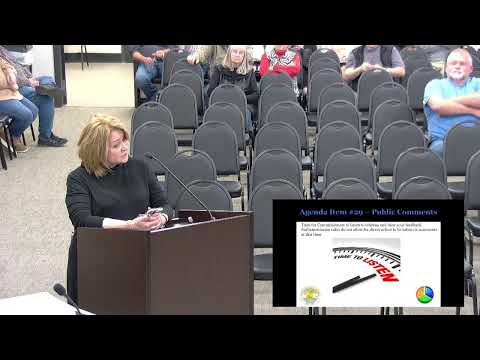
Residents and agricultural stakeholders filled the meeting to argue both sides. Greg Bates, a farmer who said he has chicken houses, walked commissioners through the practical effect of a 200-foot setback on parcel buildability. “If you have a square piece of property that’s 20 acres … when you set that back 200 feet off of each property line, you then have narrowed that 20 acres down. That leaves you 6.5 acres that you could build those chicken houses on,” Bates said, and he added that modern ‘‘roller houses’’ can be about 600 feet long and may not fit under the setback formula.
Opponents and neighbors said the proposed standards do not address all of their concerns. William Morgan, who lives on Mount Pleasant, urged a continuing technical review and suggested forming a working group that would include residents, county zoning staff and, if needed, state agencies to study impacts and recommend changes.
Several residents described health and quality-of-life effects they attribute to nearby poultry operations. Bonnie Hewitt presented video and photographs of airborne particles she said settled on homes near a poultry complex and urged commissioners to consider health impacts. Diane Stanley said a family member developed emphysema after decades near chicken houses and warned of respiratory risks.
Supporters of clearer rules told commissioners the county previously had no regulations specifically tailored to large poultry operations and that the new ordinance establishes baseline standards for setbacks, setbacks-based lot calculations, a special-use framework and limits on houses per parcel. Commissioners discussed a provision that, as written, sets an upper limit on the number of houses associated with a tract while acknowledging that parcel subdivision could be used to increase capacity in some cases.
After discussion the board voted to adopt the Planning Commission language without a moratorium; the clerk recorded the vote as passing 3-1. Commissioners said the ordinance can be amended in the future and that staff will return with clarifications if technical issues—such as fan placement, odor mitigation and setbacks that make conventional poultry buildings impracticable—require revisions.
County attorney and planning staff reiterated that rezoning and public hearing rules are governed by Georgia—s zoning procedures law and that a separate public hearing would be required to reopen any rezoning matter. Commissioners and staff urged residents to submit written comments and petitions for the official record.
The new provisions were described by commissioners as a first step intended to provide regulatory standards and a path for special-use review in the county’s agricultural areas. Residents who spoke opposed to the ordinance said they will continue pushing for tighter limits and technical controls on fan orientation, waste handling and odor mitigation.