Get Full Government Meeting Transcripts, Videos, & Alerts Forever!
Get email alerts on the Air Transportation topic
No spam. Unsubscribe anytime.
Metropolitan Topeka Airport Authority lays groundwork to restore passenger service, plans large hangar and flight academy
Summary
The Metropolitan Topeka Airport Authority updated the Topeka governing body on capital projects at Philip Billard and Topeka Regional (Forbes) airports and outlined a push to restore scheduled passenger service, including a revenue-guarantee strategy and grant-seeking.
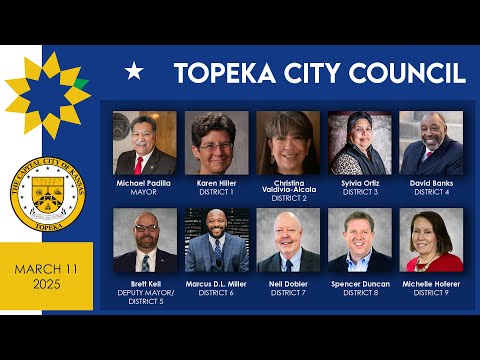
Mike Munson, a member of the Metropolitan Topeka Airport Authority (MTAA) board of directors, and Curtis Sneeden, the authority’s director of development, gave the governing body an annual update on March 11.
Munson and Sneeden described MTAA operations at Philip Billard Airport and Topeka Regional Airport (Forbes Field), and outlined projects intended to expand aviation-related business in the region. “We are looking forward to the establishment of a flight academy there at Billard,” Sneeden said, and the authority is pursuing construction of an 80,000-square-foot hangar at Forbes Field.
The MTAA said revenue comes mainly from property taxes and from tenant rent and fuel sales. The authority has been able to increase rental income and tenant activity through tenant outreach and by improving on-airport services at Billard, the speakers said. Munson noted new terminal food service at Billard and increased military traffic, while Sneeden described plans to replace aging fuel tanks at both fields and complete airfield work including a taxiway realignment at Forbes.
The authority’s headline initiative is a multi-pronged campaign dubbed “Get There From Here,” intended to lure a point-to-point carrier to restore scheduled passenger service at Forbes. Sneeden and Munson said airport staff and a consultant have data showing hundreds of Topekans daily drive to Kansas City International to fly to a small set of destinations; the MTAA’s pitch is that a route to one of those destinations would be patronized by local flyers. “We have data at our disposal now which makes it very clear that hundreds of Topekans every single day drive over to Kansas City so that they can fly to one of three places: Phoenix, Orlando, or Las Vegas,” Sneeden said.
Munson and Curtis described a funding strategy that includes an advisory committee, a community “buy-in” campaign, and pursuing both a small-community air service grant and a revenue-guarantee arrangement the airlines commonly require. Munson specifically named a consultant, “Jax Penny with Valaire,” whose report MTAA has engaged to support carrier negotiations. “One of the big components of this commercial service is what you hear. The buzz phrase is a revenue guarantee that the airlines command,” Munson said.
Board members and councilors asked about lessons learned from previous service attempts, whether Topeka could compete with Kansas City and Manhattan, and the choice between national network carriers and growing point-to-point carriers. Sneeden said the market has changed since earlier efforts and that MTAA will pursue smaller, point-to-point carriers that are adding routes. He said the authority will target carriers that serve destinations favored by Topeka travelers and emphasized community and corporate outreach to generate a base of riders. “Adding routes out of Topeka has a number of ramifications,” Sneeden said, adding that restoration of service could produce economic development and better access for conventions or sporting events.
Council members pressed for protections in any revenue-guarantee agreements. Councilwoman Hiller recalled earlier local experience where a carrier received payments despite cancellations; Sneeden said the consultant’s work addresses structuring agreements and monitoring carrier performance.
MTAA also outlined non-air-service projects including runway and taxiway work, terminal repairs and modernization, a planned new fuel farm at Billard, rehabilitation of hangars and maintenance facilities, and tenant-driven expansion of a flight school. The presenters said some capital work has been paid with federal grants such as the Airport Improvement Program or CARES Act funds and that the board has set aside funds for marketing a future commercial service launch.
The MTAA asked for council support in outreach to local businesses and stakeholders while it pursues grant applications and airline negotiations. No formal action was requested or taken at the meeting.