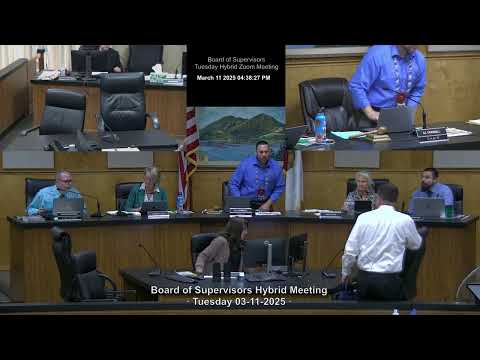
Lake County Air Quality Management District reports 35 years of attainment, details monitoring, permitting and burn-permit workload
Loading...
Summary
The Lake County Air Quality Management District reported it has met state air-quality standards for 35 years and described its monitoring, permitting and burn-permit operations, while the public urged the agency—s recommendations be made mandatory in some major-use permits and asked AQMD to reengage on commercial cannabis odor.
The Lake County Air Quality Management District updated the Board of Supervisors on the district—s mission, staffing, monitoring and permitting procedures, saying the district has 35 consecutive years of attainment for state air quality standards and is managing a growing workload.
Doug Garrett, the air pollution control officer, told the board the district has hired one new employee with another starting soon and described the agency—s mission: to regulate stationary sources of air pollution and protect public health. "2024 was our 35th year of clean air attainment," Garrett said, adding that attainment depends on state and federal standards and both natural and human-caused events.
Garrett described monitoring sites, including the main station in Lakeport, the Geysers monitoring program for hydrogen sulfide and portable particulate monitors used after wildfires. He said the district placed low-cost sensors at every school campus in the county to provide real-time data during wildfire and other events, and that some sensors need replacement due to limited lifespans.
On permitting, Garrett said the district reviews authority-to-construct applications and performs annual renewals. He said the district currently reviews about 670 permits each year during the renewal cycle and that permit renewals are requested starting Sept. 1 for permits that expire Oct. 31 and restart Nov. 1. Garrett also described the online burn-permit system (developed with CAL FIRE and South Lake County Fire and now run by the district) and said more than 1,400 online burn permits have been issued since the start of burn season; additional paper permits are issued in person for those without internet access.
Garrett described specific technical risks the district reviews during permitting. He gave an example of a commercial-size propane engine sited near a school that produced acute health-risk calculations far above the district—s permitting threshold: "The risk that was going to be over a hundred in a million. Our permitting threshold is 10 in a million for high risk," he said, noting those risks can block permitting. He also described work on the Clear Lake vent site and a filtration system that disperses emissions higher into the air.
Public commenters thanked the district for its work and urged stronger enforcement language. Tom Lasik told the board he had seen cases where interagency recommendations (for instance, to pave or chip-seal a high-traffic unpaved road) were made but not required by permit language; he urged agencies to use mandatory wording such as "shall include." Margo Kambara asked whether AQMD should re-engage on commercial cannabis permitting and odor control, noting that odor from outdoor grows can be persistent and has led other municipalities to litigation. Supervisor Owen said the odor issue merits further discussion with ordinance staff.
Garrett said office hours are Monday through Thursday, 9 a.m. to noon, with appointments available other times, and asked that burn requests call by 3 p.m. the day before or by 3 p.m. Friday for weekend burns so staff can review forecasts.
The board thanked Garrett for the update; no board action was required at the time of the presentation.