Get Full Government Meeting Transcripts, Videos, & Alerts Forever!
Get email alerts on the Pedestrian Safety topic
No spam. Unsubscribe anytime.
Titusville police present pedestrian-speed study; CRA asks FDOT to evaluate more flashing beacons and consistent signage
Summary
Commander Wright, Titusville Police Department, told the Community Redevelopment Agency on March 11 that the department conducted internal pedestrian and speed studies in January and February and shared counts, crash history and enforcement results.
Commander Wright, Titusville Police Department, told the Community Redevelopment Agency on March 11 that the department conducted internal pedestrian and speed studies in January and February and shared counts, crash history and enforcement results.
The presentation found relatively few historical crashes at the Julia Street/South Hopkins location over a 13-year period ("37 during that time frame," Wright said), and higher counts at Julia Street and South Washington Avenue (55 crashes over the same span, including two involving pedestrians). Wright summarized the department's data collection and recommended increased pedestrian signage and more rapid rectangular flashing beacons (RRFBs) in downtown unsignalized crossings.
Why it matters: the downtown CRA district includes several unsignalized crosswalks where board members said inconsistent signage and vehicle speeds create safety concerns for pedestrians, including seniors and people using mobility devices. The board voted to ask FDOT to evaluate additional beacons and to pursue consistent high-visibility pedestrian signage along the corridor.
Wright described the counts and speeds the department recorded. The department conducted two-hour visual counts on Jan. 23–24 at Julia and Washington (the daytime two-hour window on Jan. 23 produced 1,053 vehicles and 75 recorded violations). A traffic data collector deployed at Washington and Stephen House Way initially recorded one 24-hour sample of 9,309 vehicles (about 46% under 30 mph, 54% in the 31–39 mph range, and about 5% 10 mph over the limit). A later seven-day deployment (Feb. 8–15) recorded 56,612 vehicles with similar distributions: roughly 45% under the speed limit and 55% between 31 and 39 mph; about 5% were 40 mph or greater.
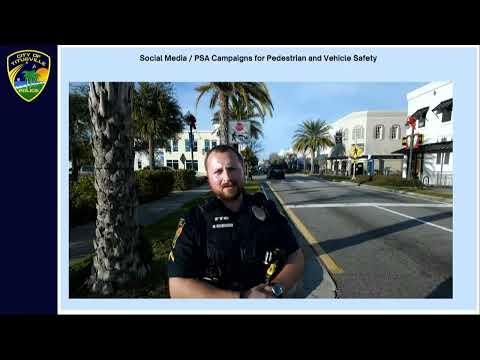
Wright and staff emphasized education before enforcement. The department ran a two-part outreach campaign: social media posts explaining RRFB use and a short enforcement operation conducted with BikeWalk Central Florida as part of Operation Best Foot Forward. Officer Rasmussen, Titusville Police Department Traffic Unit, recorded a short video used in the campaign and warned of penalties: "If you do get caught, it's a hundred and $169 fine and possibly 3 points in your license," he said in the posted message.
Commander Wright said crosswalks with RRFBs drew fewer violations than similar crosswalks without flashing beacons. He recommended (and provided examples of) installing state law signage that reads motorists must stop for pedestrians and placing "stop here for pedestrians" pavement markings at properly marked crossings.
After discussion and requests to identify priority unsignalized crossings, Member Ball moved that the CRA send a letter to FDOT requesting evaluations for RRFB installations at Pine Street (both directions), Palmetto (both directions), and the senior-tower crossing, and to request FDOT review consistency of pedestrian signage and the high-visibility yellow color. Member Nelson seconded. The motion passed on a voice vote.
Board members said they also supported more enforcement details, education and consistent sign color throughout downtown to improve pedestrian visibility. Wright said the police department will continue education and enforcement work in the CRA district and collaborate with staff on the FDOT request.
Next steps: staff will transmit the board's FDOT evaluation request per the motion; further changes (sign installation or beacons) will be subject to FDOT review and approval.