Get Full Government Meeting Transcripts, Videos, & Alerts Forever!
Get email alerts on the Stormwater Finance topic
No spam. Unsubscribe anytime.
County staff propose countywide stormwater service, four‑year rate ramp to fund ditching, culverts and short‑span bridges
Summary
Spokane County public works recommended expanding the stormwater service area countywide and phasing in a new fee over four years to fund ditching, culvert replacements and short‑span bridge work after recent runoff damage.
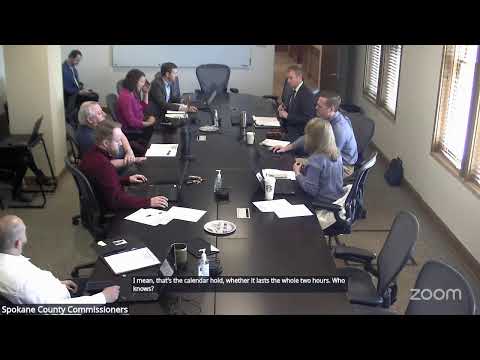
Spokane County public works staff recommended on March 10 that the county expand its stormwater service area to the entire unincorporated county and adopt a multi‑year fee schedule to finance a minimum countywide level of service for drainage, culvert maintenance and small bridge repairs.
Staff said the county’s current stormwater service boundary dates to the early 1990s and covers mostly urbanized areas; many rural roads, culverts and short‑span bridges remain outside that boundary and therefore have no dedicated stormwater revenue. After a March runoff event that caused multiple washouts, staff argued a countywide service and new fees would fund ditch cleaning, culvert clearing and replacements, targeted short‑span bridge work and staffing to meet NPDES permit inspection and enforcement duties.
The rate study and staff recommendation propose a minimum level of service applied countywide and a four‑year ramp from the initial recommended fee (roughly $4 per parcel equivalent in year one) to a target level of about $7 per parcel equivalent. Staff proposed gradual implementation to allow staffing ramp‑up and to avoid an immediate rate shock. At full ramp the program would generate about $10 million in annual revenue (staff estimate), while initial year collections would be under $6 million.
Public works staff said the new funds would enable a formal ditching program, a target completion rate for ditch/culvert maintenance of roughly 3% of the county road network per year, and a continuing program for small culvert and short‑span bridge replacements (replacement rate estimated at about 1% annually under the proposal). Staff emphasized that in‑house crews could perform many repairs more cheaply than contracting, and that a stable dedicated revenue stream would reduce the need to use the county road fund for emergency washout repairs.
Commissioners asked for more detail on permitted uses of the fee, examples of well‑drained shoulders vs. eroded roads, and exact current road fund transfers to emergency repairs; staff agreed to supply those numbers, a list of allowable expenditures, and the latest event cost estimates. No vote was taken March 10; staff proposed drafting two draft resolutions for public hearing (one to expand the service area and one to adopt the multi‑year rates) if the board wishes to proceed.
Staff said the county’s proposed fee would remain low compared with many peer Eastern Washington jurisdictions even after the increase. The county’s recommended target would keep Spokane County on the low end of regional stormwater fees while raising stable funding to address visible drainage problems and to protect road preservation budgets from one‑off emergency costs.