Get Full Government Meeting Transcripts, Videos, & Alerts Forever!
Get email alerts on the Transportation Traffic Calming topic
No spam. Unsubscribe anytime.
City releases draft traffic-calming policy for 14-day public comment; staff outlines warrants, measures and funding options
Summary
Salisbury’s transportation staff on Feb. 18 released a draft traffic-calming policy for 14 days of public comment that spells out warrants, a petition threshold, ranking and proposed physical and nonphysical measures for slowing traffic on city streets.
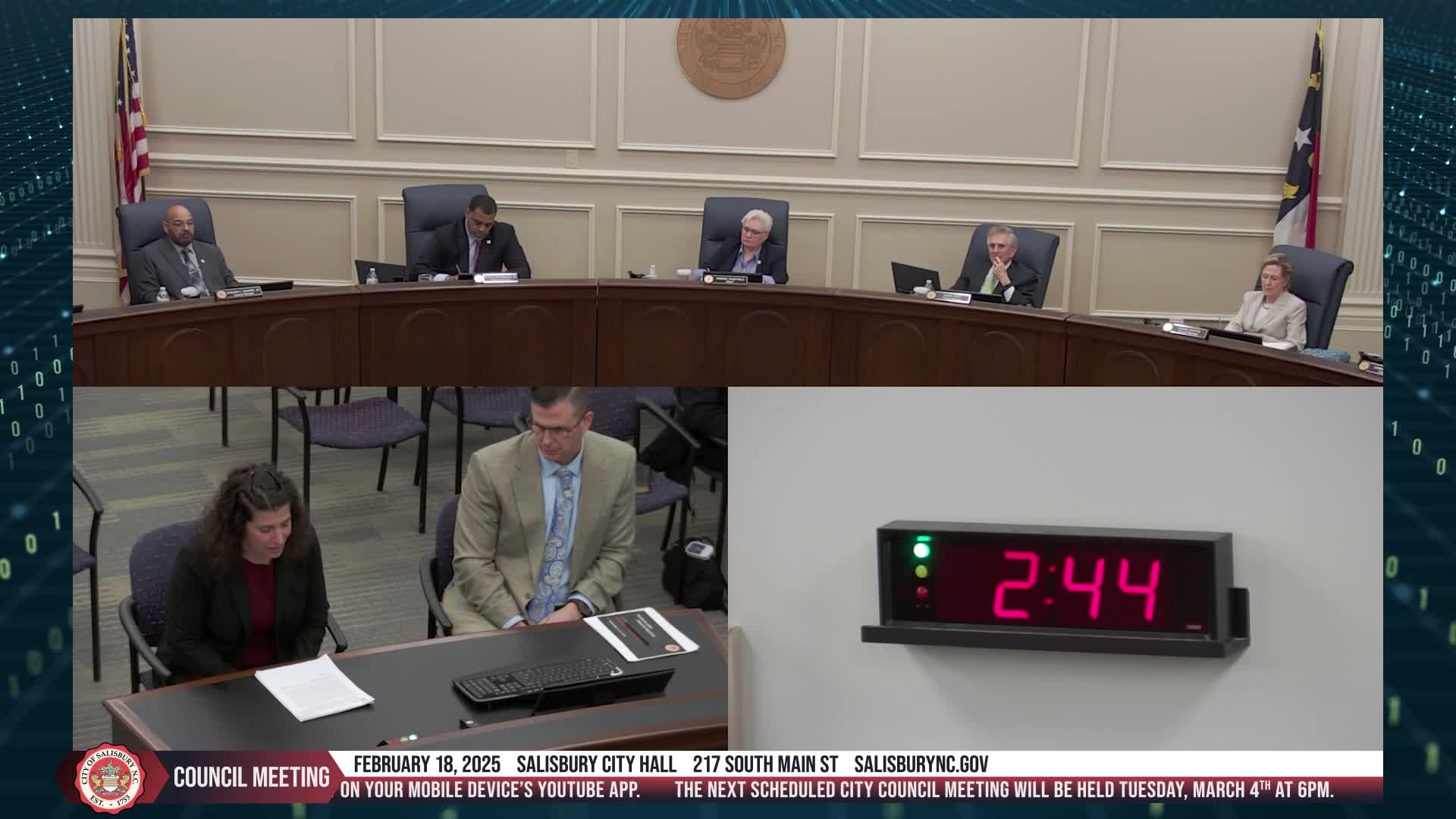
The City of Salisbury’s transportation staff introduced a draft traffic-calming policy to the City Council on Feb. 18 and opened a 14-day public comment period.
Transportation Director Jared Mathis and traffic engineer Victoria Trexler presented the draft policy, which establishes purpose, objectives, warrants, procedures, funding mechanisms and implementation steps for traffic calming on city streets. The policy applies to city-maintained local streets (not NCDOT roads or private streets), requires that candidate streets have a posted speed of 35 mph or less and a one-hour average speed above 30 mph, and requires at least 100 vehicles in that hourly period for a study to proceed. The draft also restricts consideration of traffic-calming measures on primary emergency or transit routes.
Under the proposed process, residents may submit a traffic-calming request form (appendix A) and must submit a petition with signatures from 75% of affected property owners on the street to initiate staff evaluation. Staff will collect traffic counts, speed data and crash history, coordinate with public safety (police and fire), and use a ranking system to prioritize projects. If warrants are met, staff will present cost estimates and designs to council; nonphysical measures (education and enforcement) are required prior to installation of physical devices in many cases.
The draft policy lists both nonphysical measures (education, enforcement, temporary digital signage) and physical engineering measures (temporary and permanent speed humps, speed cushions, traffic circles, chicanes, raised crosswalks, curb extensions) and includes estimated cost ranges; staff said temporary devices can be used to pilot responses before committing to permanent infrastructure. Funding options discussed include general-fund appropriations, special assessments, and private funding from neighborhoods with rules for cost timing (90% prior to advertisement, 100% 30 days prior to council approval) if residents wish to accelerate installation.
Council members asked procedural and public-safety questions: staff said police and fire would be consulted during evaluation and that public-safety concerns (response times, apparatus access) would be weighed before approving devices like speed humps. Staff noted the policy is a draft and sought council feedback; Jared Mathis said the draft will be posted on the transportation website and the two-week public comment period begins immediately.
No formal action was taken; staff requested public feedback and will return later with revisions and recommendations based on public input and internal review.