Get Full Government Meeting Transcripts, Videos, & Alerts Forever!
Get email alerts on the Transportation Sales Road Development topic
No spam. Unsubscribe anytime.
Residents warn Sales Road traffic will worsen if 94-home development proceeds; city to pursue further analysis
Summary
Residents told Salisbury City Council that a newly annexed 27.6-acre, 94-home development on Sales Road would worsen existing backups at the Sales Road/Highway 601 intersection and near North Hills Christian School, and city staff said they will continue coordinating with NCDOT and pursue additional study of school drop-off queuing.
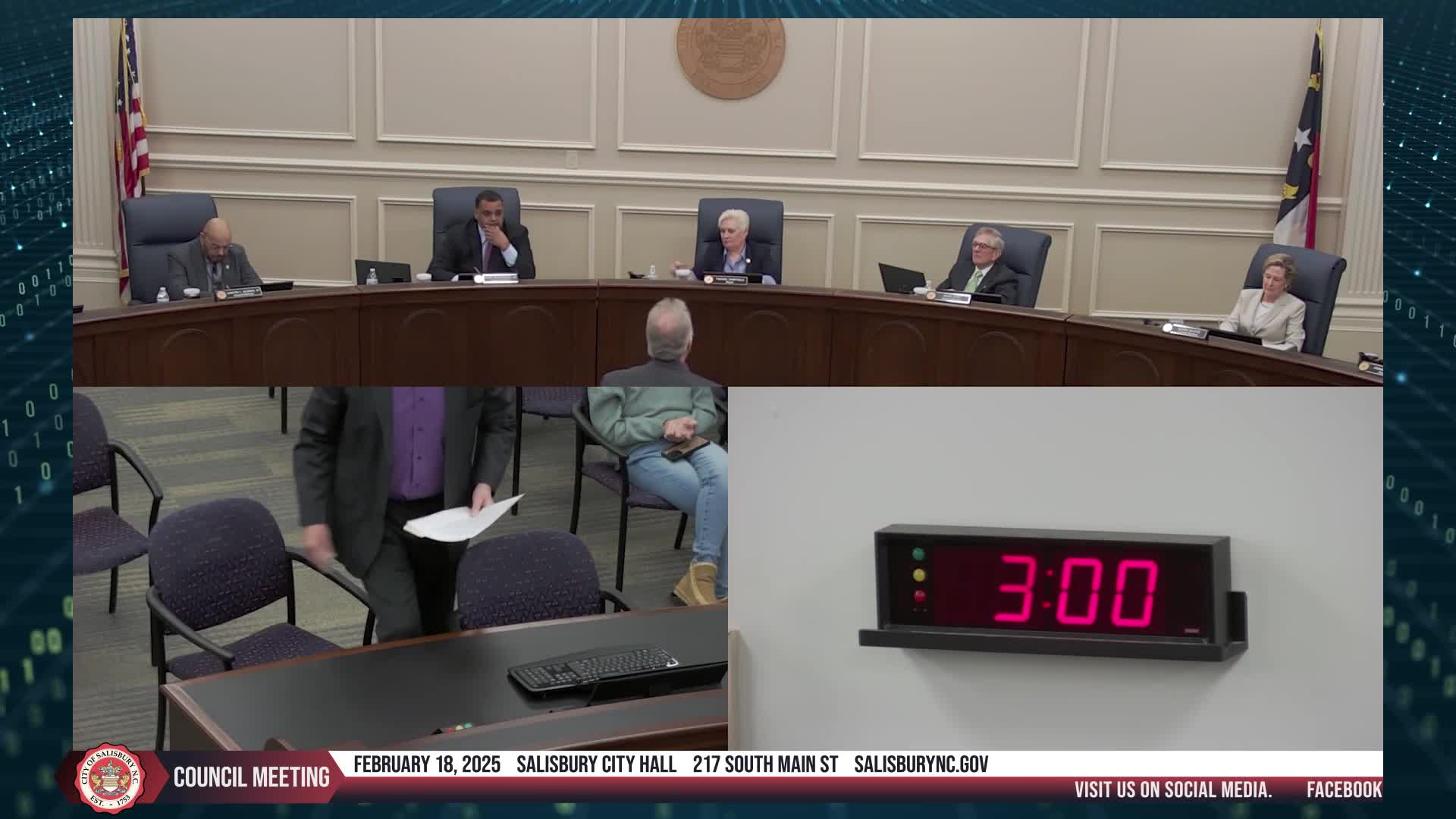
Residents from neighborhoods near Sales Road told the Salisbury City Council on Feb. 18 that a recently annexed 27.6-acre subdivision planned for Sales Road will sharply increase dangerous traffic conditions at the Sales Road/Highway 601 intersection and near North Hills Christian School.
The concern was raised by several speakers, including Tim Norris of 485 Sales Road, who said the road “was not built to handle high density traffic” and that “traffic currently backs up from the intersection of 601 to Windsor Drive” during school drop-off and pick-up. Leanne Norris, who also lives on Sales Road, told the council she calculated daily trip estimates using Bureau of Transportation and household-car assumptions and said those figures could be “over double the projection” presented by the developer’s consultant.
City staff responded that the development was approved through annexation and is a by-right project in the city’s extraterritorial jurisdiction. City Manager Jim Green said the zoning allows the development by right but that transportation staff have been evaluating issues and working with the North Carolina Department of Transportation. Transportation Director Wendy Bridal confirmed Sales Road is an NCDOT-maintained road and that the project did not trigger a full traffic impact analysis under current ordinance thresholds, meaning a complete TIA was not required by code. Bridal said: “A full traffic impact analysis was not done” and added staff had not specifically studied school drop-off queuing.
Bridal and the city’s traffic engineer, Victoria Trexler, described the trip-generation assumptions used for staff evaluations. Trexler said the Institute of Transportation Engineers trip generation rates were applied; staff presented estimates ranging from “right under a thousand” to “about 1,600 or so trips per day” from the 94-home plan, with staff conservatively assuming roughly 80% of generated trips would route toward the 601/Sales Road intersection during peak periods. Bridal said the city has spot evaluations at key intersections and that the level of service for intersections, using the ADT assumptions, “does remain acceptable,” but she acknowledged the study did not specifically analyze school queuing times.
Speakers warned the existing backups are already creating safety risks for neighbors and students. Carl Arthur, who described daily school-run backups, urged the council to make a traffic study mandatory. Several residents asked the council to require a broader study that includes nearby subdivisions—Country Club Hills, Oxford Downs, and others—that may add traffic by routing through Sales Road corridors.
City staff said they will continue coordinating with NCDOT and can seek DOT funding to study school queuing. Bridal noted DOT may have funds for a school queuing study and that the city can perform in-house counts to provide data for DOT. City Manager Jim Green said the city will follow up with attendees and the police department and that staff will continue evaluating the road impacts with DOT.
Clarifying details provided in the meeting: the developer’s plans presented to DOT and the city assumed 94 single-family homes; staff used ITE trip-generation tables to estimate roughly 900–1,600 new daily vehicle trips depending on assumptions; Sales Road currently carries about 4,000 vehicles per day (ADT) on DOT counts. Bridal said some prior projects were required to provide neighborhood access improvements, and the city has requested Moxville Avenue upgrades through the STIP process but that the project previously scored low and is not planned this year.
The council did not take formal action on the matter at the Feb. 18 meeting. Staff committed to follow up with residents, explore potential DOT-funded studies of school queuing, and continue coordination with NCDOT and the developer’s engineers.
The issue arose during public comment and during council staff discussion of ongoing annexation and transportation coordination; no rezoning or construction authorization was decided at the meeting.