Get Full Government Meeting Transcripts, Videos, & Alerts Forever!
Get email alerts on the Library Oath topic
No spam. Unsubscribe anytime.
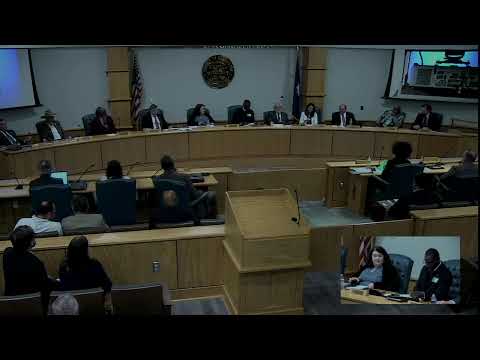
Charleston County council votes to require county boards and commissions to take constitutional oath after heated public comment
Summary
CHARLESTON, S.C. — Charleston County Council voted 5–4 Tuesday to require members of county boards and commissions to take the oath of office to the South Carolina and U.S. constitutions in conformance with the state Attorney General's opinion, after more than an hour of public comments and extended council debate.
CHARLESTON, S.C. — Charleston County Council voted 5–4 Tuesday to require members of county boards and commissions to take the oath of office to the South Carolina and U.S. constitutions in conformance with the state Attorney General's opinion, after more than an hour of public comments and extended council debate.
The action came after roughly 15 residents and community members addressed the council during the public-comment portion focused on the Charleston County Public Library and its trustees. The council's final directive instructs county boards and commissions to administer the constitutional oath; council members said the requirement is intended to match the Attorney General's legal interpretation and to provide uniform guidance for county-appointed officials.
Why it matters: The vote responds to a public controversy over whether Charleston County Library Board of Trustees members must take a constitutional oath. Speakers from across the political spectrum urged the council to either protect local control and avoid politicizing the library or to require a formal oath of loyalty to constitutional duties. Council members also debated whether the South Carolina General Assembly should settle the issue statewide rather than the county acting alone.
Public comments emphasized the library's role in the community. Resident Adrienne Lett said the push for an oath was "nothing more than the latest political ploy" and urged council not to force trustees to take an oath "they are not required to take." Darlene Jackson Thompson, who identified herself as a 32-year library employee and former chief deputy director, said the library and its executive director have "excelled in serving all Charleston County residents" and warned that the move could undermine local control. Joshua Ferguson, who identified his address to the council, said "the board is not a political arena" and called the oath requirement political overreach. Resident Carlton Walker, a veteran, urged the council to require the oath, recounting his military experience and describing the oath as a solemn civic act.
Council debate focused on two competing motions. Council member Boykin moved for indefinite postponement to allow the General Assembly to act; that motion failed on a roll call vote (4 ayes, 5 nays). After further discussion, Council adopted a motion that "all boards and commissions of Charleston County say the oath in conformance with the Attorney General's opinion." That motion passed 5–4. The council's roll-call votes and final tallies were recorded in the meeting minutes.
Several council members urged deference to the General Assembly, noting Representative Tipple (House District 116) had filed a budget proviso and planned legislation intended to clarify the state's requirements for all counties. Council member Boykin said the proviso could create a statewide statutory mandate and that council's action should be handled uniformly across South Carolina. Other members, including Vice Chair Kobrowski and several veterans speakers, argued the Attorney General's opinion already identified trustees as officers under Article VI of the South Carolina Constitution and that county boards should follow that guidance now.
What council decided: The council's motion requires county boards and commissions to take the oath consistent with the Attorney General's opinion. The council did not suspend any board members during the meeting, and members of the library board were not removed at the meeting. The motion does not, by itself, change state law; several council members said they expected the General Assembly to act on a broader statutory clarification.
Distinguishing discussion from decision: Much of the evening's remarks from residents were framed as public comment and not as council directives. Council members explicitly separated their deliberations (including a failed motion to postpone) and the final binding action (the 5'to'4 vote requiring the oath). Several speakers emphasized the distinction between a personal willingness to take an oath and a formal county requirement.
Next steps: Council members noted the General Assembly may act via the filed proviso or a statute; if the state enacts a law, it would apply statewide and supersede local practice. Council staff or the county attorney did not announce an implementation timetable at the meeting. The county clerk's minutes and the official roll-call record list the motions and vote counts.
Ending: The library issue dominated public comment and produced a close council vote; council members and residents left the meeting with differing views on whether the action should be a county-level decision or a matter for the state legislature.