Get Full Government Meeting Transcripts, Videos, & Alerts Forever!
Get email alerts on the Land Use Zoning Appeal topic
No spam. Unsubscribe anytime.
Chesapeake Beach Board of Appeals continues deliberations in Rod and Reel/Donovan Estates site-plan appeal
Summary
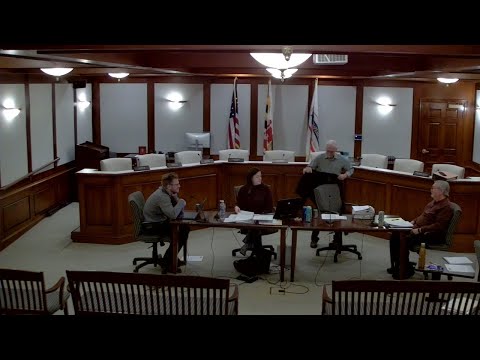
CHESAPEAKE BEACH, Md. — The Chesapeake Beach Board of Appeals on March 6, 2025 resumed deliberations in Case 20 23 0 3, an appeal by Rod and Reel Incorporated and Donovan Estates LLC asking the board to require the zoning administrator and the Planning and Zoning Commission to process site plans submitted on Jan. 29, 2021 under the zoning code in effect at that date.
CHESAPEAKE BEACH, Md. — The Chesapeake Beach Board of Appeals on March 6, 2025 resumed deliberations in Case 20 23 0 3, an appeal by Rod and Reel Incorporated and Donovan Estates LLC asking the board to require the zoning administrator and the Planning and Zoning Commission to process site plans submitted on Jan. 29, 2021 under the zoning code in effect at that date.
The issue matters because the appellant contends officials failed to apply the 2021 zoning ordinances when the town later adopted a moratorium and new zoning measures; the appeal asks the board to "order the zoning administrator and planning and zoning commission to immediately commence and prioritize the processing and review of the relevant site plans" and to apply the ordinances in effect Jan. 29, 2021.
Board members said they were concentrating on discrete, administrable questions rather than broader council actions. Chair Jody Hoon Star opened the session by confirming attendance and scheduling additional deliberation dates, saying, "we have a quorum." The board reserved two further meetings for additional deliberation: March 17 and March 31, both at 6:30 p.m., each for up to two hours, to allow the boardand legal counsel time to prepare a written resolution.
During more than two hours of discussion the board repeatedly returned to three factual and legal inflection points: the zoning administratorFebruary 5 letter (commonly referred to in the record as the Jakubiak letter), the town councilmoratorium timing and extensions, and a later exchange in May 2022 in which Town Attorney Todd Pounds responded that the moratorium remained in effect. The board also discussed a letter from a third party, identified in the record as "Blitz," requesting the Planning and Zoning Commission resume review after the comprehensive plan was adopted.
Members summarized the contested timeline: site-plan submissions on Jan. 29 (transcript shows uncertainty between 2019 and 2021), a February 5 administrative letter, a council moratorium that was described as temporary, extensions of the moratorium, formal lifting of the moratorium in March 2023, and the towncomprehensive plan adoption on April 21, 2022. The appellant filed an appeal application on June 24, 2022, according to the transcript. Board members said the record before them contains multiple ambiguous actions and nonactions and that the board must identify a concrete administrative "decision, order or determination" by the zoning administrator or the Planning and Zoning Commission before it can rule on an alleged error of interpretation of the zoning chapter.
Board members discussed whether the February 5 letter constituted an appealable decision. Legal counsel (referred to in the record as Fred) flagged a potential interpretive defense the town could raise, telling the board that "it could be argued that the 60 days was directory and not mandatory because there was no sanctions for failure to comply with that 60 day time frame." Members noted that even if a 60-day processing target applied to site plans in critical areas, the moratorium began before that deadline expired, which complicated any claim that the administrator or commission violated a mandatory timeline.
Members also spent significant time on the timeliness requirement for filing an appeal. The code sections they reviewed include two different appeal-time provisions cited in the transcript: a five-day provision for some site-plan decisions and a 30-day provision specific to appeals to the board. The board agreed this issue is central but left a final reading for a future session, instructing members to return with written questions and suggested timelines.
The panel repeatedly emphasized limitations on the Board of Appealsauthority. Several members said their proper role was to assess whether an administrator or the commission committed an error in interpreting the zoning chapter, not to second-guess council resolutions or ordinances. As one board member put it, the boardshould "look at those points where a decision or action was made and whether that resulted from a misinterpretation of the code." Another member warned against a "domino effect" in which a finding of error would be used to overturn actions outside the board's jurisdiction.
The board did take one formal action at the start of the meeting: it approved meeting minutes for this case in bulk (minutes for Oct. 21, 2024; Jan. 15, 2025 open and closed sessions; and a Feb. 3 special meeting). A motion to approve the minutes was made and seconded and carried by voice vote; no roll-call tally was recorded in the transcript.
No final determination on the underlying appeal was made at the March 6 meeting. The board set follow-up tasks for members: circulate a list of specific legal and factual questions (timeliness, identification of an administrative decision, whether an appeal was properly filed and accepted), review key exhibits (the Jakubiak Feb. 5 letter, the May 20/May 25, 2022 exchange, the comprehensive-plan adoption and related implementing ordinances), and reconvene on the announced dates.
"If we decide there was an error, just us determining the error would be where we stop," one member said, summarizing the group's view that the board's role is to find error, not to implement remedies beyond its statutory authority.
Next steps: the board will resume deliberations at the March 17, 2025 session (6:30 p.m.) as a standing tentative date; members were asked to submit and consolidate lists of questions before that meeting. No timeline or remedy was adopted at the March 6 session.