Get Full Government Meeting Transcripts, Videos, & Alerts Forever!
Get email alerts on the Public Safety Volunteer Fire topic
No spam. Unsubscribe anytime.
Committee Gives Due‑Pass to Bill Offering Job Protections for Volunteer Firefighter Training; Members Cite Small‑business Burden
Summary
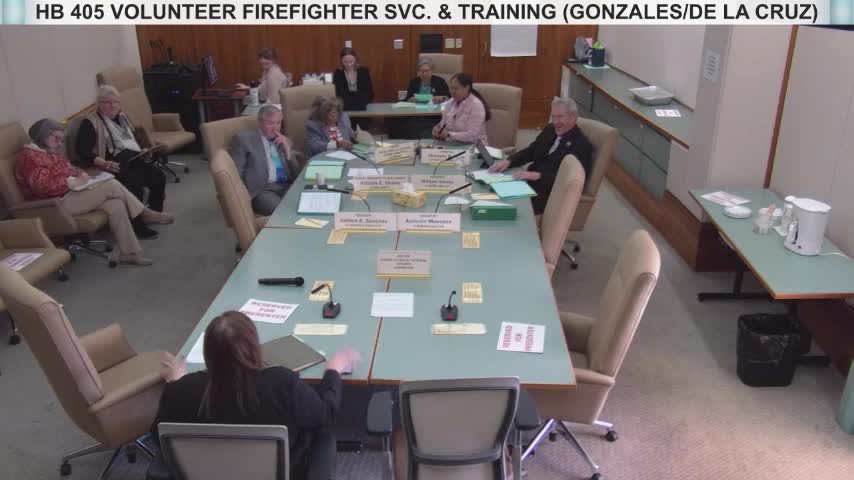
House Bill 405, introduced to provide job protections for volunteer firefighters attending training and service, received a due‑pass recommendation after committee debate about recruitment benefits and costs to small businesses; committee vote recorded as 2‑1‑2.
Representative Gonzales presented House Bill 405, which would provide job protections for volunteer firefighters for training and in‑service time, modeling the status as a public‑service leave similar to jury duty or military leave.
The measure is intended to help rural volunteer fire departments recruit and retain personnel by protecting volunteers’ regular jobs when they attend mandatory or multi‑day training, sponsors said.
"House Bill 405 ... essentially provides job protections for our volunteer firefighters in our rural communities," Representative Gonzales told the committee. Gonzales said the bill would let volunteers give notice to employers and preserve their positions for training periods and service calls.
Committee members raised concerns about the financial and operational cost to small businesses when an employee is away for training. One senator characterized the proposal as imposing an ongoing cost on small employers and contrasted it with jury duty, which is intermittent; that senator said the expense of covering a missing employee would fall to the small business.
Gonzales responded that the bill does not create paid leave and that the intent is to treat volunteer firefighter service as a public duty, like military leave or jury duty, and to encourage employers to accommodate training schedules through flexible options such as nights, weekends or virtual instruction. The sponsor said some training can require multiple days and that rural departments sometimes need multi‑day or out‑of‑area courses to meet ISO or safety standards.
A committee member asked about the typical length of classes; the sponsor said a common Level 2 or basic EMS course can be up to five days and that exact training needs vary by department and chief. The sponsor also noted the bill would not affect federal employees.
The committee recorded a due‑pass recommendation for HB 405 with a roll‑call tally reported as 2 yes, 1 no, 2 excused. The transcript records debate over recruitment and retention benefits weighed against the burden on small employers; no appropriation or reimbursement mechanism for affected businesses was discussed in the hearing excerpt.