Get Full Government Meeting Transcripts, Videos, & Alerts Forever!
Get email alerts on the Auto Insurance Uim Offsets topic
No spam. Unsubscribe anytime.
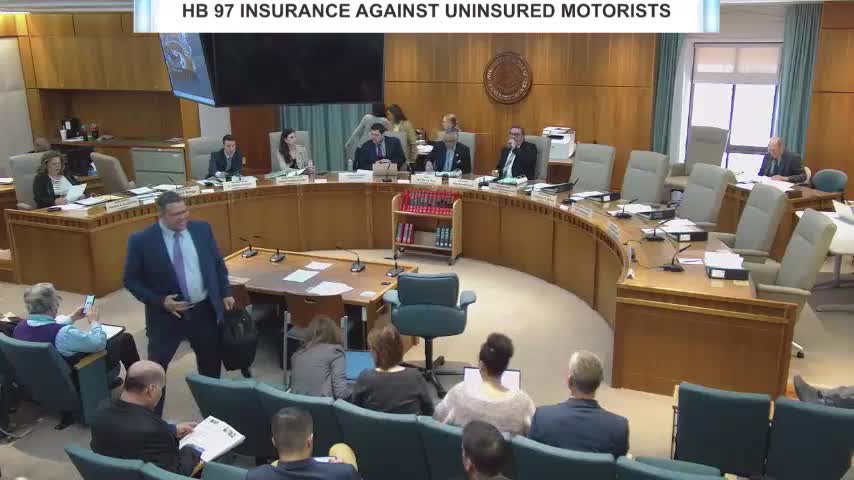
Committee hears HB97 to stop insurers offsetting underinsured motorist benefits; bill advanced after roll call
Summary
Representative (sponsor) introduced House Bill 97, which would prohibit insurers from offsetting a policyholder—s underinsured motorist (UIM) benefit by the at-fault driver—s liability limits, and walked members through handouts showing scenarios and projected premium impacts.
Representative (sponsor) introduced House Bill 97, which would prohibit insurers from offsetting a policyholder—s underinsured motorist (UIM) benefit by the at-fault driver—s liability limits, and walked members through handouts showing scenarios and projected premium impacts.
The sponsor and counsel described the current practice: a motorist who carries $25,000/$50,000 UIM coverage may effectively receive nothing when an at-fault driver carries only the state minimum liability because insurers are allowed to offset the UIM by the at-fault driver—s liability. The bill would remove that offset so that a policyholder—s UIM coverage can make up the difference between damages and the other driver—s liability limit.
Christian Myers, chief actuary at the Office of the Superintendent of Insurance (OSI), summarized data from private rate filings and third-party studies. Myers said the analysis was vehicle-based: about 90% of insured vehicles in the state already carry UIM and therefore would see no per-vehicle rate change under the bill; 7% of insured vehicles would see an estimated 16% increase on the modeled premium; and roughly 3% of insured vehicles that now carry only minimum liability would see a modeled 43% increase. Myers and the sponsor emphasized the analyses applied only to insured vehicles and do not include the estimated 24.9% of vehicles that experts estimate currently have no insurance.
Committee members asked whether the bill would mandate purchase of UIM for every vehicle, whether insurers would compete to lower prices, and whether the state has the enforcement tools to ensure the uninsured obtain coverage. Members also pressed OSI for the basis of the vehicle-level statistics and how households with multiple vehicles would be affected. Myers said the office—s data came from rate filings and the Insurance Information Institute—s periodic uninsured motorist studies; he acknowledged limits in the data, particularly household-level stacking details.
Several members, including Representative Armstrong and Representative Dow, said they supported fixing the offset but opposed a mandate requiring every vehicle to carry UIM; they warned the premium increase for low-income or liability-only drivers could prompt some to drop insurance and increase the uninsured rate. Others said removing the offset is necessary so insured drivers receive the coverage they paid for. The sponsor said she was willing to continue discussions about removing the offset and potential amendments to the mandate.
At the close of the hearing members moved the bill. The committee took a recorded roll call; after votes and an explanation from Representative Lundstrom the sponsor said she would pursue amendments going forward. The transcript shows multiple recorded yes and no votes during the roll calls; members who spoke during debate noted the bill—s focus is twofold: (1) end offsets, and (2) add a vehicle-level mandate under current draft language.
No changes to statutory citations were introduced on the record; testimony repeatedly referenced the state—s minimum liability levels of $25,000 per person and $50,000 per accident as the baseline used in the bill—s examples. The record did not include a final enacted-text amendment or a court or statutory citation beyond the numeric coverage examples.