Get Full Government Meeting Transcripts, Videos, & Alerts Forever!
Get email alerts on the Water Quality topic
No spam. Unsubscribe anytime.
Committee approves bill to give New Mexico control of surface-water permitting, creates cleanup fund
Summary
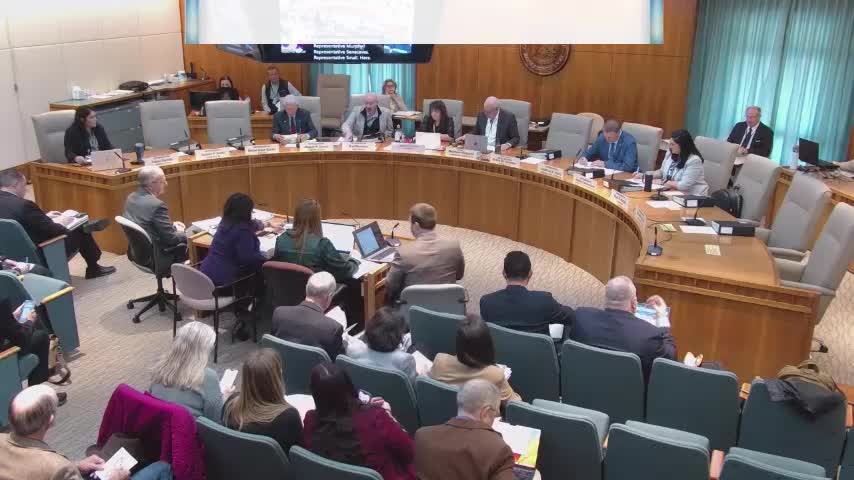
Representative Ortez and Senator Wirth asked the House Energy, Environment and Natural Resources Committee on March 11 to recommend passage of a Judiciary Committee substitute for Senate Bill 21, a measure that would authorize the New Mexico Environment Department to seek state administration of Clean Water Act permitting and create a state cleanup mechanism for contaminated groundwater sites.
Representative Ortez and Senator Wirth asked the House Energy, Environment and Natural Resources Committee on March 11 to recommend passage of a Judiciary Committee substitute for Senate Bill 21, a bill that would move New Mexico toward state administration of Clean Water Act permitting and create a state mechanism to clean up contaminated groundwater sites.
The bill would direct the Water Quality Control Commission to adopt rules for a state surface-water permitting program and authorize the New Mexico Environment Department (NMED) to apply to the U.S. Environmental Protection Agency for NPDES primacy. "This bill takes some really important steps to make New Mexico give New Mexico control over our own water resources," Representative Ortez told the committee. "We are one of only three states in the entire country that does not have its own surface water permitting program."
The measure also amends the state Water Quality Act to cover surface waters that the U.S. Supreme Court narrowed in Sackett v. EPA (Feb. 2023). Senator Wirth said the Sackett decision "dramatically narrowed the scope of the Clean Water Act" and left roughly 95% of New Mexico stream miles without federal coverage; the bill would extend state permitting and cleanup authority to many intermittent and ephemeral waterways previously treated as federally protected.
Why it matters: supporters said the change returns New Mexico to the regulatory posture it operated under from 1972 until the Sackett decision. Opponents said the state may lack staff and stable funding to administer the program and warned of cost and permitting impacts for industry and local governments. "We fear county governments and other subdivisions of government will become targets of suits," said Howard Hutchinson, who testified in opposition, and urged caution on the pace of rulemaking.
Key provisions and context
- Primacy and rules: The bill would require the Water Quality Control Commission to adopt rules implementing the state NPDES program; NMED would then apply to EPA for authorization to administer NPDES in New Mexico. Jonas Armstrong of NMED described a multi‑year stakeholder process NMED convened and said the department expects a multi‑year buildout of staff and rules.
- Backfilling the Sackett gap: Sponsors said the bill is intended to "fill the gap" created by the Supreme Court's 2023 ruling by amending the state Water Quality Act so that discharges to intermittent and ephemeral streams (arroyos) and other surface waters remain subject to state permitting and cleanup requirements.
- Cleanup fund and liabilities: The bill aligns state cleanup authority more closely with federal Superfund (CERCLA) liability provisions, clarifies financial liability for contamination, and establishes a fund to clean up neglected groundwater contamination from sources named in testimony (dry cleaning, uranium mining, PFAS, petroleum). Sponsors pointed to $50,000,000 included in House Bill 2 for initial cleanup work.
- Funding and staffing: Committee testimony described three broad funding approaches discussed in the legislature: fee funding, general‑fund support, or a hybrid. NMED and sponsors discussed estimates for program startup and operations: testimony cited a long‑term staffing need on the order of roughly 50 additional employees (NMED later estimated about 50 additional FTE, 60 total in some testimony) and a multi‑year timeline before the state program would be fully operational (comments referenced 2027–2028 as when programs typically lift). Committee discussion included a cited figure that fully funding the stand‑up could cost tens of millions per year; one testimony referenced about $78,000,000 per year as an estimate for a fee‑funded approach, while initial legislative funding for cleanup seeds the new fund at $50,000,000 in House Bill 2.
Public comment and stakeholder positions
Tribal governments, environmental advocates and outdoor recreation businesses testified in support, saying state primacy would preserve tribal water quality standards and protect rivers important to recreation and drinking water. "Water is life," said JD Bullington, testifying for the Pueblo of Laguna, and called the bill a way to preserve tribal water quality standards now assured under federal permits.
Business and industry groups expressed remaining concerns about rulemaking, staffing and costs. Terry Cole of the Greater Albuquerque Chamber of Commerce and others said the state faces a rapid hiring need to administer complex permits and urged caution on costs and timing. Construction and agriculture representatives feared fee structures could increase project costs; Jason Espinosa cited worries about construction cost escalation if permit costs shift from federal to state funding.
Technical and enforcement details
NMED staff and counsel told the committee that the bill largely uses existing federal definitions and exemptions to preserve the regulatory history and case law that governed permitting for five decades. NMED said general permits (for recurring categories such as construction stormwater) would remain the norm for many activities, while individual permits would be used for more complex, site‑specific discharges. NMED described the distinction between point sources (pipe discharges that are the focus of the NPDES program) and nonpoint runoff (managed through voluntary or other state programs).
Committee debate and vote
Representative Garcia moved a recommendation to pass the Judiciary Committee substitute for Senate Bill 21. The committee recorded a roll‑call recommendation to pass by a 5–4 vote: Representatives Beata, Dixon, Garcia, Guerala and Small voted yes; Representatives Henry, Montoya, Murphy and Cortez voted no. The committee report will accompany the substitute as it moves through the House process.
What remains unresolved
Sponsors and NMED staff said several policy decisions remain for the interim and rulemaking: whether to rely mainly on fees or on general‑fund appropriations, the timing and content of detailed permit and threshold rules (for pipelines, oil and gas operations, and construction), and the precise staffing and budget phasing. Opponents said some statutory language still needs clarification to reduce litigation risk and to protect local governments and agricultural practices. NMED said it expects an extensive, public rulemaking process and stakeholder engagement before a program would be fully implemented.
Ending note
Supporters urged the committee to preserve state authority and allow New Mexico regulators — rather than an EPA regional office outside the state — to make permit and enforcement decisions affecting local waters. Opponents urged slower implementation tied to clear funding and staff plans. The committee's favorable recommendation now moves the Judiciary Committee substitute for Senate Bill 21 forward to subsequent House action.