Get Full Government Meeting Transcripts, Videos, & Alerts Forever!
Get email alerts on the Economic Development topic
No spam. Unsubscribe anytime.
Brainerd EDA approves design revision for BlockMetrics project at 1911 TC Drive despite questions about future expansion and noise
Summary
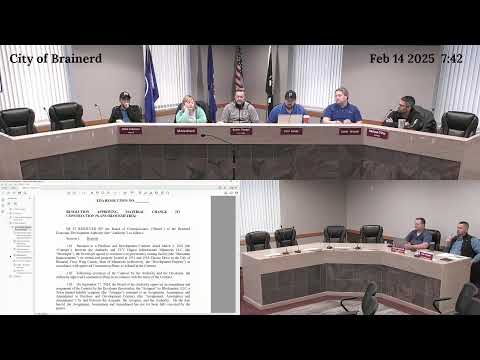
The Brainerd City Economic Development Authority on Feb. 14 approved a resolution revising the purchase and development agreement for BlockMetrics’ project at 1911 TC Drive to incorporate construction documents that reserve space for a possible ninth cooling/data unit.
The Brainerd City Economic Development Authority on Feb. 14 approved a resolution revising the purchase and development agreement for BlockMetrics’ project at 1911 TC Drive to incorporate construction documents that reserve space for a possible ninth cooling/data unit. The resolution passed on a roll call vote; all members present voted yes.
The change updates the construction documents and the minimum improvements required under the agreement, staff said, and reserves footprint space should an additional cooler or data unit be added in the future. James Kramvik, Brainerd City staff, told the EDA, “BlockMetrics has proposed a slight redesign as part of the design and bid package for the project at 1911 TC Drive.” He said the building footprint remained at the 25,000-square-foot minimum used for tax-abatement purposes and that some equipment layout changes, not a larger building, produced the revision.
Why it matters: the revision allows a potential future equipment expansion without a new building footprint, which affects how the city monitors noise, zoning and utility capacity. The EDA and project consultants discussed whether the revision effectively approves an additional unit now or only reserves space for a future expansion that may require further approvals.
City staff and the project consultant described the technical and regulatory constraints. Mike Dorn, a consultant with NCD representing ISHAC on the project, said the building size did not change and that the ninth unit was shown to demonstrate the footprint could accommodate an additional unit if more power were available in the future: “The building size actually did not change. ... the only reason that ninth was shown was to show within the footprint ... we could accommodate additional if it were ever available in the future.” Kramvik said the current design uses eight coolers and the project is sized around about 25 megawatts of available power; the ninth unit would only be possible if additional power were approved by public utilities.
On noise, Kramvik said staff calculated that adding a ninth unit would increase sound levels by about 0.375 decibels. He explained the methodology to the EDA and summarized that doubling the number of units would add about 3 decibels because the coolers act as point sources. “To actually add another 3 decibels, you'd have to go up to 16 of the coolers next to each other,” he said.
EDA member Sandy pressed for clarity on enforcement if future equipment produced excessive noise. Kramvik said the project would remain subject to Minnesota Pollution Control Agency noise standards and that the city could request measurements or require corrective actions if standards were exceeded; fines or legal action were possible if violations occurred. He also explained that a pending local data-center ordinance could change permitting requirements for future expansions, and that if that ordinance is adopted an applicant would likely need a conditional-use permit to add the ninth unit.
The EDA voted on an attached resolution described in the meeting packet as approving the “change of scope to the minimum improvements (construction documents)” and a revision of the purchase and development agreement. The motion to approve the resolution was seconded by Johnson. Roll-call votes recorded in the meeting transcript show the following recorded affirmative votes: Crissula (yes), Johnson (yes), Kirsch (yes), O'Dea (yes), Sandy (yes) and Yeager (yes). The EDA chair announced, “The resolution passes.”
Next steps: staff said the city is working on a data-center ordinance through the planning commission; staff estimated the ordinance could be in effect roughly a month and a half after current review meetings, and that if the ordinance is adopted an additional cooler added after construction would require planning-commission and city-council review. Kramvik and the consultant also noted that the developer currently does not have sufficient power approved for a ninth unit and would need public-utilities approval before installation.
The EDA’s action on Feb. 14 changes the purchase and development agreement documents to reflect the revised equipment layout and reserving space for a potential ninth unit but does not, by itself, change zoning rules or the city’s ability to enforce state noise standards or later permitting requirements under a future ordinance.