Get Full Government Meeting Transcripts, Videos, & Alerts Forever!
Get email alerts on the Tax Policy topic
No spam. Unsubscribe anytime.
Residents warn Montgomery County that 25-year tax abatements in Bill 2-25 could shift costs to homeowners
Summary
Public testimony on Bill 2-25 (payment in lieu of taxes / tax abatements for office-to-residential conversions) focused on a proposed 25-year tax abatement and whether that incentive would produce equitable housing outcomes or merely transfer costs to existing taxpayers and neighborhoods facing displacement risks.
At a public hearing on Bill 2-25 — a proposed payment-in-lieu-of-taxes/tax-abatement framework for converting high-vacancy commercial properties to residential use — residents and community groups expressed concern the incentive would amount to a long-term public subsidy benefitting property owners without guaranteeing deeply affordable units.
Several witnesses invoked the Office of Legislative Oversight and county fiscal context in criticizing the scale of proposed abatements. Karen Bolte, representing the Wildwood Manor Citizens Association, said OLO concluded the bill “provides an insufficient number of affordable units for the size of the proposed tax abatement,” and added that foregone property tax revenue “could undermine the county’s ability to provide future public goods and services.”
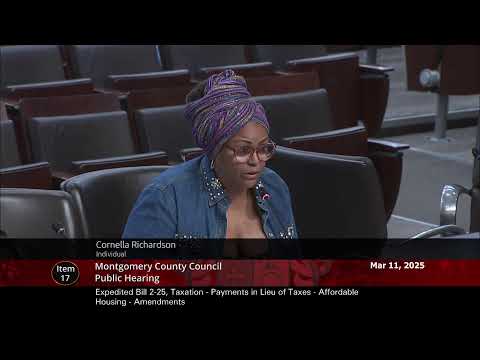
Cornella Richardson, the sole registered in-person speaker at the Bill 2-25 item, framed her testimony as a personal account of displacement risk. Richardson described long residency in the Georgia Avenue corridor and said she faces renewed displacement pressure tied to rising rents and redevelopment in the area. “I am facing displacement,” she said, and urged the council to consider how the proposed incentives would affect long-time residents who may be priced out.
Other public commenters raised related concerns during the ZTA 25-02 and ZTA 25-03 hearing panels, including that a 25-year abatement would reduce county revenue for schools and infrastructure and that any conversion incentives should be tied to stronger affordability requirements or to a shorter abatement period.
Supporters of conversions and expedited approvals told the council incentives are necessary to overcome the cost and complexity of converting older commercial space into housing. Advocates suggested pairing tax incentives with requirements that ensure a meaningful share of deeply affordable units and with targeted use of county funds (for example, using the Housing Investment Fund) rather than blanket abatements.
Council staff noted a joint Government Operations & Fiscal Policy and Economic Development Committee work session and reminded speakers of written testimony deadlines for the joint review. The public hearing concluded with no council vote taken on Bill 2-25 that evening.