Get Full Government Meeting Transcripts, Videos, & Alerts Forever!
Get email alerts on the Housing Affordability topic
No spam. Unsubscribe anytime.
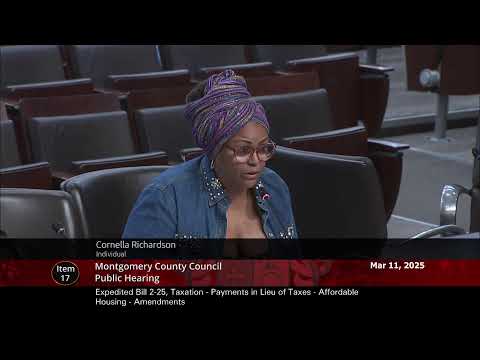
Split public reaction as Montgomery County council hears testimony on workforce housing ZTA 25-02
Summary
Supporters said ZTA 25-02 will increase housing supply near transit and corridors; opponents warned it is rushed and risks displacement and infrastructure strain.
Montgomery County residents, municipal officials and housing advocates debated Zoning Text Amendment 25-02 — part of the county’s “More Housing Now” package — at a public hearing that drew lengthy, sharply divided testimony.
Supporters described the measure as a modest but necessary step to increase housing supply along major corridors and near transit; opponents said the ZTA is rushed, risks displacement and will strain schools, water and traffic infrastructure without comprehensive impact analysis.
Lou Morseberger, speaking for Chevy Chase Village, said his municipality generally supports a “tailored approach” but asked the council to prohibit assembling corridor and adjoining lots for large redevelopment, retain planning board site-plan review and require on-site stormwater controls for new triplex/townhouse/apartment development. “Please prohibit the assemblage of lots located behind corridor lots and prohibit the assemblage of lots located side by side on a corridor,” he said, and urged clear mapping of eligible parcels.
Dan Reed, Maryland policy director for Greater Greater Washington, said the package aligns with county policy goals. “The more housing now package is a crucial first step to addressing our housing crisis,” Reed said, and urged additional reforms including conversions near Metro and the Purple Line.
Public-comment speakers included housing advocates and civic associations on both sides of the debate. Michael Larkin of Action Committee for Transit praised the package’s corridor focus and office-to-residential conversion proposals while urging denser building near transit and corner-lot eligibility. Nonprofit Montgomery’s Bridget Howe said her organization’s needs assessment showed nonprofit employers struggle to recruit staff because they cannot afford to live in the county, and urged zoning changes and investment to address workforce housing needs.
Opponents — including representatives of Chevy Chase municipalities, Wildwood Manor Citizens Association, and numerous residents from single-family neighborhoods — focused on infrastructure capacity. Testimony cited school overcrowding in specific clusters, WSSC data that “approximately 40% of the water mains in the WSSC water system are more than 50 years old,” and Planning Board climate-assessment findings that denser corridor projects could reduce tree canopy and increase stormwater runoff. Karen Bolte of the Wildwood Manor Citizens Association said ZTA 25-02 “will exacerbate school overcrowding” in the Walter Johnson cluster and urged the council to seek alternatives to the proposed workforce housing tax abatement (bill 2-25).
Speakers pushed for both technical amendments and broader policy clarity. Suggestions included: (1) prohibiting lot assemblage that would multiply density beyond setbacks, (2) keeping Planning Board or site-plan review rather than by-right approvals, (3) requiring two on-site parking spaces per dwelling in areas without on-street parking, (4) expanding corridor coverage to include areas within a mile of transit stations, (5) including corner lots and side streets, and (6) stronger stormwater and tree-canopy protections.
Several speakers questioned the targeting and scale of “workforce” units. Testimony cited a 15% set-aside in the ZTA for workforce housing units, questioned whether 15% meaningfully offsets teardown of naturally occurring affordable housing, and warned of a “developer giveaway” via a 25-year tax abatement described in Bill 2-25. The Office of Legislative Oversight was cited by opponents as concluding that proposed abatements could undermine the county’s ability to provide public services and could have negative equity impacts.
Multiple residents requested additional study, including analysis of the development pipeline (more than 35,000 approved but not yet built units was cited by speakers), school capacity modeling, water/sewer capacity, stormwater, traffic and emergency access. Municipal representatives asked for a clear, map-based list of eligible lots rather than a cross-reference to road classifications.
County staff at the hearing noted committee work-session dates: Planning, Housing and Parks committee work sessions were scheduled for 03/24/2025 (ZTA 25-01), 03/31/2025 (ZTA 25-02) and 03/24/2025 for part of the package. The record for ZTA 25-02 remained open for written testimony through the deadlines announced by staff.
No formal council vote was recorded during the public hearing; sponsors and staff will consider amendments before committee review.
Speakers’ competing views reflected broader disagreements about pace, scope and tools for increasing housing supply while protecting infrastructure and community character.