Get Full Government Meeting Transcripts, Videos, & Alerts Forever!
Get email alerts on the Land Use Variances topic
No spam. Unsubscribe anytime.
Planning commission recommends denial of seven shoreland variances for Chavez Sunfish Lake parcel
Summary
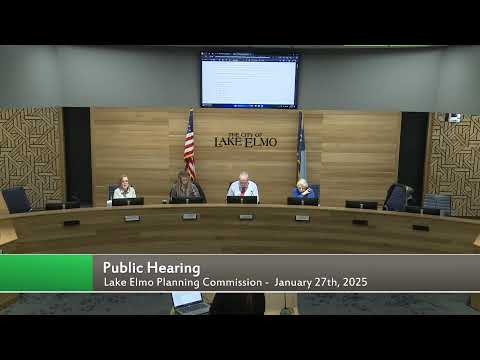
The Lake Elmo Planning Commission on Jan. 27 voted to recommend denial of seven shoreland and bluff variances sought by Joe and Joan Chavez for a parcel abutting Sunfish Lake.
The Lake Elmo Planning Commission on Jan. 27 voted to recommend denial of seven shoreland and bluff variances sought by Joe and Joan Chavez for a parcel abutting Sunfish Lake.
City planner Sofia told the commission the parcel is about 11.2 acres, with roughly 1.37 acres lying above the ordinary high water mark, is zoned Village Low-Density Residential with a shoreland overlay, and would receive access and utilities through the Northstar Second Edition development once that phase receives city council approval. Sofia said staff found the application met only one of the four statutory variance criteria and recommended denial. She said other agencies — the city engineer, the landscape architect and the Minnesota Department of Natural Resources — also recommended denial, citing premature grading, erosion and water‑quality concerns.
The variances before the commission included a reduction of the ordinary high water level (OHWL) structure setback from the required 150 feet to 120 feet, a request to build within the city’s 30-foot bluff setback and multiple requests related to construction and clearing within bluff and steep-slope impact zones, grading within the shoreland overlay and subdivision/lot-creation variances necessary to combine Outlot B with the adjacent parcel.
Why it matters: the property sits in a sensitive bluff and shoreland area where the city and state regulations aim to limit disturbance to protect water quality and steep‑slope stability. Staff told commissioners the proposal would introduce development into areas the Northstar and Hamlet developments were designed to avoid, and that approving the variances would conflict with regulations adopted to protect those sensitive areas.
Staff presentation and agency input
Sofia summarized the variance criteria set out in state statute and explained staff’s findings that only the variance criterion dealing with impacts to adjacent properties and traffic was met; the other three criteria (practical difficulties, unique circumstances not created by the landowner, and character of locality) were found unmet. She read agency comments: the city landscape architect recommended denial for concerns about vegetative clearing and erosion, the city engineer recommended denial because infrastructure (streets, sewer, water) is not yet in place and easements would be needed, and the DNR recommended denial and flagged water‑quality concerns. The watershed agency noted a permit would be required if work proceeds.
Applicant response and public comment
Applicant Joe Chavez told the commission he and his wife have owned the parcel since 1993 and said the footprint they propose is modest compared with nearby houses in Northstar and the Hamlet. "In essence we're only looking for 25 feet ... that's in essence all that we're asking for," Chavez said, adding the parcel is a "buildable lot" for marketing purposes and that no construction will begin until infrastructure is available.
Neighbor Bill Fredericks spoke during public comment and said he received a similar variance in 1993 and urged the commission to consider that precedent: "We were provided that variance in the past," Fredericks told the commissioners.
Commissioner concerns and discussion
Commissioners pressed the applicant on design alternatives and footprint size. Several commissioners cited the DNR memo as a substantial concern — one commissioner said DNR language that approval would be "arbitrary and capricious" was particularly troubling — and noted that four of the seven requests involve actions the code currently prohibits (clearing, grading and building in bluff/steep‑slope zones). Commissioners suggested alternatives such as a smaller footprint or moving the structure farther east to reduce encroachment.
Formal action and next step
A motion to recommend denial of all seven shoreland variance requests was made and seconded; commissioners approved the motion by voice vote. The commission’s recommendation will be forwarded to the City Council; the staff noted the Chavez variances are slated for the council agenda on Feb. 4.
What remains unresolved
The applicant maintains the lot is buildable and said he had attempted in earlier years to secure access and easements from neighboring owners without success. Staff and agencies emphasized the application did not demonstrate the statutory necessity or minimum disturbance required under the variance standards, and recommended the applicant pursue design changes or property‑shape revisions with the Northstar developer to avoid or reduce variances.
The record
This matter was heard as a public hearing; one written comment from an owner/manager at Gagne (GWSA) was received before the meeting, indicating the signatory did not support the proposed encroachment on his property. The commission closed the public hearing and returned the application and recommendation to the City Council for further consideration.