Get Full Government Meeting Transcripts, Videos, & Alerts Forever!
Get email alerts on the Eda Governance topic
No spam. Unsubscribe anytime.
Lake Elmo EDA appoints officers, agrees to meet six times a year and forwards work plan to council
Summary
The Lake Elmo Economic Development Authority appointed Tony Manzera chair and Jeff Holtz vice chair, voted to increase meeting frequency to six times a year, and approved sending the EDA work plan to the City Council with an added contingency to submit a proposal if the DNR accepts the letter of intent.
The Lake Elmo City Economic Development Authority (EDA) appointed Tony Manzera as chair and Jeff Holtz as vice chair, voted to change its regular meeting schedule to six times a year and approved forwarding its economic development work plan to the City Council with an added instruction to submit a proposal if the Minnesota Department of Natural Resources (DNR) accepts the EDA’s letter of intent.
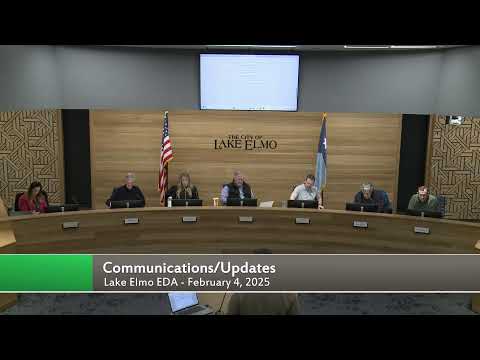
The decisions came during a February 4 EDA meeting in which members debated how the body should use its statutory authority, how much staff time and funding the EDA needs to advance redevelopment projects, and how environmental review should affect the timing of an upcoming request for proposals (RFP).
Members said the changes are intended to give the EDA more time to exercise its statutory authority and shepherd redevelopment projects. The board voted to move from four meetings a year to six, aiming for longer sessions that would better accommodate the panel-style work and occasional special meetings the EDA expects while running an RFP process.
Discussion and reasoning
Members who supported more frequent meetings said the current cadence—four short meetings a year—does not allow enough time to develop proposals or respond to complex redevelopment needs. One EDA member said the EDA has been limited by meeting length and staff availability and recommended more frequent, longer meetings so the authority can “do something with our statutory authority.” Other members said a six-meeting schedule should be a starting point and that special meetings could be called for focused items such as an RFP review.
Practical considerations surfaced in the debate: several members said a multi‑hour EDA meeting held immediately before a City Council meeting would be difficult to attend. The compromise approved by the EDA was to meet every two months at the same time they currently meet before council meetings while retaining the ability to call special sessions for time‑sensitive matters if needed.
Work plan and RFP timing
The EDA reviewed and acted to forward its economic development work plan to the City Council. The motion approved by the EDA included a friendly amendment: if the DNR (or Minnesota Pollution Control Agency, if applicable) accepts the EDA’s letter of intent for a given site, the EDA will proceed to submit a proposal. The EDA chair noted the work plan will go to the City Council on 02/18; staff said the RFP for the site was tentatively scheduled for 03/18 but might be pushed back depending on the outcome of environmental assessment work.
Staff provided additional updates relevant to RFP timing: an access agreement for the planned environmental assessment of the old fire station has been approved, and the EDA received a county grant to pay for a Phase I environmental assessment that the Environmental Protection Agency (EPA) has approved. Staff estimated the assessment will take about two to three months from the start of on‑site work; if further work is required, that timeline could extend.
Budget and risk considerations
Participants noted the EDA currently operates without a defined budget, which affects the authority’s ability to undertake predevelopment work or pursue site improvements directly. One member suggested the EDA could develop a city‑owned property rather than sell lots via an RFP to exert more control over long‑term outcomes; staff and other EDA members warned that such an approach would increase financial risk and would require Council and finance‑director review because the EDA has no dedicated budget.
Votes at a glance
- Amended agenda: approved by voice vote. - Approval of minutes (11/19/2024): approved by voice vote. - Appointment of Tony Manzera as EDA chair: approved by voice vote. - Appointment of Jeff Holtz as EDA vice chair: approved by voice vote. - Change meeting frequency to six times per year (every two months) with ability to call special meetings: approved by voice vote. - Forward EDA work plan to City Council with addition “submit proposal if accepted by DNR”: approved by voice vote.
Next steps
Staff said they will circulate a revised meeting schedule reflecting the new six‑meeting cadence, finalize the work plan materials for the City Council packet on Feb. 18, and coordinate the Phase I environmental assessment for the old fire station site. The RFP timetable will be re‑evaluated once the environmental assessment report is available.