Get Full Government Meeting Transcripts, Videos, & Alerts Forever!
Get email alerts on the Street Reconstruction topic
No spam. Unsubscribe anytime.
Austin City Council approves public hearing resolution for $15.6 million Oakland/First Avenue reconstruction project
Summary
Council approved a resolution to advance a three‑year, $15.6 million street and utility reconstruction project on Oakland Avenue and First Avenue, including a phased construction schedule, utility replacements and property assessments for adjacent owners.
Austin City Council on March 3 advanced a public‑hearing resolution to proceed with a planned, three‑year reconstruction of Oakland Avenue and First Avenue, a project staff estimated at $15,600,000 that includes complete road and underground utility replacement and assessments for adjacent property owners.
The project, identified in the agenda as Project 25103, will be constructed in three phases beginning in 2025. City staff described full roadway and utility reconstruction — including 8‑inch concrete pavement in some sections, concrete sidewalks and driveways, storm sewer and sanitary sewer replacement, and proposed full water‑main replacement by Austin Utilities. The plan also includes decorative signal lighting, pedestrian safety features such as rapid‑flashing beacons, boulevard landscaping and some undergrounding of electrical service where feasible.
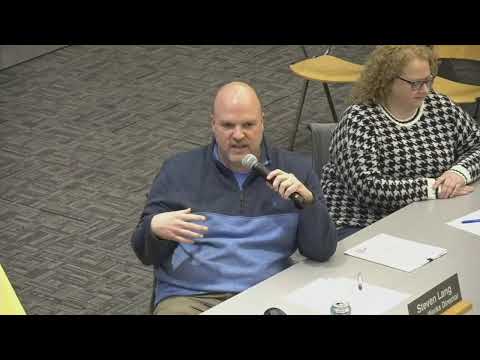
Project manager Steven Lang told the council the city has held multiple public meetings and outreach efforts since initial design work began, and that the city plans to begin construction in 2025 at the block by the fire station and work west past Seventh Street. A second construction phase would finish the remainder of Oakland Avenue in 2026 and add work on the east end of First Avenue; the final phase would complete the remainder of First Avenue in 2027. Lang said each phase would take roughly five months, with specific start dates dependent on state plan review and bid timelines.
Lang said planned pedestrian and traffic changes include converting a segment of Oakland from two‑way to one‑way between Main Street and First Street Northeast, adding an 8‑foot sidewalk on the north side of Oakland and the south side of First Avenue, bump‑outs at several intersections, and limiting some driveway access to improve traffic flow. He said rapid‑flashing beacons would be installed at Eighth Street and elsewhere to improve pedestrian safety.
Lang presented a funding breakdown that combines state and federal grants, municipal state aid dollars, sanitary sewer funds and assessments. Council was told grant and state aid sums total $7,680,000 for the project and that assessment notices sent to adjacent property owners amount to “a little over $1,000,000” of the overall estimate. The city set preliminary assessment rates earlier this year at $68.82 per front foot for residential properties and $98.28 per front foot for commercial properties; Lang said there is no sidewalk assessment and that the assessment rates will be held for properties regardless of which phase they are in. Property owners in a given phase would have until Oct. 30 of that phase year (for 2025, Oct. 30, 2025) to pay without interest or may pay 50% and place the remainder on their taxes spread over 15 years at 5.75% interest.
Council members asked about phasing logic, detour routing and the security of grant funding. Lang said the phasing was designed so the city would not close parallel two‑way corridors at the same time and avoid pushing all traffic onto other streets; he said Second Avenue was selected as the best detour route despite local inconvenience. Lang said the state aid office had indicated the project’s state and federal grant amounts were approved and that, as proposed, the project would not be subject to an additional Washington, D.C. review that would come with changing the grant amount.
Council asked about traffic speed and roadway narrowing. Lang said traffic‑calming studies support that narrowing travel lanes and retaining parked cars slows vehicle speeds, and that bump‑outs and other design elements would help reduce speeds.
The council unanimously approved the resolution to proceed with the public‑hearing process for Project 25103 by a 7–0 vote.
Although staff said the city mailed assessment notices and provided handouts at the meeting, no members of the public spoke during the hearing. Lang said the city will continue outreach including text alerts and handouts; final assessment hearings will follow construction when final costs are known.
Project identifiers and next steps: staff said plans had been under state review since Jan. 17 and that the city hoped to advertise for bids in May if state review completes on schedule. Each phase’s estimated five‑month construction window means later phases could be pushed into the following months if start dates slip.