Get Full Government Meeting Transcripts, Videos, & Alerts Forever!
Get email alerts on the Municipal Management topic
No spam. Unsubscribe anytime.
Town Manager outlines 2025 goals; council discusses sidewalks, fiscal priorities, staffing and open-space planning
Summary
Kimball presented a draft set of 2025 goals and objectives and asked councilors for additions or edits; the council discussed fiscal management, sidewalks, employee retention, open-space planning, and recreation master planning.
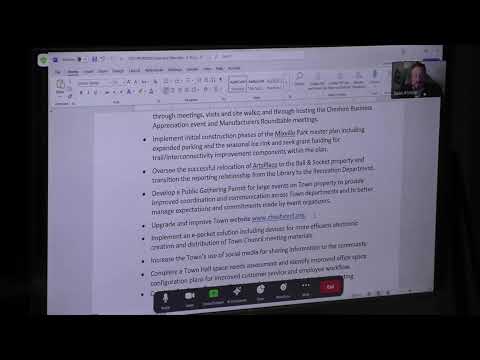
Cheshire — At a special meeting Feb. 25 the town manager, Sean M. Kimball, reviewed a draft set of his 2025 goals and objectives and led an extended council discussion about priorities and timelines for capital projects, staffing and community initiatives.
Lede and scope: Kimball said the document (shared with the council and in the meeting packet) groups priorities across general government operations, finance, public safety, education, recreation and sustainability/transportation. He noted that “what is in blue” in the document indicated items that were new or substantially changed from the prior year’s goals.
Key priorities discussed
- Fiscal management and mill rate: Council members, led by John (council member), asked that the manager include explicit language to look critically at town expenditures during this transitional period to minimize impacts on the mill rate. Kimball said he would update the operating/capital budget language to reflect minimizing taxpayer impact while maintaining essential services.
- Employee recruitment and retention: Kimball identified recruitment and morale as an ongoing town priority and discussed exploring strategies short of salary competition — including scheduling flexibility, recognition and other nonwage incentives — to retain staff. Several councilors said collective bargaining agreements (including the police contract) factor into recruitment and that finalizing open contracts is part of broader retention work.
- Sidewalk and school-area safety: Councilors pressed for continued progress on sidewalk expansion projects tied to schools (Jarvis/Marion to the North End elementary school, Lanyon Drive, and gaps on Route 10). Kimball said Jarvis/Marion design was nearing completion and that sidewalk projects will move forward as funding and neighborhood approvals permit; he agreed to rephrase the document to prioritize sidewalk projects proximate to schools.
- Traffic and circulation around Cheshire High School and Route 10: Members discussed long-standing traffic congestion and left‑turn conflicts near Cheshire High School and Bartlett Road. Kimball said engineering work and legal title issues (for potential alternate access) are under review and that the multimodal transportation study consultant could inform potential solutions.
- Yankee Highlands and open-space planning: Councilors asked staff to keep Yankee Highlands open-space planning and the feasibility of a second access/parking area under active consideration. Kimball and councilors discussed field and trail needs, access challenges and the idea of targeted soils/feasibility studies to inform future capital planning for the parcel.
- Parks, pools and recreation: Council members requested continued emphasis on a Cheshire Community Pool master plan (capital needs and lifecycle items), Mixville Park improvements, and parking/field capacity planning at Cheshire Park given new uses such as pickleball and disc golf. Kimball noted current and planned design work and emphasized the need for master planning to prioritize capital funding.
- Historic documents grant and municipal projects: The manager flagged grant applications and other funding approaches (for example, the Connecticut State Library historic documents preservation grant) that will support records storage and other small capital needs.
Process and timing: Kimball said the goals should remain a “living” document. The council directed staff to recirculate a finalized version and scheduled to vote on the adopted goals in March. Council members agreed to revisit the list in late summer (August/September) to adjust priorities if needed ahead of finalizing the FY26 operating and capital budgets.
What the council did not decide: The meeting included extended discussion but did not produce new ordinances or formal votes about most items on the goals list (for example, no formal decision tonight on the North End fire station nor on changing land-use designation for particular parcels). Councilors asked staff for follow-up analyses and to return with cost estimates, feasibility studies or draft budgets as appropriate.
Why this matters: The goals document shapes staff priorities and ties into FY26 budget planning and major capital projects including two new elementary schools. Items discussed — sidewalks around schools, open-space stewardship, and employee retention — all have operational and budget implications for the 2025–2026 planning cycle.
Next steps: Kimball will revise language per council feedback (including explicit language on minimizing mill-rate impact), recirculate an updated draft and return to the council for final adoption in March. The council also set a revisit window in late summer to re‑prioritize or adjust objectives ahead of budget season.