Get Full Government Meeting Transcripts, Videos, & Alerts Forever!
Get email alerts on the Housing Policy topic
No spam. Unsubscribe anytime.
County hearing draws heated debate over ‘More Housing Now’ zoning package and 25-year tax-abatement pilot
Summary
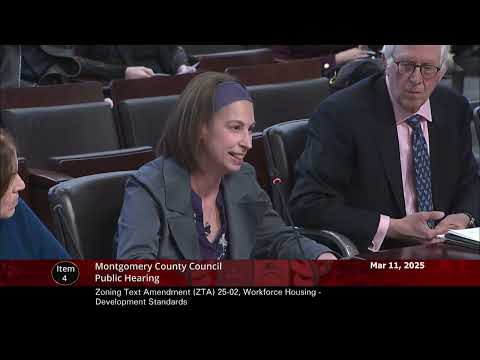
Montgomery County Council members heard more than six hours of public testimony March 3 on a package of zoning and tax changes designed to spur housing construction near major corridors and convert underused commercial buildings to residences.
Montgomery County Council members heard more than six hours of public testimony March 3 on a package of zoning and tax changes designed to spur housing construction near major corridors and convert underused commercial buildings to residences.
Supporters — including the county planning board, affordable‑housing advocates, business groups and some municipal officials — said the package creates tools to increase housing supply and homeownership options for middle‑income residents and to repurpose vacant office space. Artie Harris, chair of the Montgomery County Planning Board, said the suite of bills ‘‘tackles the crisis from numerous perspectives’’ and that the board ‘‘remains available to support the council as you move this package forward through work sessions.’’
Opponents — including many civic associations, neighborhood residents and civil‑rights and teacher groups — warned the changes could spur displacement, strain schools and utilities, increase traffic and give developers large public subsidies while producing few deeply affordable units. Debbie Heller, a council member from the town of Somerset, urged a pause: ‘‘Please pause the now zoning process and bring a representative from every stakeholder group to the table and start again.’’
What’s proposed - Zoning Text Amendment (ZTA) 25‑02 would allow additional residential building types along specified corridors (and some corner lots) in multiple residential zones, with a minimum workforce housing requirement (the draft sets a 15% workforce unit floor in many cases). Speakers repeatedly described the plan as an ‘‘85/15’’ split: roughly 85% market‑rate units and 15% workforce units under the draft. - ZTA 25‑03 would create an expedited approval option for commercial‑to‑residential conversions when a property is substantially vacant, intended to encourage reuse of vacant offices and retail. - Bill 2‑25 would establish a pilot payment‑in‑lieu‑of‑taxes (PILOT) program that can provide property tax abatement for qualifying commercial‑to‑residential conversions; drafts discussed a 25‑year abatement in exchange for an affordability minimum (the bill text and fiscal impacts remain under review). - A related subdivision regulation amendment (SRA 25‑01) would create an administrative subdivision process for expedited commercial‑to‑residential conversions.
Supporters’ arguments Supporters framed the package as one component in a broader housing strategy. Samantha D’Amato of the Greater Capital Area Association of Realtors described it as a ‘‘strong start’’ that adds tools to produce housing types targeted to middle incomes. Habitat for Humanity Metro Maryland’s president said the package complements down‑payment assistance and other investments that help households purchase homes.
Developers and property owners testifying said conversions can be expensive and risky; several urged expedited permitting and tax relief to make projects financially feasible. Representatives for large mall and office owners said the pilot could allow stalled conversion plans to proceed.
Concerns raised by opponents Speakers opposing the package raised multiple themes: inadequate public engagement; lack of data on infrastructure capacity (schools, stormwater, water/sewer); unclear or permissive lot‑aggregation rules that could allow ‘‘chaining’’ corridor parcels into deeper lots; and insufficient protections against displacement. Roman Nelson, a resident of the Four Corners area, called for pausing ZTA 25‑02 ‘‘until a full infrastructure impact study is conducted and a fair, transparent zoning process is restored.’’
Several civic groups and the county NAACP warned the pilot’s proposed tax abatement could worsen fiscal pressures and increase racial and economic disparities. The Office of Legislative Oversight (referenced in multiple testimonies) has drafted early analysis raising equity and fiscal‑impact questions; speakers requested fuller fiscal and racial‑equity studies before approvals.
Process and next steps Council staff and the sponsors said the measures are being routed to committee work sessions: Planning, Housing and Parks work sessions were scheduled for late March; a joint government operations/fiscal policy and economic development committee work session was scheduled on the PILOT bill. No final council votes occurred during the March 3 hearing; the council kept the public record open for later written submissions and scheduled follow‑up meetings.
Why it matters County leaders and residents framed the debate as a tradeoff between speeding construction of a wider range of housing options and protecting existing neighborhoods and public infrastructure. Proponents say the mix of zoning reforms, conversion incentives and expanded down‑payment assistance could help retain teachers, health‑care workers and young professionals; opponents say the package, as drafted, risks uneven benefits and infrastructure shortfalls without stronger affordability and anti‑displacement guarantees.
Ending note Council members indicated they would consider written submissions and amendments in upcoming work sessions. No council action on the zoning amendments or the PILOT program was taken on March 3; the items remain in committee for further review and revision.