Get Full Government Meeting Transcripts, Videos, & Alerts Forever!
Get email alerts on the Inclusionary Zoning topic
No spam. Unsubscribe anytime.
Simsbury zoning commission adopts inclusionary housing text amendment with 10% minimum affordable units
Summary
The Simsbury Zoning Commission voted unanimously to adopt a text amendment establishing inclusionary housing requirements that set a no-less-than 10% affordable-unit requirement for qualifying developments, apply primarily to rental and multi-unit for‑sale projects, and use 20‑year deed restrictions for credit toward state goals.
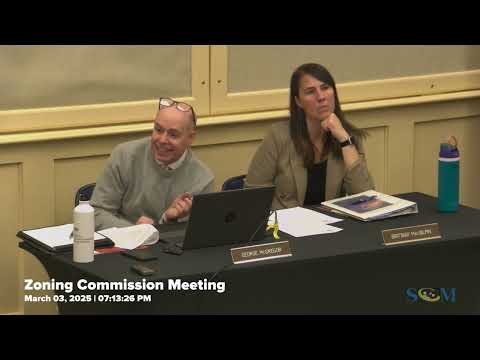
The Simsbury Zoning Commission voted unanimously at its March 3, 2025 meeting to adopt a text amendment creating inclusionary housing requirements that set a minimum 10% affordability requirement for qualifying developments and use 20‑year deed restrictions for credit toward the town’s affordable‑housing totals.
The amendment creates a new inclusionary housing section in the town zoning regulations and related form‑based codes and is intended to add one tool to Simsbury’s housing strategy, commission members said. The commission adopted the amendment as application ZC‑24‑06; the motion sets the adopted language to be effective March 3, 2025, pending the statutory appeal period.
Why it matters: the change directs future large residential developments to include a baseline share of affordable units, shifting Simsbury from relying solely on negotiated agreements to a standing regulatory requirement. Supporters told the commission the amendment is intended to increase the town’s supply of housing affordable to lower‑income households while avoiding thresholds that could deter development.
Discussion and key provisions
Commission members and staff described the adopted draft as a compromise reached after public hearings and consultation with developers and local housing advisers. The amendment, as adopted, contains several key elements discussed during the meeting and in materials provided to commissioners:
- Minimum requirement: new qualifying developments must provide no less than 10% of units as affordable housing (the draft language uses the phrase “no less than 10%” so developers may provide more). (source: motion language and staff presentation)
- Income and unit type: required affordable units are set at 80% of area median income (AMI) in the adopted draft; the earlier two‑tier approach (splitting units at 80% and 60% AMI) was removed after feedback that deeper affordability is difficult to achieve in market projects. The amendment applies principally to rental projects and to multi‑unit for‑sale developments such as condominiums and townhouse projects, and exempts single‑family detached homes intended for fee‑simple individual ownership. (source: staff presentation summarized during discussion)
- Threshold and building types: the obligation applies to projects of 10 or more units (counting units rather than structures); small infill duplexes or standalone single‑family houses generally will not be captured unless they are part of a larger qualifying development. (source: staff presentation)
- Duration and credit toward state goals: affordable units created under the text amendment will be subject to deed restrictions of 20 years in the adopted draft. Commissioners discussed that Connecticut’s 8‑30g program typically requires 40 years for full 8‑30g benefit; the commission noted the town will receive some credit toward its 10% goal for shorter deed‑restriction periods such as the 20 years used in the Aspen Green example. Commissioners explicitly said the 20‑year term is not intended to meet 8‑30g’s 40‑year standard but will still count toward local achievement. (source: multiple commissioner questions and staff answers)
- Examples and precedent: staff pointed to Aspen Green, where a developer agreement resulted in 18 deed‑restricted units on the site for 20 years; commissioners cited Aspen Green, Dorset Crossing and the Hartford South application as previous local examples where affordable units were offered through application agreements. (source: staff memo dated 12/16/2024 and meeting remarks)
Commission motion and vote
The commission’s formal motion (ZC‑24‑06) moved to adopt the “housing strategies toolkit” text amendment and to insert inclusionary housing sections into the town‑wide zoning regulations and two form‑based codes. The motion was seconded during the meeting; with no further discussion, the commission voted unanimously in favor and the motion carried. The adopted language was announced as effective March 3, 2025, subject to the statutory appeal period. (source: motion read into the record and roll call procedure)
What commissioners said
Shannon, a member of the Simsbury Housing Advisory Committee, told the commission her committee had met after the commission’s earlier hearing and had reached draft recommendations but had not yet approved final language; she said those recommendations would not be ready for public release immediately. A number of commissioners said the revised draft addressed earlier concerns that a higher percentage requirement could discourage development, and several described the 10% minimum and 20‑year deed restriction as a pragmatic compromise.
Next steps and limits
The amendment takes effect subject to the statutory appeal period; the zoning commission and staff noted that the text amendment process allows future changes. Commissioners said incentives or alternative tiers (for example, additional deeper‑affordability options if incentives are adopted) could be added later through the same public hearing and amendment process if the commission or applicants propose changes.
The commission’s action does not itself provide funding or create a municipal housing program; implementation details (monitoring, enforcement, unit tracking and any town incentives) will be handled by town staff and may require additional administrative rules, agreements or interdepartmental procedures.
Ending
Commission members framed the adopted regulation as one tool in a broader housing strategy rather than a standalone solution to Simsbury’s affordability goals. The commission adjourned after completing the zoning toolkit agenda item.