Get Full Government Meeting Transcripts, Videos, & Alerts Forever!
Get email alerts on the Charter Revision Open Space topic
No spam. Unsubscribe anytime.
Simsbury open-space work group seeks charter, ordinance fixes; urges clearer stewardship and public notice
Summary
Members of the Open Space and Stewardship and Policies Work Group reviewed mismatches between the town charter and related ordinances, proposed adding stewardship language and clearer procedures for land disposition, and asked that meetings and minutes be more accessible to the public.
The Open Space and Stewardship and Policies Work Group on March 5, 2025 reviewed proposed edits to town governance language and recommended clarifications to how the town handles open‑land stewardship, committee composition and public notice.
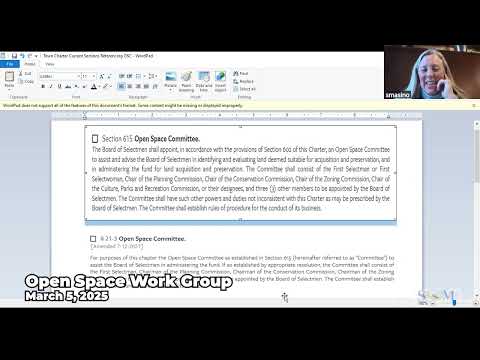
The changes under discussion focused on aligning Town Charter language in section 6‑15 with ordinance language in section 21‑3 and related provisions (including 21‑4 and 21‑8). Members suggested adding explicit authority for stewardship and administration of acquisition funds, correcting clerical mismatches introduced by prior charter revisions, and clarifying who may initiate or intend land disposition processes.
Marjorie Winters, member, Open Space and Stewardship and Policies Work Group, opened the agenda item by sharing the charter text on screen and asking the group to consider one section at a time. Members noted that the charter’s 2017 update and a later ordinance amendment in 2021 are not consistently reflected across the town code and charter documents.
Susan Cino, member, suggested explicitly adding stewardship language to section 6‑15. Cino proposed the committee should advise the Board of Selectmen “in identifying and evaluating land deemed suitable for acquisition and preservation, the stewardship of said land, and administering the fund for land acquisition and preservation.” The group agreed the added phrase would clarify the committee’s role beyond acquisition and disposition.
Members also flagged a mismatch in how many appointed members are referenced in different places. Helen Peterson, member, traced the change history and said the most recent charter changes increased the number of appointed members to three but the corresponding ordinance text was not updated. Participants called this a clerical inconsistency that should be corrected so the charter and ordinance match.
The group discussed whether the first selectman (or first selectperson) should be specifically identified as chair or an ex officio participant. Tom Taberski, member, and others noted the committee historically included selectmen and chairs of land‑use boards to expedite administrative decisions when land needed rapid attention. Several members said the existing language already allows selectmen or their designees to serve; they did not reach a firm consensus on adding explicit chairing language to the charter.
Panelists also discussed the disposition process in ordinance 21‑8 and the verb used to describe the town’s role in starting a disposition. Members debated whether the code should say the Board of Selectmen "initiates" a disposition, "intends" to sell, or merely "considers" it. Several speakers said a stronger verb would be appropriate where substantial staff and commission time will be expended, so there is a clear rationale before moving the process forward.
Discussion touched on a specific parcel of Meadowood property. Members clarified that most of Meadowood is deed restricted, while a smaller parcel — described in the meeting as “about 24 acres, plus or minus” — is not deed restricted. The group discussed the role of the Connecticut Farm Preservation program (described in the session as a program whose grant funding helped purchase deed‑restricted acreage) and said that program has input on deed‑restricted parcels but not necessarily on the non‑restricted portion.
The work group also urged better public notice and outreach. Several members said work‑group meetings and minutes should be distributed to the full committee and to interested residents so the public can follow stewardship work. Participants discussed whether some of those practices belong in the committee’s rules of procedure rather than the charter; members said they would include the preference in the draft and let the Charter Revision Commission advise on uniformity across boards and commissions.
Wendy (identified in the meeting as head of the Open Space Committee/First Selectman role in prior practice) said she would look at the suggested edits and consult legal staff about moving ordinance items out of the code to make future changes clearer. The group agreed to finalize language at the next work‑group meeting and to present the draft to the full committee before submission to the Charter Revision Commission.
Votes at a glance - The work group approved the meeting minutes by voice vote (recorded in the meeting as a voice vote; tally reported as yes: 3). Names for the tally were not specified in the transcript. - The group voted to adjourn (voice vote; tally not specified).