Get Full Government Meeting Transcripts, Videos, & Alerts Forever!
Get email alerts on the Transportation Pedestrian Safety topic
No spam. Unsubscribe anytime.
Selectmen authorize easements, state grants for Firetown Road sidewalk project
Summary
The Board of Selectmen authorized the town manager to execute easement agreements and allocate state LOTS grant funding so the long‑planned Firetown Road sidewalk can move into construction bidding once property rights are in place.
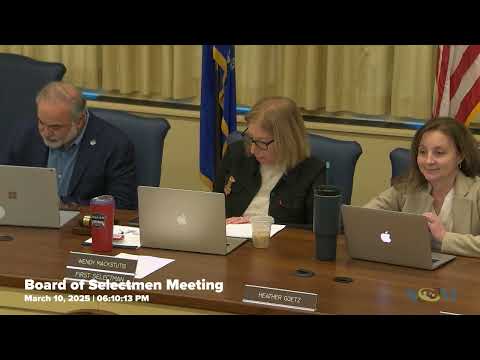
The Simsbury Board of Selectmen on March 10 authorized Town Manager Mark Nelson to execute easement agreements and use state LOTS grant funding for easements tied to the Firetown Road sidewalk project.
The action comes after project staff told the board design is at about 90% and that nine property owners need either permanent or temporary easements for the roughly one‑mile sidewalk from West Street to Plank Hill Road. “The sidewalk project will start almost a mile of sidewalk from West Street all the way up to Plank Hill Road,” said Adam, a project engineer with the town. He said two of the nine easements are temporary for construction and seven would be permanent rights over frontage that in some cases is only a few square feet and in others extends to several thousand square feet.
Why it matters: easements and signed property agreements are required before the town can finalize grant submittals and advertise for bids. Adam told the board the town cannot move forward on procurement until the easement paperwork is signed and paid. He estimated that if easements were completed by April 1 and state review took one to two months, the town could be in a July bid period with potential construction start in September — though staff said bidding in mid‑summer and disturbing soil late in the season create tradeoffs.
Board members asked whether the state grant covers easement costs; Adam said the LOTS and other state grants were written to reimburse eligible right‑of‑way costs and the town had executed a grant agreement. “That would apply to all eligible costs under the grant,” he said, adding sometimes the state does not reimburse 100 percent. Selectman Curtis said the police department had been consulted about a crosswalk and stop control near Grama Pond and that a stop sign is likely to be added where the sidewalk creates a new crossing.
The board voted to authorize Nelson to execute required easement documents and to allocate LOTS grant funding for the easements. All who voted said “aye.” The motion and vote move the project toward final state review and a construction bid schedule that staff said will be set after the remaining easements are secured.
Project scope and next steps: staff described the preferred cross‑section as a roughly 6‑foot pedestrian path with a 3‑foot snow shelf to reduce plow snow onto the sidewalk; in constrained areas the sidewalk footprint was reduced and grading would be used to achieve appropriate slopes. Several property owners raised questions about winter maintenance; staff noted town ordinance requires adjacent property owners to clear sidewalks and that the town had discussed maintenance expectations with affected owners.
Budget and funding: the project uses two state grants mentioned in the public discussion — a Connectivity program award of about $594,000 and a separate LOTS grant of roughly $1 million — both described in the meeting as state (not federal) funding that flow through the town. Staff said the grants were intended to reimburse right‑of‑way and construction costs where eligible, but the town could still face unreimbursed items.
The board’s authorization allows the town manager to finalize the easement transactions and accept grant reimbursements so the design can proceed to bidding once the state and property work are complete.