Get Full Government Meeting Transcripts, Videos, & Alerts Forever!
Get email alerts on the Special Education Funding Reform topic
No spam. Unsubscribe anytime.
Senate committee advances sweeping special‑education funding overhaul; committee substitute adopted, broad testimony spotlights costs and implementation
Summary
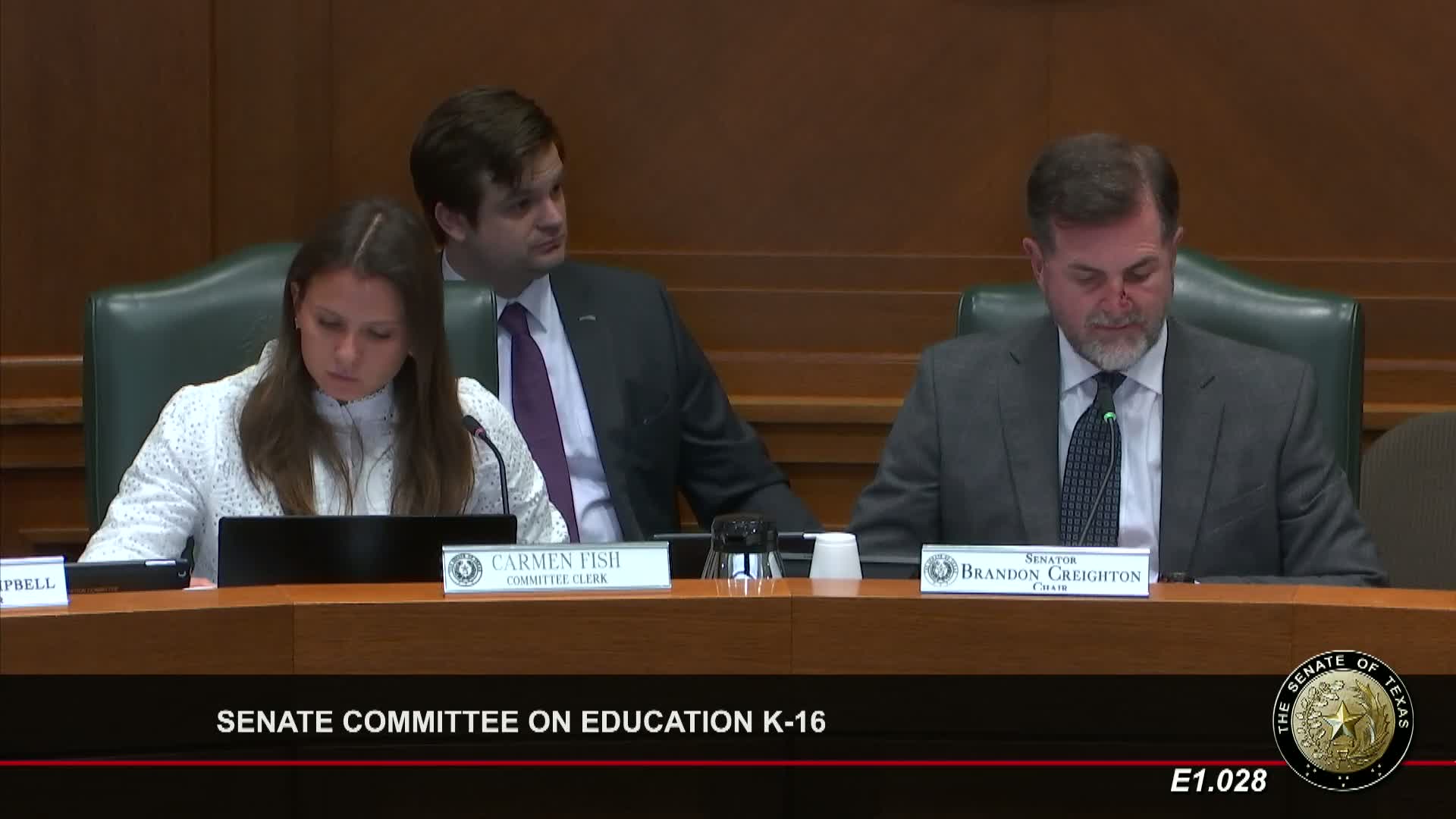
The committee adopted the committee substitute for Senate Bill 568 — a broad revamp of special‑education funding that shifts Texas from a placement‑based to a service‑intensity funding model — and heard multi‑hour testimony from commission members, superintendents, advocates and parents.
The Senate Committee on Education took up a comprehensive special‑education finance and policy package in the committee substitute for Senate Bill 568 (refile of earlier Senate Bill 1474). Committee members adopted the substitute and then heard several hours of invited and public testimony from commission members, superintendents, advocates and parents.
What the bill would do: Sponsor Senator Paul Bettencourt summarized the substitute as a sweeping rework of special education funding and services. Key measures described in committee testimony include: - Transition from a placement‑based funding model to a service‑intensity model organized into tiers (the substitute expanded the proposal from a 7‑tier to an 8‑tier model to include students who receive only speech therapy). The tiers pair with four service groups for targeted supports. - Embed a cost offset to help cover the expense of full and individual initial evaluations (witnesses said evaluation costs can range widely, with several district witnesses estimating $1,000–$5,600 per evaluation and multiple witnesses citing typical costs near $3,000). - Increase the special‑education transportation mileage reimbursement and double the college, career and military readiness (CCMR) outcome bonus for students identified as receiving special education services (with witness suggestions to extend bonus eligibility to 18+ life skills certifications). - Move regional day school programs for the deaf into a student‑based allotment in the Foundation School Program instead of a separate rider. - Create grant programs to build local educator capacity and to recruit/retain qualified special‑education staff, and fund salary stipends for paraprofessionals.
Committee action: Senator Hagenbu (committee member) moved adoption of the committee substitute; the transcript records unanimous consent with no objection and the substitute was adopted by the committee.
Invited testimony: The committee called multiple invited witnesses, including Stacy Combust (chair of the Texas Commission on Special Education Funding), Dr. Doug Killian (superintendent, Cypress‑Fairbanks ISD), Dan Huberty (former House member and commission member), Matthew McCormick (Texas Public Policy Foundation), and TEA resource staff. Key points from invited testimony: - Stacy Combust said the commission’s recommendations were unanimous or near‑unanimous and emphasized protecting high‑cost students; she urged retaining language in Section 9 related to State Supported Living Centers (SSLCs) and high‑cost pool protections. - Dr. Doug Killian (Cy‑Fair ISD) praised the intensity model, flagged staffing shortages (Cy‑Fair reported 388 open teaching positions, 41% in special education), and urged higher evaluation offsets (he said evaluations can approach $3,000 per student and districts face significant staffing gaps). - Dan Huberty and Matthew McCormick described the structural rationale for the intensity model and the expected effects on resource alignment; Huberty called the legislation "transformational."
Public testimony and points of contention: The record shows extended public testimony from parent advocates, disability rights organizations, district trustees and students. Recurring themes: - Strong support for the intensity‑based funding model and for restoring dyslexia and autism grants and parent‑directed services programs. - Repeated calls for a larger fiscal commitment to close a reported $1.7 billion annual gap that witnesses said Texas districts currently cover with general‑fund dollars. - Implementation concerns: educators and several witnesses urged a phased‑in implementation timeline (one biennium to pilot/refine data and then full transition) and asked for clear TEA technical assistance and expanded training for staff and vendors. - Evaluation funding: witnesses urged a higher per‑evaluation offset than the low figures mentioned earlier in drafting (committee discussed targets ranging from $250 to $500 in early drafts but testimony advocated for substantially higher offsets to reflect market costs). - SSLC language: Some witnesses (parents and SSLC advocates) urged keeping Section 9 language to make State Supported Living Center options explicit for parents of certain high‑cost students; other advocates (community‑based services groups) urged striking SSLC language and warned the provision could steer families toward the most restrictive residential option.
Next steps: After extended testimony the committee closed public testimony and left the committee substitute pending. Members and TEA resource staff agreed to work further on fiscal numbers, evaluation offsets, teacher certification pathways and a phased implementation timeline.
Why it matters: The substitute would materially change how Texas funds and administers special education for roughly 775,000 students referenced in testimony, affecting district budgets, staffing, eligibility decisions and parental options. Witnesses said the proposal could transform services if sufficient funding and implementation support are provided; critics warned about unintended consequences if timelines or fiscal commitments are inadequate.