Get Full Government Meeting Transcripts, Videos, & Alerts Forever!
Get email alerts on the Professional Regulation topic
No spam. Unsubscribe anytime.
Bill to bar estheticians from administering injections advances to hearing; proponents cite patient safety
Summary
Senate Bill 378 would clarify TDLR disciplinary authority over estheticians and cosmetologists who administer injections without proper medical authorization; testimony emphasized safety risks from unauthorized injections and called for statutory clarity.
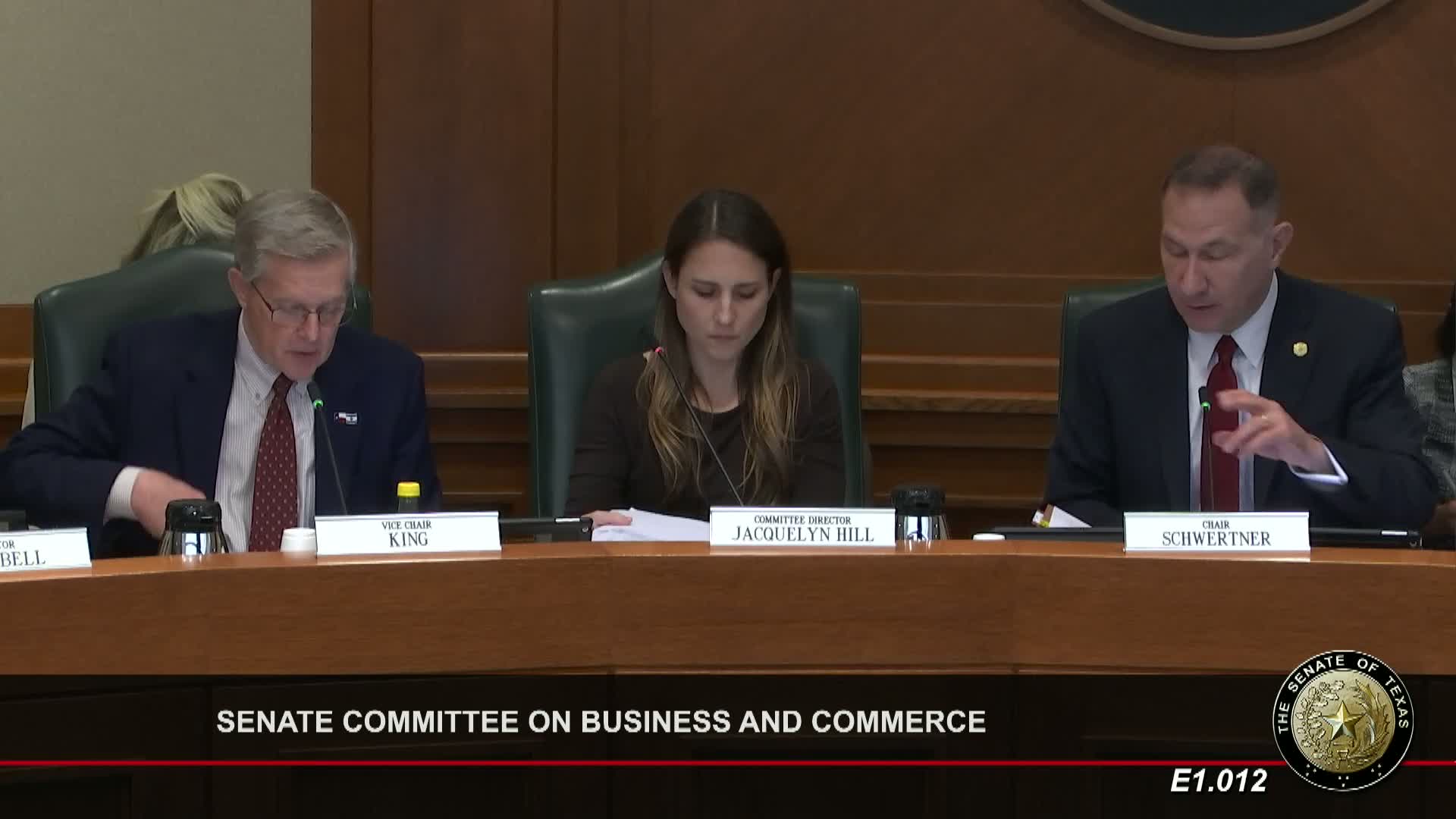
Senate Bill 378, intended to clarify who may legally administer injections such as Botox and dermal fillers, drew public testimony about patient safety before the Committee on Business & Commerce and was left pending for further consideration.
The bill, explained by Senator Schwartner, would prohibit estheticians and cosmetologists from administering injections or using prescriptive medical devices unless they are "legally authorized and licensed to perform these acts." Schwartner told the committee the measure responds to reports of estheticians performing injections without appropriate physician supervision and to ambiguity in disciplinary authority between the Texas Medical Board and the Texas Department of Licensing and Regulation (TDLR).
"By law, aestheticians and cosmetologists may only perform injections under the authority of a physician," Schwartner said. "This bill corrects this regulatory oversight by clarifying in statute that TDLR has disciplinary authority over the esthetician or cosmetologist in violation of their license."
Public testimony included Dr. Patricia Aronin, a retired pediatric neurosurgeon testifying in support. Aronin described reports of pop-up clinics and nonmedical settings performing injections and warned of documented harms including infections and vascular occlusion from intravascular filler injections. "Real patient risks exist," Aronin said, citing FDA warnings about counterfeit products and a high-profile case of antibiotic-resistant infection tied to an unsafe injection.
Derek Burkhalter, deputy general counsel for TDLR, appeared as a resource witness and confirmed the agency had raised the supervision issue previously and suggested legislative action to clarify TDLR's authority.
The committee closed public testimony and left SB 378 pending for the chair's call.
Ending: The bill was not voted out of committee; sponsors and agency witnesses said statutory clarification is needed to give TDLR authority to discipline licensees who administer injections outside authorized practice.