Get Full Government Meeting Transcripts, Videos, & Alerts Forever!
Get email alerts on the Regulatory Reform topic
No spam. Unsubscribe anytime.
Senate committee advances bill to create regulatory‑efficiency office, web portal and change judicial review standard
Summary
After hours of testimony and debate the Senate committee voted to report Senate Bill 14 favorably; the bill would create a regulatory efficiency office in the governor’s office, require expanded cost‑benefit analysis, establish a searchable web portal of state rules and statutorily clarify judicial review of agency interpretations.
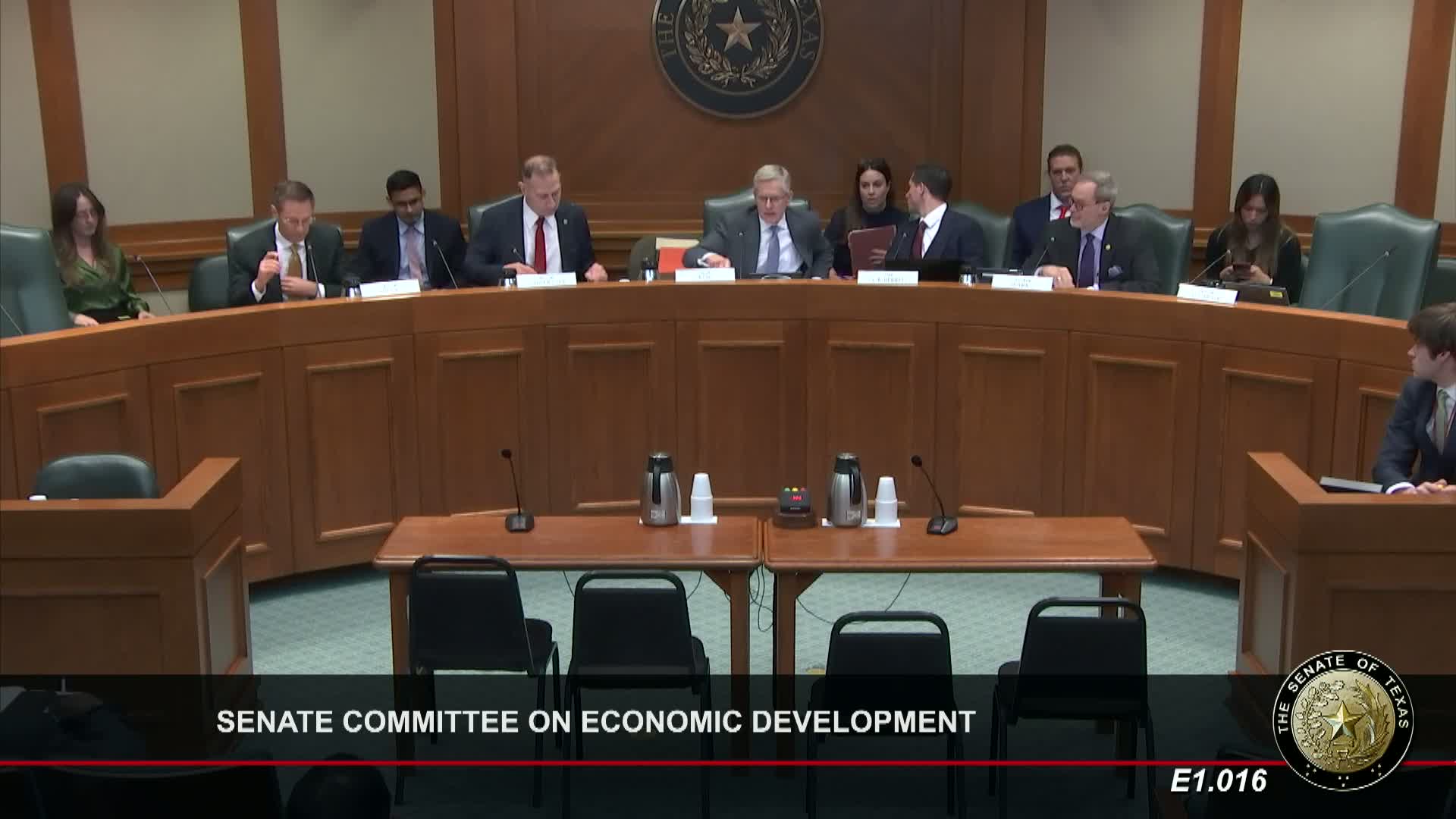
The Senate Committee on Natural Resources & Economic Development voted to report Senate Bill 14 to the full Senate with a favorable recommendation after a lengthy hearing and public testimony.
SB 14 would create a regulatory efficiency office in the governor’s office to assist state agencies in their statutorily required four‑year rule reviews, commission a user‑friendly web portal that compiles state regulations tied to particular businesses, expand cost‑benefit and impact analysis requirements for proposed and readopted rules, and codify that state courts are not required to give special deference to agency interpretations of statutes or rules.
Supporters — including business groups, the Texas Public Policy Foundation, the Texas Association of Builders and regional economic organizations — said agencies face a growing inventory of regulatory text and lack capacity to do deep reviews. “The review process … is an important tool, [but] the agencies are busy implementing and enforcing the rules,” said Rod Bordelon of the Coalition for Regulatory Efficiency and Reform, who testified in favor.
Proponents pointed to research used in testimony showing a large stock of regulatory text and cited potential economic gains from targeted reductions or modernization. Scott Norman, CEO of the Texas Association of Builders, told the committee that regulatory costs add materially to housing prices and supported stronger cost‑benefit analysis for rules that affect housing.
Witnesses from the governor’s office explained how the state’s existing international trade and outreach contracts operate and described that contractors provide local in‑country staffing for trade offices; witnesses said the proposed portal would centralize already‑digitized rules into a single searchable database.
Opponents and skeptical members raised concerns about concentrating review authority in the governor’s office, possible duplication with the Sunset Advisory Commission, potential industry influence, and an initial fiscal note that showed substantial startup costs and staff. Several senators asked for language changes and for reports to be sent to the Legislature as well as the governor so lawmakers would receive the work product. Senator Johnson urged clarification and asked the authors to preserve public participation and agency independence.
Senator King, the bill’s author in committee, said he and staff had begun discussions with the Legislative Budget Board and the governor’s office about the fiscal impact and expected to resolve ambiguities before floor action.
Votes at the committee roll call were recorded after debate. Senator King moved the committee recommendation; the clerk recorded Senator Sparks as “Aye,” Senator Alvarado “Abstain,” Senator Johnson “Present,” Senator Schwartner “Aye” and Senator King “Aye.” The clerk reported “three ayes, two present,” and the committee’s action sent SB 14 to the full Senate with a favorable recommendation.
The committee left public testimony and other technical amendments open as the bill moves forward to the calendar.