Get Full Government Meeting Transcripts, Videos, & Alerts Forever!
Get email alerts on the Watershed Moratoriums topic
No spam. Unsubscribe anytime.
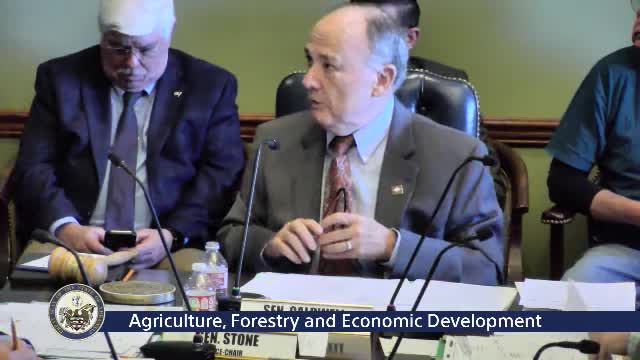
Bill to require legislative approval of watershed moratoriums draws broad public comment; sponsor pulls measure
Summary
Senate Bill 290, which would require legislative committees to approve moratoriums on permits affecting watersheds, drew extensive testimony both for and against protections for the Buffalo River and other watersheds. After more than an hour of testimony, sponsor Senator Blake Johnson withdrew the bill for further study.
Senator Blake Johnson introduced Senate Bill 290, a bill that would require state agencies to obtain approval from the legislature—(through the Senate and House agriculture committees) before imposing moratoriums affecting watersheds.
The measure drew more than a dozen public witnesses in a divided hearing that ranged from conservation groups pleading for existing watershed protections to agriculture interests urging legislative control of moratoriums. Supporters of the bill said moratoriums limit private property rights and should be decided by elected legislators; opponents said the draft is vague, could block emergency agency action and would undercut the Administrative Procedures Act.
The bill—(Johnson said) would route any proposed moratorium through the relevant agriculture committees before agencies could finalize rulemaking. "This process was put into this piece of legislation because this body creates the laws that create those departments," Senator Blake Johnson said when presenting the bill.
Conservation groups focused much of their testimony on the Buffalo National River and other karst-area watersheds. Brian Thompson of the Ozark Society told the committee, "We prevented the Buffalo River from being damned," and warned that allowing large CAFOs near the river would damage recreation and tourism economies. Gordon Watkins, president of the Buffalo River Watershed Alliance, argued that the bill is "redundant and unnecessary" because the Administrative Procedures Act already provides legislative review of rules.
The Arkansas Farm Bureau and the Arkansas Cattlemen—s Association backed the bill. Mark Lambert of the Arkansas Farm Bureau testified, "Arkansas Farm Bureau strongly supports Senate Bill 290 regarding legislative oversight on moratoriums in Arkansas," saying the bill would give elected officials a voice on restrictions that can affect farmers statewide. Megan Allen, a Farm Bureau director and cattle producer, said, "This is about protecting Arkansas farmers and ranchers across our entire state."
Scientists and other opponents raised technical concerns and cited local cases. David Peterson, a retired applied mathematics and hydrology professor, presented statistical analyses tied to the CNH site and said nutrient and nitrate patterns downstream of a large operation are consistent with impacts observed near other CAFOs. Other opponents, including the Arkansas Canoe Club and conservation organizations, said the bill is vague on key terms such as "moratorium," "permit" and "watershed," risks excessive litigation and could prevent timely agency responses to urgent public-health or environmental threats.
Committee members asked procedural and constitutional questions about the bill and whether it conflicts with the Administrative Procedures Act (APA) and the preexisting legislative oversight processes. Senator Gilmore and others queried how the bill would affect emergency moratoria and whether a two-year renewal requirement would be practicable; Senator Johnson said committees would need to convene to approve emergency actions but later agreed to withdraw the bill to allow further study.
After the public comment period and committee questions, Senator Johnson told the committee he would pull the bill for further work. "I'll pull this down," he said, and no final vote was taken on SB 290.
The bill—s withdrawal leaves intact existing moratoriums and the existing APA-based procedures until sponsors return with revised language.
Members and witnesses provided extensive technical and policy testimony; the committee record shows strong, organized advocacy on both sides and several members requesting clearer statutory definitions and an analysis of how the bill would interact with the APA and emergency rulemaking.
For now, SB 290 is withdrawn for revision and further study; proponents said they would return with clarifying amendments and opponents said they will continue to press protections for sensitive watersheds such as the Buffalo River.