Get Full Government Meeting Transcripts, Videos, & Alerts Forever!
Get email alerts on the Public Meetings Foia Clarification topic
No spam. Unsubscribe anytime.
Committee adopts broad FOIA rewrite to define 'public meeting,' polling and remote rules
Summary
The committee approved a bill that revises Arkansas' public-meeting rules: it defines "deliberation" and "polling," clarifies remote attendance and recording rules, authorizes executive sessions for court-ordered ADR and cybersecurity response, and allows courts to invalidate actions taken in violation of the law.
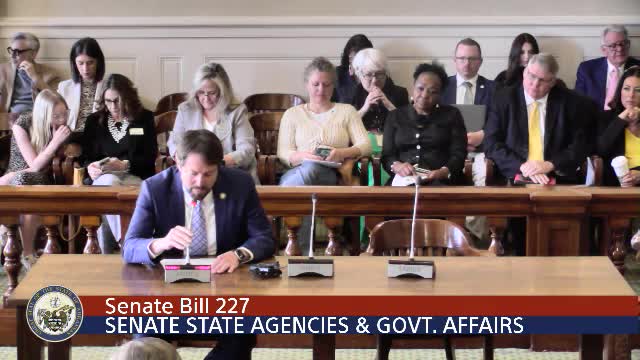
Senator Tucker presented a comprehensive rewrite of the state's public-meeting law intended to clarify when officials must meet in public and what kinds of off‑meeting communications are permitted.
The bill amends multiple FOIA provisions, including definitions and the public-meeting section, to provide working definitions for terms that have been litigated for decades. "We wanted to bring clarity to that process," Tucker said during an extended floor presentation, describing new definitions for "deliberation," "informal meeting," "polling" and other terms that determine whether out‑of‑meeting exchanges are permissible.
Key provisions include a definition of deliberation that covers exchanges of information or opinions about decisions that a governing body will make; an explicit prohibition on "polling" (when a nonmember solicits how individual members will vote and then uses that information to affect official action); and rules governing remote participation. The bill requires that when a member participates remotely, the remote portion of the meeting be recorded in the same manner (for example, a Zoom participant's audio/video must be preserved). It also requires reasonable public access to meetings and, where boards meet remotely, that the public be able to attend via the same means used by the board.
The measure preserves existing executive‑session exceptions and adds a narrowly drawn authorization for executive sessions to respond to cybersecurity incidents or to discuss settlement authority in a court‑ordered alternative-dispute-resolution process. It also clarifies that a court may invalidate official actions if they were the product of a prohibited informal meeting or other unlawful communication.
Supporters said the bill finally draws a bright line after years of confusing case law and offers guidance that benefits both the public and elected officials. Critics and some skeptics on the committee raised constitutional and vagueness concerns, asking whether terms such as "foreseeably" are sufficiently precise and whether the rules could chill speech. Senator Sullivan and others discussed earlier federal court rulings and urged care on constitutional grounds; Tucker told members the bill was drafted with input from a bipartisan FOIA working group, the Attorney General's office and a range of stakeholders and emphasized that the bill aims to reduce litigation by clarifying existing law.
Committee members debated hypotheticals—campaign events, school-board discussions at public gatherings, and town meetings—about where the line between permissible talk and prohibited deliberation should be drawn. Supporters and several transparency advocates who spoke in favor at the hearing said the bill provides more predictability than current case law.
After extended discussion and amendment work, the committee adopted the bill and a final amendment and advanced the measure by voice vote. The transcript records the committee chair calling for aye/ no and announcing passage; no roll-call tally appears in the transcript.