Get Full Government Meeting Transcripts, Videos, & Alerts Forever!
Get email alerts on the Committee Votes Roundup topic
No spam. Unsubscribe anytime.
Arkansas Senate committee advances five local-government bills, including vaping registry and zoning changes
Summary
The City, County & Local Affairs Committee of the Arkansas Senate advanced five bills after debate and public testimony on matters including municipal planning authority, a vaping‑product registry, police leave accrual, accessory dwelling units and a narrow underground‑digging clarification.
The City, County & Local Affairs Committee of the Arkansas Senate advanced five bills after debate and public testimony on March (date not specified in transcript). Committee members voted to pass measures limiting municipal extraterritorial planning authority, to create a state directory for federally‑approved vaping products, to clarify leave accrual for full‑time municipal police, to legalize accessory dwelling units statewide, and to clarify a narrow exception in the state’s Underground Facilities Damage Prevention Act.
Why it matters: the package addresses property rights and local planning, public‑health regulation for vaping products, municipal staffing policy, housing supply, and a technical utility‑digging exception. Several items drew lengthy public testimony and partisan questioning; the vaping‑product registry produced the most sustained public comment and cross‑examined tradeoffs between small retailers and regulators.
The committee’s most contested debate centered on a proposed statewide directory that would list vapor products approved or under active federal review. Small vape‑shop owners warned the measure would make many current products illegal in Arkansas and would harm rural retailers; retail associations and members of the Arkansas Tobacco Control Board said the directory was necessary to give retailers and enforcement a clear list of legal products and to reduce illicit imports. In the end the committee passed the measure, with the bill sponsor saying he will seek to separate an emergency clause in a later floor vote to give retailers more transition time.
On extraterritorial jurisdiction (ETJ), sponsors described long‑standing conflicts in which municipalities’ planning boundary claims affected property owners outside city limits, sometimes reducing value or complicating sales. Planners from the Arkansas chapter of the American Planning Association urged caution and more study, warning that repealing current ETJ authority could remove subdivision and street standards that protect future infrastructure and public safety; they asked for cooperative solutions and phased sunsets rather than an immediate repeal. Supporters of the change emphasized property‑rights concerns and said annexation remains an available tool.
The committee also advanced a cleanup bill clarifying that local sick and annual leave accrual applies to full‑time municipal police officers; a bill to legalize accessory dwelling units (ADUs) statewide, which supporters framed as an affordable‑housing tool that adds “invisible density” without widespread community disruption; and a clarification to the Underground Facilities Damage Prevention Act allowing utility operators to hand‑dig within a limited distance of their own facilities to make connections without calling 811 first (with restrictions on depth and distance).
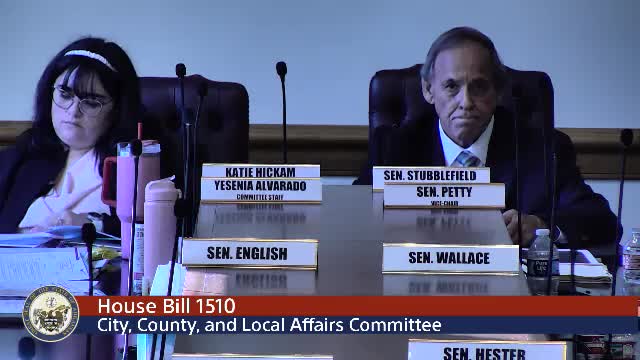
Votes at a glance (as recorded in the committee transcript): - House Bill 1510 (extraterritorial planning boundary): motion to pass made and seconded; named recorded votes in the transcript included Yes votes from Senator Davis, Senator Rice, Senator Hester and Senator Patty and No votes from Senator Wallace and Senator English. The committee reported the bill passed. (Transcript contains additional named roll‑call entries; the public record should be checked for the complete roll.)
- Vaping‑product registry (house bill number not specified in transcript): motion to pass made and seconded after extended testimony from small retailers, industry groups and Tobacco Control board members. The sponsor, Senator Jonathan Dismang (Senate District 18), said the committee would vote separately on an emergency clause on the floor to delay immediate effect if enacted. The transcript shows mixed support and opposition in committee; the motion passed.
- House Bill 1600 (cleanup clarifying municipal police leave): sponsor said the bill clarifies that sick and annual leave accrual applies to full‑time municipal police officers and does not prevent local governments from setting different policies for part‑time staff. The committee passed the bill on voice vote.
- House Bill 1503 (accessory dwelling units): sponsor described ADUs as an affordable‑housing option that cities sometimes over‑regulate; a representative of the Arkansas chapter of the American Planning Association testified in favor, calling ADUs “invisible density” that make better use of existing infrastructure. The committee passed the bill.
- Senate Bill 401 (Underground Facilities Damage Prevention Act clarification): sponsors and an AT&T representative said the change clarifies that hand‑digging by utilities is allowed for certain short distances and depths when connecting a customer line to existing facilities, provided locate procedures (811) are followed for deeper or further work. The committee passed the bill.
Key testimony and positions (select): - "This bill limits that extraterritorial territory to the city's actual boundaries," said Senator Jim Petty (Senate District 29), describing a case in his district where a long‑range road plan affected property sales when owners said they had not received notice. - James Walden, representing the Arkansas chapter of the American Planning Association, testified against the ETJ repeal as written: "When the bill takes away that extraterritorial jurisdiction... it, in fact, does take away planning. It takes away also any ordinances that are designed to carry that out... It's a total repeal, in that respect." - Scout Stubbs (Drippers Vape Shop) and Rachel Steele (citizen and former retail worker) warned the vaping‑product registry would force many small shops to close if products without FDA approvals remained illegal and if an emergency clause made the law effective immediately. Stubbs said the bill is "19 pages" and "devastating as written," and raised enforcement and interstate‑commerce concerns for small retailers. - Steve Good, representing the Arkansas Retailers Association, supported a registry to give retailers a clear list of approved products, saying registries in other states list hundreds to more than 1,000 approved items and that a directory would help store managers decide what to stock. - David Hendrick, Family Market Stores and member of the Arkansas Tobacco Control Board, said the board approves wholesale and retail permits without a product‑level list and argued a registry would help enforcement agents and retailers know which products are legal.
Committee next steps and implementation notes: the transcript records several committee members saying they would consider amendments or a separate floor vote on the emergency clause for the vaping bill to allow transition time for small businesses. Planners asked for study, phased sunsets or cooperative city–county regulatory language on ETJ changes to avoid unintended infrastructure and public‑safety consequences. Sponsors of ADU and Underground Facilities clarifications said local standards for setbacks, fees and inspections would remain in place.
What the transcript does not specify: exact bill numbers for the vaping registry measure and the full roll‑call tallies for some votes (the transcript records several named votes but not a complete tally for every member); any floor action or final enrolled bill language. Committee debate and several public comments cited pending federal litigation and FDA actions that are still in process; those federal outcomes will affect how a state registry would function.
The committee’s record and any subsequent floor votes will be the authoritative source for final vote tallies, amendments, and enacted effective dates.