Highline leaders outline MTSS rollout, aim for districtwide teams by 2025–26
Loading...
Summary
District leaders presented a plan to implement Multi-Tiered Systems of Support (MTSS) across Highline schools, highlighting tiered instruction, cross‑department teams, four focus schools piloting practices and a goal that all schools have operational MTSS teams by the end of the 2025–26 school year.
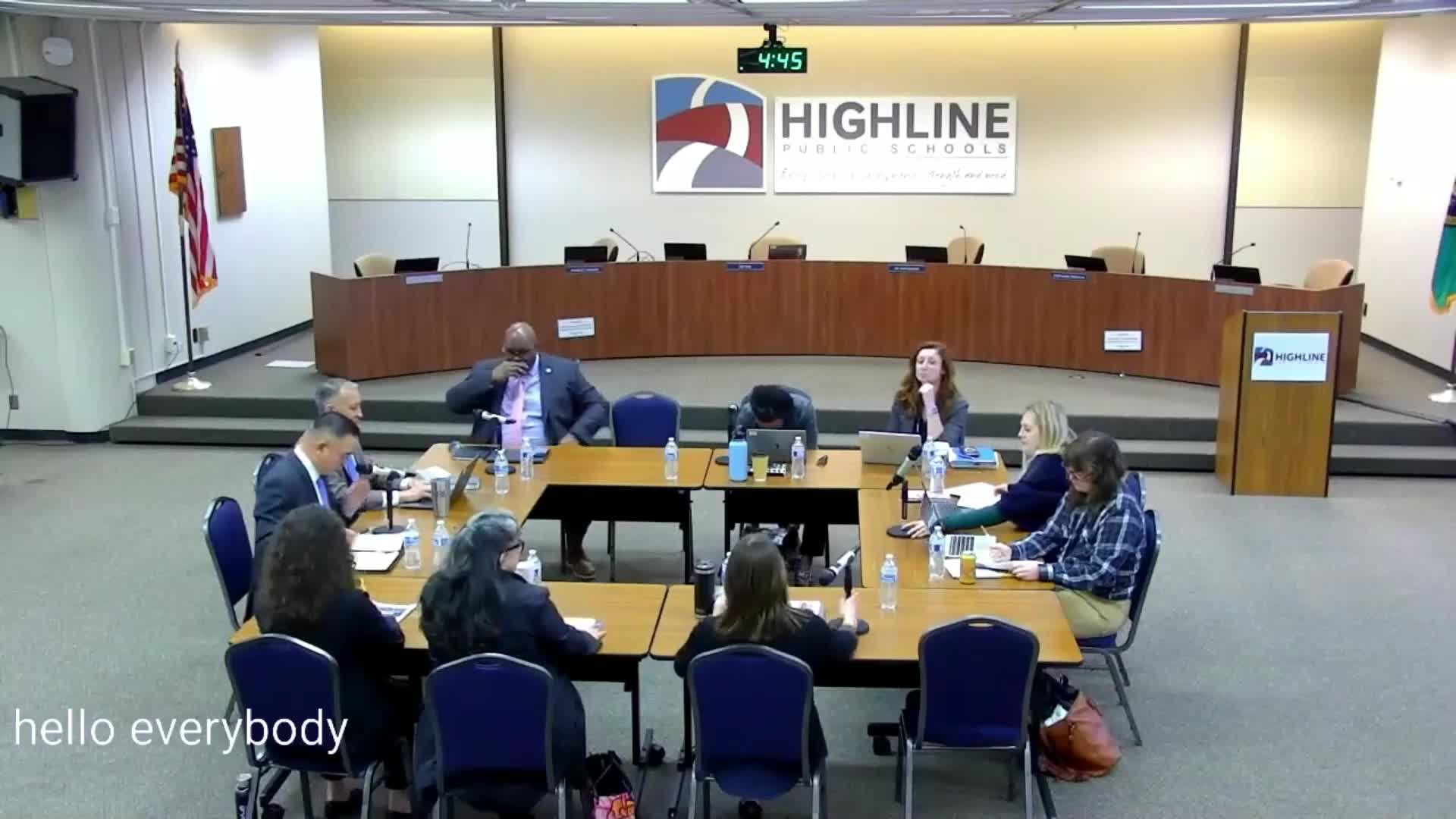
At a special Highline School District board work session, district leaders described the district’s plan to implement Multi‑Tiered Systems of Support (MTSS) across schools and said they will collect baseline data this spring as they work toward having operational cross‑department MTSS teams in every school by the end of the 2025–26 school year.
The presentation, led by Keesa Hendrickson, Assistant Superintendent, explained MTSS as a districtwide framework that organizes adult teamwork and data use to support students’ academic, behavioral and attendance needs. “It helps us to understand and know our students by name, strength, and need,” Hendrickson said, tying MTSS to the district’s strategic plan priorities.
District staff framed MTSS around four components — teaming structures, data‑based decision making, family and community engagement, and a continuum of evidence‑based supports — and emphasized a focus on strong tier‑1 instruction so most students receive appropriate core instruction before additional supports are layered on. Jenny Jacobs, Assistant Director of Research and Assessment, said, “MTSS is actually a framework. It's not a thing we do or a thing we do to kids.”
Leaders said MTSS implementation will rely on multiple coordinating teams: a district MTSS leadership team (DMLT) to set system direction and resource allocation, a district MTSS implementation team (DMIT) that includes department directors and school staff to develop usable guidance, and school‑level teams ranging from principal or oversight teams down to PLCs or teacher collaboration teams where the work is executed.
Four focus schools — Parkside Elementary, Mount View, Pacific and Evergreen — are piloting more intensive supports and serving as learning sites for district guidance. Parkside’s instructional planning team identified widespread foundational reading gaps that staff linked to pandemic‑era learning interruptions and recent arrivals from Afghanistan; the school adjusted staffing, provided targeted professional development (including GLAD strategies for multilingual learners), monitored progress and reported reductions in the percentage of students needing direct phonics instruction. Mount View, a dual‑language school, used multilingual data to choose targeted phonics interventions in both English and Spanish and moved some intervention oversight into PLCs so teachers could take ownership of group decisions.
District staff told the board that the Office of Superintendent of Public Instruction (OSPI) is shifting special‑education eligibility rules beginning in the 2028 school year to emphasize response to interventions (RTI) rather than only standardized cutoffs, and that the district is watching recent state legislation and board policy (listed by staff as board policy 2161) for required changes. Hendrickson told directors that MTSS work is on the district dashboard and that spring baseline data collection will populate measures currently empty on the dashboard.
Board members asked how the district will communicate MTSS to families. Director Alvarez asked whether the family‑facing visual would be translated; staff said the content is on the district website and will be accessible in multiple languages and that a family‑facing backside explaining “what to do next” is under development. Staff also said they will partner with the superintendent’s Family Action Committee (FAC) subcommittee and the Family and Community Engagement (FACE) team to design family participation and navigation materials.
On implementation supports and scaling, staff described multiple dissemination channels: principal learning networks (PLNs), monthly instructional leadership sessions, coaching visits, centralized resources in the district’s Colab, and peer sharing from focus schools. They said a self‑assessment using an implementation rubric will occur in the spring to identify school‑level capacity gaps and guide targeted supports. District leaders said they will map existing centrally allocated positions to MTSS priorities rather than create entirely new positions and will refine required system capacity after the spring self‑assessment.
The meeting closed with a short formal motion to adjourn that passed by voice vote.
District staff invited board members and community partners to visit focus schools to see MTSS practices in action and asked directors to help tell the story of local gains and implementation progress.