Get Full Government Meeting Transcripts, Videos, & Alerts Forever!
Get email alerts on the School Budget topic
No spam. Unsubscribe anytime.
Highline board sees steady enrollment, $7 million preliminary shortfall for 2025–26 as legislature decides funding
Summary
At a March 5 work session, Highline School District staff reported enrollment above projections for 2024–25, an initial projected gap of roughly $7 million for 2025–26 and a wait-and-see approach pending legislative action and OSPI guidance; staff and directors discussed levy planning and community engagement.
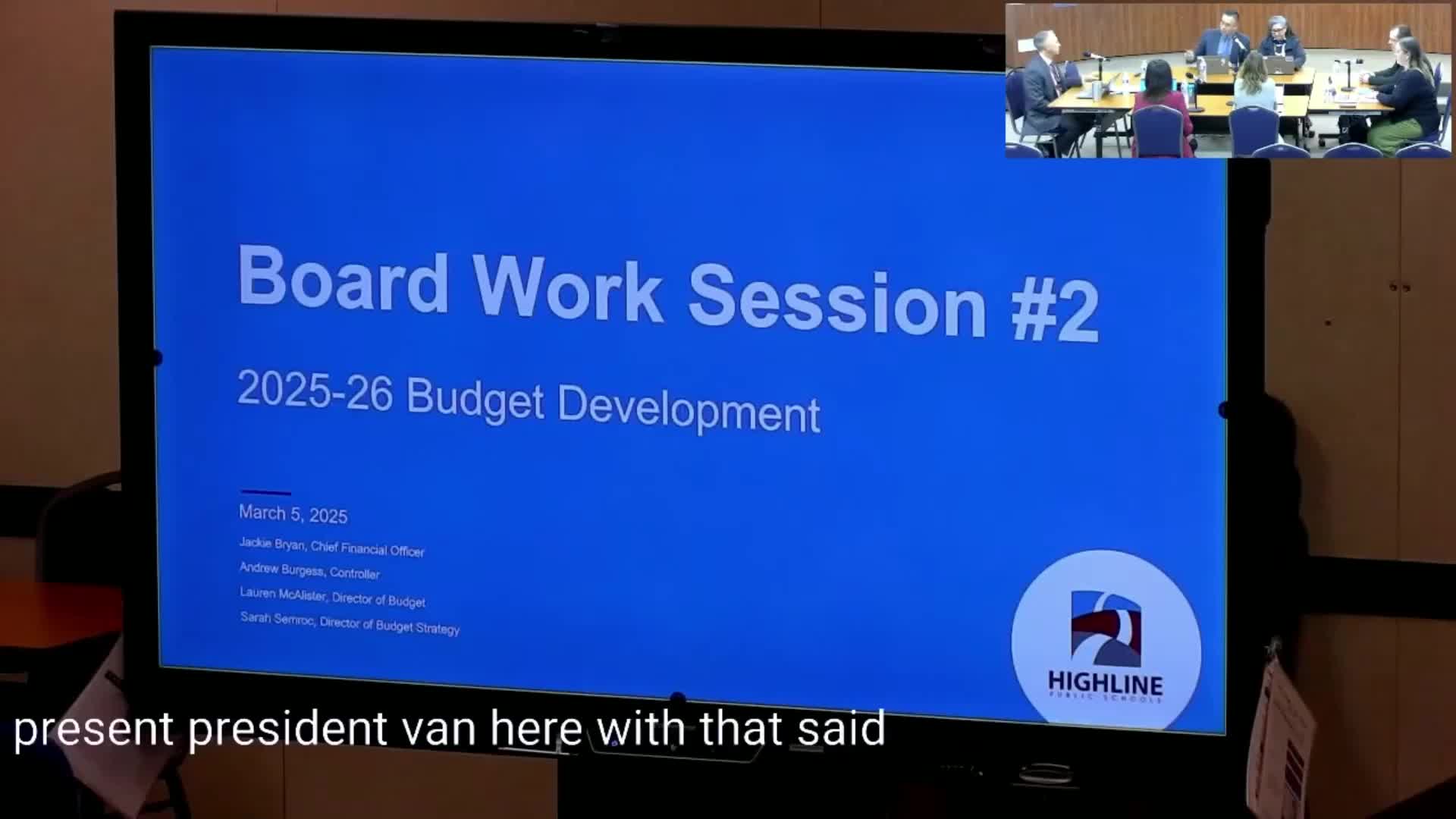
Highline School District on Wednesday, March 5, held a budget work session in which district finance leaders reported year-to-date enrollment above projection, a likely retention of this year’s 7% unassigned fund balance, and an initial forecast showing about a $7 million shortfall for the 2025–26 school year if no new state revenue arrives.
Jackie Bridal, chief financial officer, told the board that current-year enrollment came in higher than projected and that “we think right now, we're gonna actually come in almost exactly even,” meaning the district does not expect to spend the roughly $6 million it had planned to draw from fund balance for 2024–25.
The comment mattered because the district’s initial 2025–26 projection, produced before any new state revenue beyond the inflationary IPD (implicit price deflator), shows expenditures about $7 million higher than projected revenues. Bridal said those initial projections “don't contain any new revenue,” and added, “these numbers will change.”
Why it matters: Highline’s budget outlook depends heavily on the 2025 state legislative session and on the Office of Superintendent of Public Instruction (OSPI) for final tools and allocations. District staff said a long legislative session — scheduled to end April 27 — and OSPI’s subsequent two- to two-and-a-half-week turnaround means final numbers could arrive close to the district’s June budget introduction deadline.
Enrollment and near-term finances
Lauren McAllister, director of budget, summarized the demographer’s findings: the four-county Puget Sound region (King, Pierce, Snohomish and surrounding areas) gained roughly 2,900 K–12 students this year and Highline’s elementary schools are about 330 students over projection. McAllister said kindergarten enrollment remains below pre-pandemic levels but is expected to return to earlier levels in coming years.
Bridal emphasized monitoring the district’s expenditures weekly and said OSPI prefers districts to request a budget extension only when they know they will exceed budgeted expenditures. “If for some reason enrollment continues to increase and we have increased cost associated with that and our expenditures increase, we would have to go out for a budget extension,” Bridal said, adding the district currently has some contingency in place.
Legislative dynamics and the district’s priorities
District leaders outlined their top legislative priorities: (1) fuller funding of special education services, (2) transportation funding and McKinney-Vento supports, (3) material, supplies and operating costs (MSOCs), (4) capital/ bond voting thresholds, and (5) mastery-based learning funding. Bridal noted the bills in play have shifted during the session.
Bridal summarized bill movement as presented to the board: Senate Bill 5263 initially would have generated a substantial increase for special education funding (she conveyed a district estimate of roughly $8.4 million if applied to current caseloads), while House Bill 1310 — originally promising — was replaced by House Bill 1357 and now appears to offer only modest change (roughly $1.6 million in the district’s estimate). On MSOCs, a version of Senate Bill 5192 and House Bill 1338 were described as having potential to raise per-pupil MSOC allocations, but Bridal said recent amendments reduced the gains significantly from earlier drafts.
Bridal also flagged two levy-related bills that would raise local levy caps but would require districts to return to voters to collect additional local revenue. On capital finance, she said bills moving to a simple majority for bonds remain under consideration; she noted one trade-off would be losing a small amount of impact-fee revenue the district has collected in recent years.
Board discussion and next steps
Directors asked for more public-facing explanations of how funds are spent and how budget choices relate to strategic priorities. Director Alvarez urged more messaging to the community about how state funding changes would free levy dollars for other priorities; Bridal said the annual budget book and published online resources provide detailed breakdowns and that the district is working on dashboards and categorical-plan tagging so schools can mark categorical spending by strategic priority.
Bridal outlined the immediate calendar: RAM (Resource Allocation Model) meetings with each school begin next week; OSPI’s tool turnaround after the legislature will determine whether the district can introduce its 2025–26 budget on June 4 or must move the introduction to the board’s second meeting in June.
Board members and staff reiterated an advocacy push to maintain momentum at the state level. “We had a lot of momentum the first half of this session,” Bridal said, and asked directors and community members to continue testifying and contacting legislators.
Ending
The work session concluded with procedural action to adjourn; a motion was made and seconded and the board voted in favor.
(For additional details: the district reported an unassigned ending fund balance of about 7% going into 2025–26 assumptions; IPD was estimated at roughly 2.4% for planning; last year the district reduced its structural budget by $8,000,000 and used approximately $14,000,000 of levy funds to cover special education costs.)