Get Full Government Meeting Transcripts, Videos, & Alerts Forever!
Get email alerts on the Capital Bond Survey topic
No spam. Unsubscribe anytime.
District considers hiring EMC Research to test support for potential capital bond
Summary
Snoqualmie Valley School District trustees heard a presentation from EMC Research about how a voter survey would test support for a possible capital facilities bond. Board members discussed scope, timeline and updated cost estimates; no contract was approved.
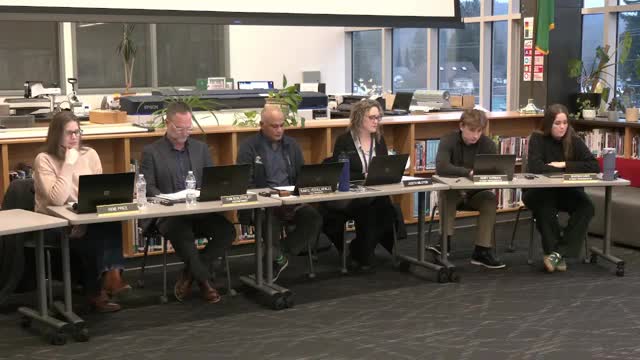
The Snoqualmie Valley School District board heard a presentation Feb. 13 from Ian Stewart, senior principal at EMC Research, on how a public-opinion survey could measure voter support for a prospective capital facilities bond.
The research firm described a multimodal survey (phone, text-to-web and email-to-web) designed to produce about 300 completed interviews with an overall margin of error of plus or minus about 5.7 percentage points. Ian Stewart said the polling approach mirrors what EMC used in 2014 and in other school-district bond tests: present an initial concept, then present a realistic cost to measure how support changes once voters hear a price.
The board and staff framed the poll as a tool to refine what projects to include in a possible bond package — for instance, whether replacing portable classrooms or addressing exterior-access safety should be prioritized. Ryan (district staff) told the board he had asked Facilities Director Matt Rumbaugh to update cost estimates; those architect-based updates showed some project costs higher than earlier projections. Ryan said the cost numbers have not yet been vetted by a formal estimator and still carry uncertainty.
“At minimum we want to ask testing questions about the three projects we’re most likely to include and see whether the public finds those priorities worth the cost,” Ryan said.
Board members asked about timing, question ordering and whether the district should run one or two surveys. Stewart advised that a single well‑focused poll is possible in roughly a month to six weeks from questionnaire drafting to completed fieldwork, but recommended scheduling the survey close enough to the planned election to reflect the expected political and economic environment. He reiterated that early testing can be useful to choose priorities, while a second poll can test a finalized package.
Trustees also asked about follow-up items the survey could cover, including asking respondents how they would like the district to repurpose an existing building if a new facility is built at another site. Stewart said such questions are viable but that survey length and branching reduce how many topics can be probed in a single 12–15 minute interview.
No formal motion to hire EMC Research was made at the meeting. The board agreed to place the topic on the agenda for a future meeting to decide whether to engage EMC to develop the questionnaire and field the survey.
Next steps identified by staff included: (1) reviewing the updated cost estimates with the facilities team, (2) deciding whether to proceed with EMC to draft the questionnaire, and (3) scheduling a follow-up board discussion about timing and the scope of a bond package.
The board’s discussion reiterated that survey results would inform whether safety, portable replacement and other capital components should be included, but that a final decision about a bond package or election timetable remains for later meetings.