Get Full Government Meeting Transcripts, Videos, & Alerts Forever!
Get email alerts on the School Police Community Resource Officers topic
No spam. Unsubscribe anytime.
Lake Washington, Redmond review community resource officer role, student feedback and data sharing
Summary
At a March 3 joint study session, Lake Washington School District and Redmond officials discussed the district’s Community Resource Officer model, data collection and student perceptions of police presence on campus.
Lake Washington School District officials and Redmond elected leaders discussed the district’s Community Resource Officer (CRO) model and efforts to collect and share data on campus policing at a joint study session on March 3.
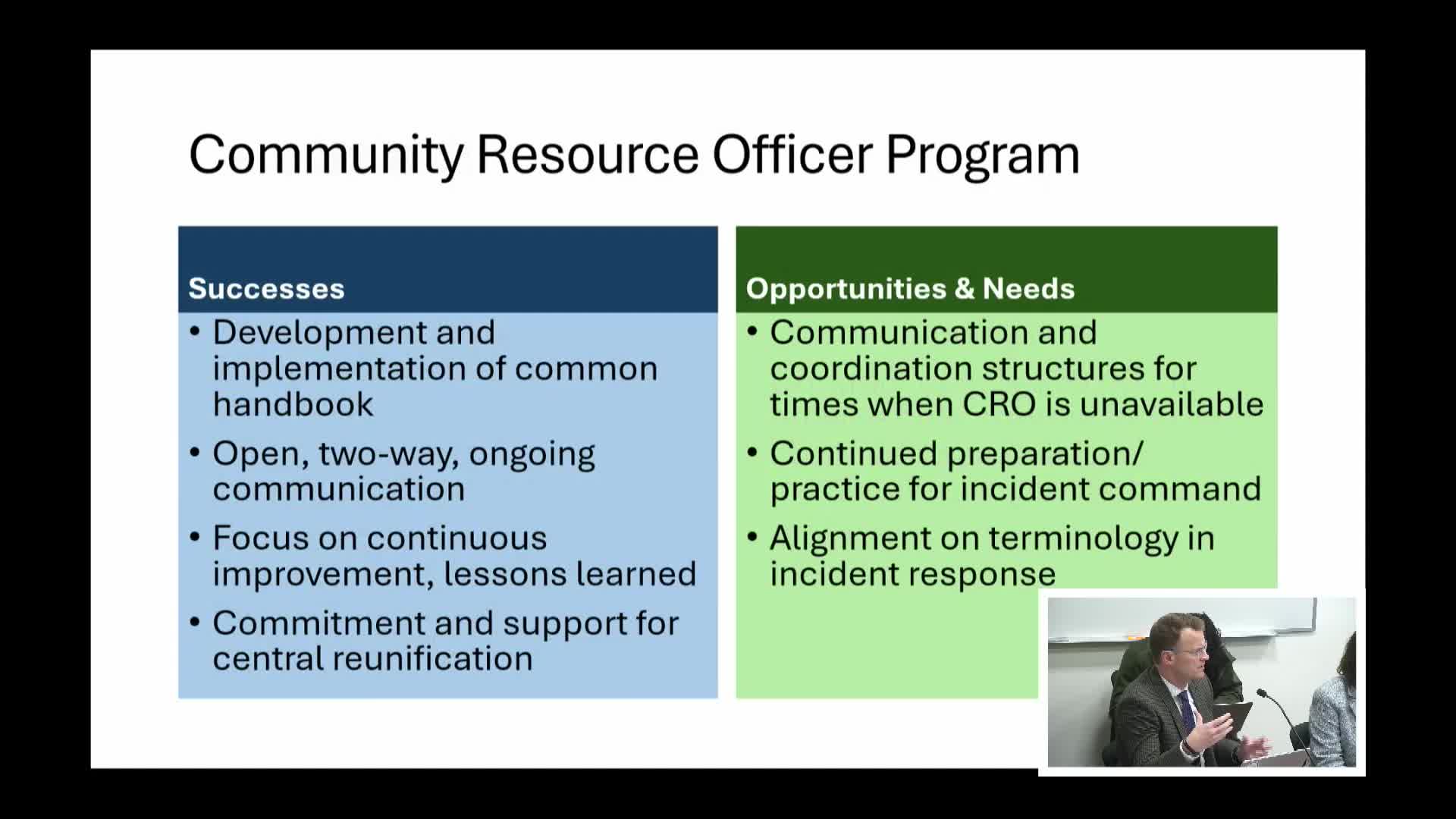
The conversation focused on how CROs are deployed, how the district and police agencies coordinate when there are threats or incidents, and how students and families receive information about CRO activity. Superintendent John Holman and district staff described long-standing, daily operational contacts between schools and local police, and said law enforcement assistance is routinely used to evaluate and respond to online and in-person threats.
Why it matters: the topic touches on student safety, racial equity in policing, legal reporting requirements and community trust. The district and city officials said the discussion aims to balance rapid response to credible threats with minimizing unnecessary policing of routine student disciplinary matters.
District and board members described structures for ongoing community input. Board Vice President Lisa Guthrie, the board liaison to the Community Connectors/CRO standing committee, said that committee has shifted from a broad community membership to an approach that emphasizes trusted community voices and staff-led coordination. Guthrie said the group reviews CRO activity, looks at how incidents are recorded and discusses where police involvement is appropriate or not.
Student representatives told officials they want clearer access to the dashboards and data the district uses. A student representative said, “I think that the community resource officer, I have one at my school, they seem to be like a constant presence … I do think though that … students don’t really know about this data and they don’t know how it serves students.” Another student added that “a lot of times it is about, like, I don’t think most students know what their purpose is … if it is, it’s not communicated well with a lot of the students.” Those comments were raised as evidence that greater transparency — not just data collection — may be needed to help students give informed feedback on CRO roles.
District staff said reporting requirements from 2022 increased obligations for school districts that have officers on campus; they described efforts to unify disparate municipal dashboards and produce a consistent district-wide dataset. District staff also described a multidisciplinary threat response protocol used when a potential threat is reported: the district typically engages the police agency with jurisdiction, assesses whether a threat is credible or a hoax, and responds through an incident command structure when necessary.
Officials stressed roles and boundaries. Matt (district staff) and board members said CROs should not perform routine student discipline, which remains the responsibility of school administrators; CROs are used for threat investigation, access to law-enforcement tools and other duties police are uniquely equipped to handle.
City council members said Redmond wants to better understand program outcomes and reimbursement practices because the city contracts and reimburses some CRO costs. Council Vice President Jessica Forsyth and Councilmember Melissa Stewart expressed interest in receiving evaluation material upfront — not only reimbursement paperwork — that explains program goals, data and changes before the fiscal review stage.
Officials described next steps: continuing work to harmonize data across jurisdictions, expanding Community Connectors outreach to gather diverse student perceptions, and maintaining regular debriefs between district staff and the Redmond Police Department to improve incident response and coordination.
Ending: Board and council members agreed to keep the dialogue active through Community Connectors and to explore how to present CRO data and findings in a student-accessible way so feedback can inform program adjustments.