Get Full Government Meeting Transcripts, Videos, & Alerts Forever!
Get email alerts on the Information Technology Oit topic
No spam. Unsubscribe anytime.
OIT brief: cloud migration praised, $25M in aging IT assets flagged and Microsoft Copilot pilot proposed
Summary
Chief Information Officer Bill Smith told the Senate Finance Subcommittee the state completed a rapid cloud migration, is pursuing mainframe and database moves, faces roughly $25 million in asset replacements over five years, and is requesting seed funding for a Microsoft Copilot pilot and several AI proofs of concept.
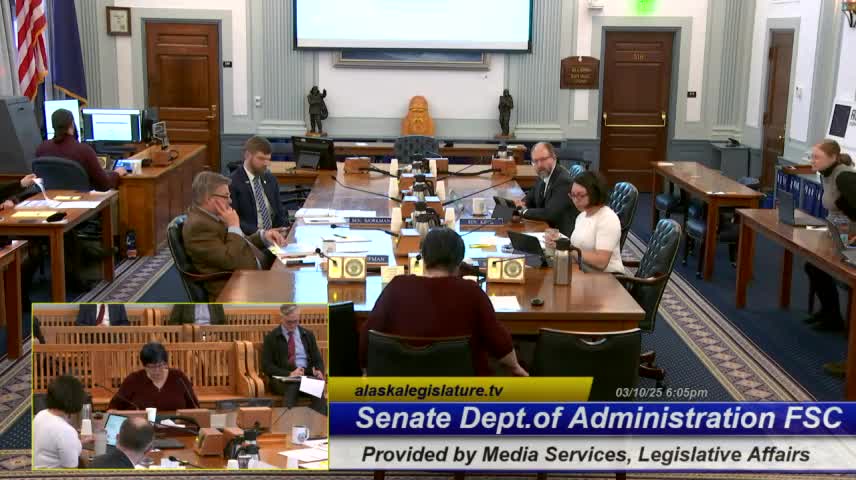
Bill Smith, chief information officer and Division Director for the Office of Information Technology, told the Senate Finance Subcommittee the state has completed a large cloud migration and that the move improved resilience and access to modern tools, but the office is tracking an estimated $25 million in IT assets that will need replacement over the next five years.
Smith told the panel the rapid cloud migration finished in May of last year and was recognized externally; he said the migration yields better redundancy for many services and creates a platform for newer cloud‑native development. He said the state is also moving mainframe workloads to a cloud mainframe provider (work scheduled for completion near the end of the calendar year) and that Oracle database migrations the office hosted are complete.
On cybersecurity, Smith described the state’s 24x7 managed security operations capability and said enterprise detection is being updated this year. "In 2024, we recorded about a little over 4,000,000,000 network attacks blocked, per month," Smith told senators to illustrate the scale of automated scanning and attack traffic. He said the number of declared critical incidents has fallen year over year while overall alerts have increased, and that the Office of Information Technology has authority to isolate or "pull the plug" on compromised systems when necessary. "We do have the authority to pull the plug," Smith said, adding that the managed security operations center is authorized to take containment steps in certain high‑severity instances and contact agencies afterward.
Smith described budget pressures driven by multi‑year contract renewals and increased consumption of enterprise services, and said licensing and hosting costs are rising because of inflation and higher usage. He said OIT is actively working to control costs by negotiating contracts, re‑scoping service levels and using cloud cost optimization techniques. Smith told senators the office has a cloud cost optimization lead and is working to make cloud spend more efficient as more applications move to cloud‑native architectures.
On staffing, Smith said recent efforts to modernize job descriptions and recruit at job fairs have improved hiring; he noted remaining challenges in highly competitive specialties such as cybersecurity. He said a statewide IT job modernization effort has been completed and that salary modernization could help recruiting but he had no implementation timeline to report to the committee.
Smith noted operational issues raised by senators: the Alvin DMV system has slow performance at times and OIT and DMV staff formed a tiger team that ruled out network congestion and identified some external integrations causing data dumps at peak times; improvements have been made but replacement is the long‑term fix. He also described Juneau fiber outages and said the cloud migration reduced the number of state services that would be disrupted by such physical cuts, though full duplication across every remote circuit is cost‑prohibitive.
On AI, Smith said the state is focused on end‑user and developer tools rather than building large custom language models. He described Microsoft Copilot (government cloud) as an end‑user feature layered on existing Microsoft 365 services and outlined a near‑term request to pilot Copilot with a centrally funded pool of licenses. The request would fund about 2,000 initial Copilot licenses and training to pilot efficiencies across departments; Smith said departments also identified developer‑level AI proofs of concept that would require seed funding and partner support to build prototypes. He said privately hosted AI tools within the state cloud will be used where data sensitivity requires it and emphasized human oversight and policy guidance for AI use.
Smith listed several near‑term technical projects: replacing the enterprise network detection and response platform this calendar year, implementing mobile device management for state phones and tablets (recently completed), continuing the mainframe transition, and work to better inventory and prioritize application modernization. He said OIT is working with the Office of Management and Budget to surface the multi‑year asset‑replacement need and expects to brief the Legislature as planning progresses.
No committee votes or formal actions were taken during the presentation; senators asked for follow‑up briefings on cost estimates for asset replacement, details on Copilot pilots, and updates on Alvin performance improvements and redundancy planning.