Get Full Government Meeting Transcripts, Videos, & Alerts Forever!
Get email alerts on the Government Appointments topic
No spam. Unsubscribe anytime.
Committee reviews bill to change appointment process for Office of Public Advocacy director
Summary
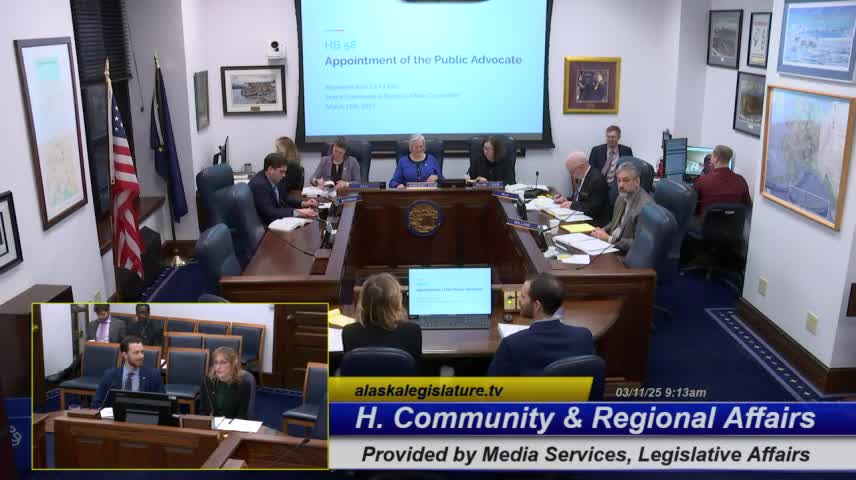
On March 11, 2025, the Alaska House Community and Regional Affairs Committee heard House Bill 58, sponsored by Representative Zach Fields, which would revise how the director of the Office of Public Advocacy is chosen, making the process parallel to the Public Defender’s Judicial Council nomination, gubernatorial appointment and legislative confirmation.
On March 11, 2025, the Alaska House Community and Regional Affairs Committee heard House Bill 58, sponsored by Representative Zach Fields, which would revise how the director of the Office of Public Advocacy (OPA) is chosen and removed. The bill proposes that the public advocate be nominated by the Alaska Judicial Council, appointed by the governor to a four‑year term subject to majority confirmation by the legislature in joint session, and removable by the governor for good cause with notice—matching the current process used for the Public Defender.
Representative Fields said the change is intended to create structural parity between OPA and the Public Defender Agency because both offices provide legal services to indigent Alaskans and often operate in circumstances where independence from political direction matters, such as confidential child‑welfare and guardianship proceedings. “These agencies were established at different points in time…they are similarly important,” Fields said during the hearing.
Courtney Owen, staff to Rep. Fields, summarized the bill’s sectional analysis and the conforming changes (many existing references to the commissioner of administration would be retitled to the public advocate). The draft would add a new statute directing the governor to appoint the public advocate from nominees provided by the Judicial Council for a four‑year term and to seek legislative confirmation. The bill includes transition provisions to preserve existing orders and allow the current director to continue until a new appointment is made.
Invited testimony included Brent McGee, who served as Alaska’s public advocate from 1984 to 2003. McGee told the committee, “This bill corrects a mistake that was made 41 years ago,” arguing the public advocate’s role is not a policy position and the office should operate independently of the governor’s department. He described the independent selection as a safeguard against political pressure and noted the public advocate’s role in protecting vulnerable clients in confidential proceedings.
Suzanne DiPietro, executive director of the Alaska Judicial Council, described the Council’s existing screening and nomination process for the public defender position, including the 28‑page application, extensive background checks, surveys of bar members, public hearings, a 45‑minute interview for candidates, and a public vote to nominate at least two candidates to the governor. DiPietro said the Council’s constitutional structure was designed to promote nonpartisan selection and geographic representation.
Terrence Haas, the current public defender, was available to answer procedural questions about the process; he confirmed the Council’s selection procedure was rigorous. Committee members asked about potential conflicts, accountability, and whether changing OPA’s selection mirrored the historical rationale for the Public Defender’s nomination process. Fields said the proposal responds to practitioner concerns and was intended as a structural fix rather than criticism of current leadership.
The committee held HB 58 over for invited and public testimony; staff said the bill may be brought back for additional public testimony on March 13, 2025.